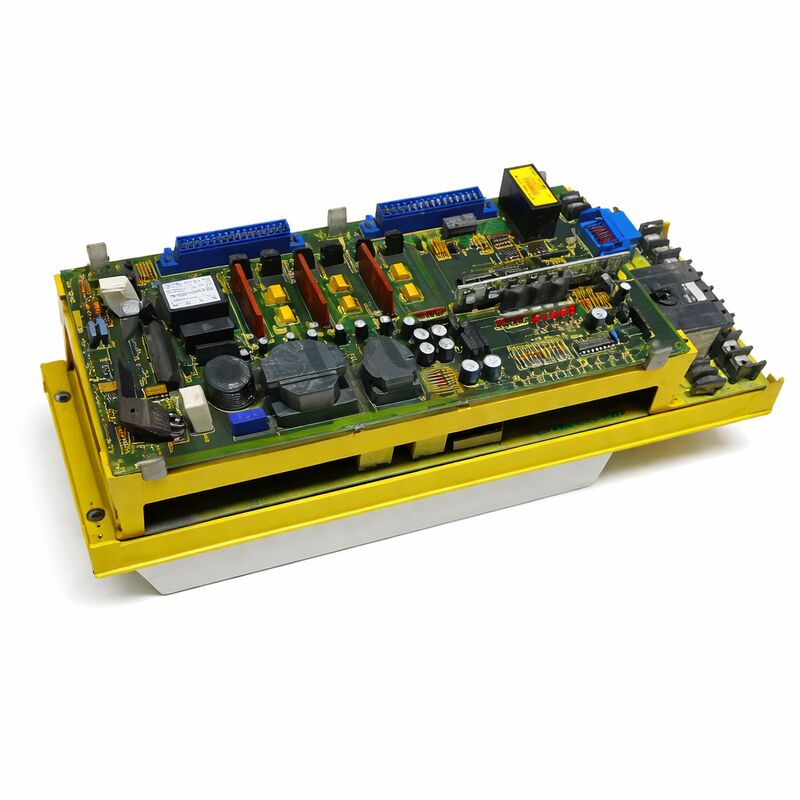
Fanuc A06B-6058-H006 | Single-Axis AC Digital Servo Amplifier — 20S/30S Motor Models, S-Series, PWM Interface, FANUC 0-B/0-C/15/16/18/21 Compatible
Overview
The Fanuc A06B-6058-H006 is a single-axis AC digital servo amplifier from Fanuc's S-series platform, configured to drive Fanuc servo motors in the 20S and 30S model range. Where the three-axis H334 handles three simultaneous servo axes in one enclosure, the H006 drives a single axis — making it the appropriate unit when a machine design calls for an independently mounted single-axis drive, or when replacing a failed axis in a system where individual axis drives are arranged separately on the drive rail.
The 20S and 30S designations refer to Fanuc's AC servo motor size classification.
These mid-range S-series motors delivered continuous torque capability appropriate for machine table drives, tailstock and steady rest axes, rotary axes, and auxiliary drive applications on lathes, machining centres, and specialty CNC equipment where the axis torque requirement exceeds what the smaller 0S/5S/10S motors provide but does not require the larger 40S or higher-capacity variants.
The H006 communicates with the CNC via the same PWM digital interface used across the S-series drive family, making it compatible not only with the earlier 0-B, 0-C, and Series 15 controls where the S-series was the primary drive platform, but also with the early production runs of the Series 16, 18, and 21 controls that transitioned from S-series to alpha-series drives during the late 1990s. This broad control compatibility means the H006 fits a wide span of machine vintages still in active use.
Key Specifications
| Parameter |
Value |
| Axes |
Single (1 axis) |
| Supported Motor Models |
20S, 30S |
| Series |
S-series digital |
| Compatible Controls |
FANUC 0-B, 0-C, 15, 16 (early), 18 (early), 21 (early) |
| Control Board |
A20B-1003-0090 |
| Power Board |
A20B-1003-008x |
| Interface |
PWM digital |
| Housing |
Compact yellow, small S-series format |
| Application |
Single-axis CNC servo, lathes, machining centres |
Single-Axis Architecture — Dedicated Per-Axis Control
The single-axis architecture of the H006 gives machine builders and maintenance engineers the flexibility to address one axis independently of others. In a four-axis machine using individual drive units, a failed H006 on one axis can be replaced while the other three axes remain untouched — no three-axis module to remove, no risk of disturbing the working axes during swap-out.
The PWM control board (A20B-1003-0090) in the H006 handles velocity and position control for the single motor, receiving commands from the CNC via the PWM serial interface and closing the current loop at high bandwidth to achieve the smooth, accurate motion that CNC machining requires.
The power board (A20B-1003-008x) handles the high-current switching stage that converts the DC bus voltage to the three-phase AC current that drives the S-series motor windings.
Fanuc's S-series single-axis drives were physically compact — the H006's small yellow casing allowed dense drive rail installations where multiple single-axis drives mounted side by side without the cable management complexity that early modular multi-axis systems required.
This compact packaging remained a practical advantage in machine tool control cabinets where space was premium.
20S and 30S Motors — Mid-Range S-Series Capability
The 20S motor designation in Fanuc's S-series hierarchy sits above the 10S and below the 40S in continuous torque output.
The 30S provides a step increase over the 20S, covering applications where torque requirements are moderate-to-high without reaching the demanding output levels that require the larger and more expensive 40S-class hardware.
In practice, 20S and 30S motors appeared on X and Z axis drives of lathes with medium-weight carriage and tailstock designs, Y and Z axes of knee-type milling machines, and B/C rotary axes on larger machining centres.
The H006's sizing for exactly this motor range reflects the application-specific nature of Fanuc's S-series drive catalogue — each part number was designed around a specific motor torque class rather than covering a broad range with adjustable parameters, as modern servo drive platforms typically do.
PWM Interface and Multi-Generation Control Compatibility
The PWM digital communication protocol in the H006 operates at the electrical interface level defined by Fanuc for S-series drives. This interface carried the velocity reference signal from the CNC to the drive, and returned encoder feedback from the motor to the CNC position control loop.
The protocol was consistent across the 0-B/0-C/15 control generation and carried over into the early 16/18/21 series before Fanuc transitioned to the optical fibre serial interface used in alpha-series drives.
This protocol continuity is why the H006 functions across such a broad span of control types.
A machine shop upgrading from a 0-B to a Series 16 control in the early 1990s could retain the existing S-series drive hardware — an important cost consideration that drove Fanuc to maintain backward compatibility across its control generations.
FAQ
Q1: What is the difference between the H006 and the H007 in the A06B-6058 series?
The H006 and H007 are both single-axis S-series digital drives for the 20S/30S motor range but differ in their specific PCB configurations and minor output stage parameters.
The H007 is a later variant with the updated A16B-1100-0300 control card rather than the A20B-1003-0090.
In practice, H006 and H007 are functionally equivalent for 20S/30S motor operation and are cross-serviceable in most CNC systems — but confirm compatibility with the specific control system's parameter settings before substituting one for the other.
Q2: How is the 20S drive connected to the CNC — how many wires does the PWM interface require?
The PWM interface between the H006 and the CNC uses a shielded cable carrying the PWM command signal from the CNC's servo interface board to the drive's control card, plus the encoder feedback from the motor back to the CNC.
The exact cable configuration and connector specification are defined in Fanuc's connection manual for the specific CNC control type. In most installations, a 20-conductor shielded cable handles the combined PWM command and feedback signals for a single axis.
The drive also requires a separate DC bus power connection from the servo power supply and a three-phase AC output to the motor.
Q3: What CNC alarm codes indicate a problem specifically with the H006?
On FANUC 0-B/0-C controls, axis servo alarms appear as SV-xxx codes on the alarm display. On Series 15/16/18/21, they appear as 400-series servo alarm codes.
The specific code identifies the fault type — SV-401 or equivalent typically indicates overcurrent in the output stage, SV-404 indicates encoder feedback fault, and SV-400 indicates a general drive fault.
Isolate whether the fault is in the drive or motor by checking motor insulation resistance and encoder cable continuity before concluding the H006 requires replacement.
Q4: Can the A06B-6058-H006 be repaired, or is replacement the only option?
Repair is commercially available and commonly chosen for the H006, given the drive's proven and well-documented circuit architecture.
Specialist Fanuc repair centres can address the most common failure modes — output transistor failure, capacitor degradation, and control board trace corrosion — with standard reconditioning procedures.
A rebuilt H006 tested under load on a Fanuc test rig with actual S-series motors provides equivalent reliability to a surplus original unit at lower cost. For production-critical machines where downtime cost is high, having a refurbished exchange unit as on-shelf spare is the typical maintenance strategy.
Q5: What is the red cap motor designation, and does it affect compatibility with the H006?
Fanuc S-series AC servo motors are sometimes identified by their distinctive red end cap design — the "red cap" designation refers to the motor's physical appearance rather than a specific technical variant.
All standard 20S and 30S red-cap S-series motors are compatible with the H006.
The motor's encoder type (resolver or pulse coder) must be matched to the encoder interface expected by the H006's control board — early S-series installations used resolver feedback while later models transitioned to pulse coders.
Verify the encoder type on the motor nameplate against the H006's configuration before installation.


 Your message must be between 20-3,000 characters!