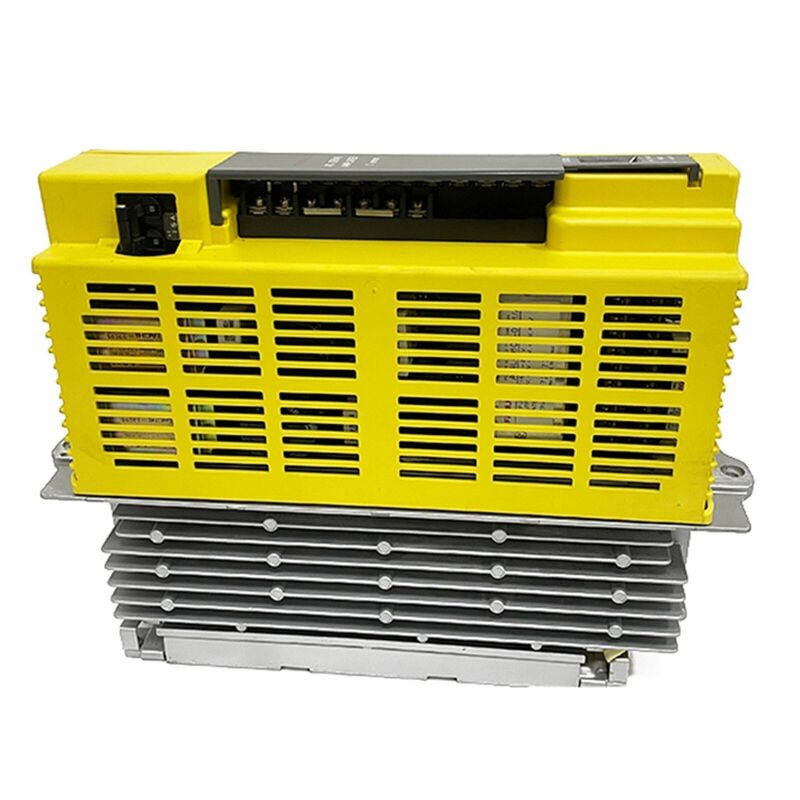
Fanuc A06B-6066-H004 | C-Series Single-Axis AC Servo Amplifier — 200V Input, PWM Control, 0S/5S/20S/1500 Motors, CNC Machine Tool
Overview
The Fanuc A06B-6066-H004 is a single-axis digital servo amplifier from Fanuc's C-series drive family — the PWM-based servo drive platform that succeeded the earlier analog amplifiers and preceded the alpha-series modular drives that dominate Fanuc CNC installations today.
The C-series occupies a specific era in Fanuc's product history, found in CNC machine tools built primarily through the late 1980s to mid-1990s on Fanuc controls including Series 0-C, Series 6, Series 10, Series 11, and early Series 15 and 16 installations.
The H004 designation within the A06B-6066 series identifies the specific motor compatibility range: the drive is configured for motors including the 0S, 5S, 6S, and 20S/1500 AC servo motors, covering the lighter to mid-range output capacity within the C-series motor family.
These motors are the physical components whose wiring and feedback connectors populate the L and M channel positions on machines using this drive generation.
The C-series design was physically compact for its time — the familiar yellow-cased drive unit that Fanuc used across its C and later S-series — and the single-axis format meant one H004 per machine axis, with each drive independently receiving PWM commands from the CNC's axis control card and returning motor current and encoder feedback through the established C-series signal interface.
The simplicity and robustness of this architecture contributed to an installed base of C-series drives that remains in active service in CNC shops worldwide decades after production ended.
Key Specifications
| Parameter |
Value |
| Axes |
Single (L or M channel) |
| Input Voltage |
200V AC (200–230V) |
| Control Interface |
PWM |
| Compatible Motors |
0S, 0SP, 5S, 6S, 20S, 20S/1500, OL |
| PWM Control Cards |
A20B-2900-0610/0620/0630 |
| Power Board |
A20B-1200-0851 / A20B-1004-0851 |
| Status Indication |
LED indicators |
| Series |
C-series |
| Category |
Single-axis servo amplifier |
C-Series PWM Architecture — Digital Control at the Drive Level
The C-series amplifier's PWM interface represented Fanuc's transition from analog servo control to digital command processing. In the C-series architecture, the CNC calculates the required motor velocity and position corrections in its axis control processor, then transmits this information as a PWM (pulse-width modulated) signal to the servo amplifier.
The amplifier decodes this signal and drives the motor output stage accordingly, closing the current loop in hardware within the amplifier while the position and velocity loops close in the CNC.
Two distinct PCB assemblies make up the A06B-6066-H004: the control board (available in variants A20B-2900-0610, 0620, or 0630, the specific variant depending on the motor model and CNC interface version) and the power board (A20B-1200-0851 or equivalent), which handles the AC rectification, DC bus, and IGBT output stage.
This two-board architecture is the standard serviceability design for C-series drives — a fault localised to one board means that board can be replaced or repaired independently rather than requiring the entire drive unit to be exchanged.
Wide Motor Compatibility Range
The A06B-6066-H004 supports a broad range of Fanuc AC servo motors from the C-series motor family, covering both S-series (servo) and T-series (torque) motor configurations across the rated current output of this amplifier class.
The 0S motor is the smallest and lightest in the compatible range, used on lighter machine axes with minimal inertia; the 20S/1500 provides significantly higher torque and is typically found on heavier-duty feed axes.
For the machine maintenance engineer, this broad compatibility is practically significant: a single H004 part number covers multiple motor models that might be fitted across different machines or even on different axes of the same machine, reducing the number of drive variants that must be stocked as spares.
The specific motor model determines which PWM control card variant is required — verify the control card part number against the motor model before fitting a replacement drive.
LED Indicators and Field Diagnostics
The C-series drives incorporate a 7-segment LED display on the drive body that provides status information and alarm codes during operation.
The display shows the drive's ready state (the ready signal from the CNC has been received), active running condition, and alarm codes when faults occur.
Alarm codes in the C-series follow a numerical scheme that identifies the fault category: overheating, overcurrent, overvoltage, encoder feedback anomaly, and communication errors each have distinct code ranges.
During troubleshooting, reading the LED display is the first diagnostic step — it identifies whether the fault is in the drive itself or in the connected motor, feedback cable, or CNC interface.
FAQ
Q1: How does the C-series PWM interface differ from the later alpha-series FSSB interface?
C-series drives receive motor commands via a parallel PWM signal: the CNC drives a dedicated cable with the PWM signal for each axis independently, and each drive has its own direct connection to the CNC's axis output card.
The later alpha-series FSSB (Fanuc Serial Servo Bus) replaced this parallel architecture with a high-speed serial optical fibre link that carries commands for all axes on a single shared bus, reducing cable count significantly.
C-series drives cannot be connected to FSSB-based CNC controls without an interface adapter — a direct CNC upgrade from a C-series to a later-generation control requires either adapting the existing C-series drives or replacing them with alpha-series modules.
Q2: What CNC controls are compatible with the A06B-6066-H004?
C-series amplifiers are compatible with Fanuc controls that provide the matching PWM servo output interface. This includes Series 0-C, Series 6, Series 10/11, and early versions of Series 15 and Series 16/18 that shipped with C-series drive compatibility.
The control's axis output card (the PCB in the CNC that generates the PWM signal) must match the C-series drive's input interface. Controls upgraded with FSSB interface cards are not directly compatible without the appropriate interface conversion.
Q3: How are L and M channel designations used with the A06B-6066-H004?
In Fanuc's multi-axis machine wiring convention, individual single-axis drives are assigned to axis channels labelled L, M, N, etc.
The H004 can be fitted on either the L or M channel position in a multi-axis cabinet arrangement.
The channel assignment corresponds to the axis connector position on the CNC's servo output card and the parameter settings that associate the physical drive with a specific machine axis (X, Y, Z, or additional).
A three-axis machine using single-axis drives would have separate H004 or H005 units for each of its three axes, each wired to its respective L, M, or N channel on the CNC.
Q4: What are the most common failure modes of the A06B-6066-H004?
The most frequently encountered failures on C-series drives are: capacitor degradation on the DC bus (presenting as DC bus voltage faults and erratic motor behaviour), IGBT failure in the output stage (presenting as overcurrent alarms, often triggered by motor winding shorts or cable insulation failure), and control board component failure affecting the PWM signal decode or current regulation circuits.
LED alarm codes on the drive body identify which category the fault falls into. The two-board architecture means power board faults and control board faults can be addressed by replacing only the affected board rather than the complete drive unit.
Q5: Is it possible to still source new A06B-6066-H004 units?
The A06B-6066 C-series was discontinued by Fanuc many years ago, and new-from-Fanuc stock is no longer available. Surplus new-old-stock (NOS) units occasionally appear in the industrial spare parts market from machine decommissioning and overstock inventories.
Refurbished and exchange units are the primary commercial availability, with specialist Fanuc repair centres offering rebuilt and tested H004 drives with warranties.
All reputable suppliers test C-series drives on Fanuc controls with appropriate motor loads before shipment to verify correct operation across the drive's full operating range.


 Your message must be between 20-3,000 characters!