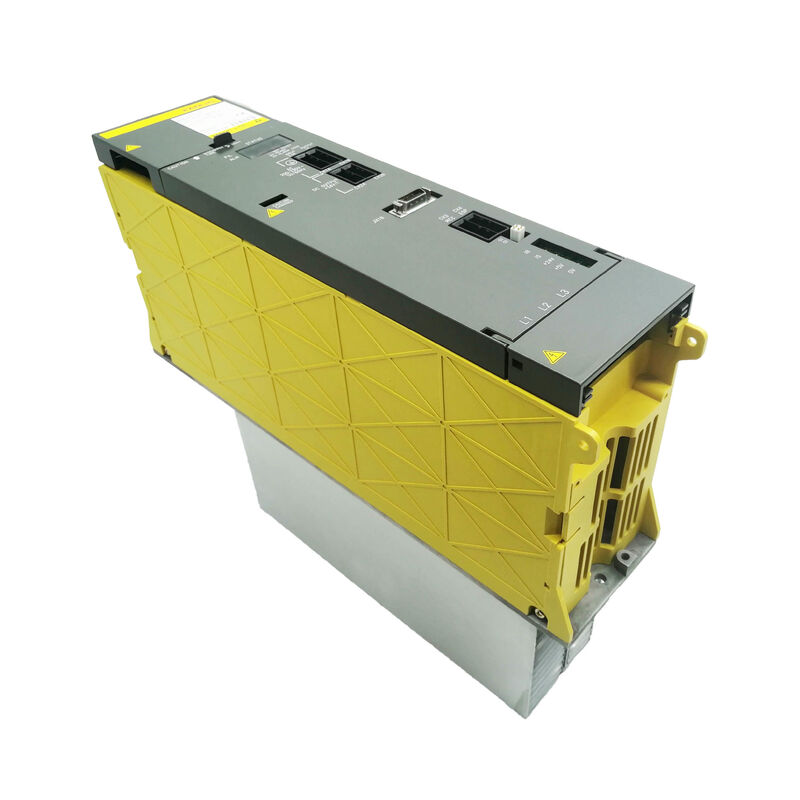
Fanuc A06B-6077-H106 | Alpha Power Supply Module — PSM-5.5, 200–230VAC / 6.8kW, 283–325VDC Output, Power Regeneration Type
Overview
The Fanuc A06B-6077-H106 is the PSM-5.5, the smallest-capacity unit in Fanuc's A06B-6077 alpha power supply module series. Rated at 6.8kW continuous DC bus output from a 200–230V AC, 26A input, it is the appropriate PSM for the smallest alpha drive system configurations — machines running two to three small-axis SVM modules in the SVM1-12 to SVM1-20 range, combined with a small spindle module in the SPM-2.2 to SPM-5.5 class.
This combination covers small CNC milling machines, CNC lathes with compact spindles, small CNC grinding machines, and similar machines where the combined motor power demand stays within the 6.8kW envelope.
Like all PSM-type modules in the A06B-6077 series, the H106 uses power regeneration: motor deceleration energy is returned to the AC supply rather than dissipated in a resistance load.
The regenerative circuit in the PSM-5.5 is rated for the energy levels generated by the small motors that this supply powers — a 5.5kW spindle decelerating from 4000rpm produces a burst of regenerated energy that flows from the SPM back into the DC bus, and the PSM's regenerative transistor circuit transfers this energy to the AC supply before the DC bus voltage rises to the AL-07 overvoltage threshold.
The A06B-6077-H106 is found primarily on machines controlled by FANUC 16iTA, 16iMA, 18iTA, 18iMA, 21iTA, and 21iMA control systems — the generation of Fanuc CNC controls that coincided with this alpha PSM's active production period.
It also appears in some older 0-C and 0-D control installations where the machine builder configured a small alpha drive stack for a compact machine tool.
Key Specifications
| Parameter |
Value |
| Module Model |
PSM-5.5 |
| Input Voltage |
200–230V AC, 3-phase |
| Input Frequency |
50/60 Hz |
| Input Current |
26A at 200V AC |
| Output Voltage |
283–325V DC |
| Output Power |
6.8kW |
| Internal Boards |
A16B-2202-0661, A16B-2202-0420, A16B-2202-0423 |
| Module Width |
90mm |
| Suffix Variants |
#CE (CE mark), #EM |
| Power Type |
PSM (power regeneration) |
PSM-5.5 in the Alpha System — Smallest Capable Configuration
The 6.8kW output capacity of the PSM-5.5 supports what might be called the minimum viable alpha system: a two-axis machining configuration with two SVM1-12 modules (0.75kW each = 1.5kW combined) and an SPM-5.5 spindle module (5.5kW), totalling 7kW at full simultaneous load — marginally above the PSM-5.5's rating, which is why the spindle and all servo axes rarely reach peak load simultaneously in practice.
The PSM's DC bus capacitor bank provides short-term energy buffering that absorbs instantaneous demand peaks, allowing the average bus power draw to stay within the 6.8kW rating even when transient peaks are slightly higher.
For machines with more than two small servo axes or a spindle larger than SPM-5.5, the PSM-5.5 becomes undersized and the next PSM in the A06B-6077 series (the PSM-7.5 or PSM-11) must be selected.
An undersized PSM produces AL-04 (DC link voltage drop) alarms specifically during demanding motion sequences — spindle acceleration combined with simultaneous multi-axis movement is the typical trigger.
The 90mm module width places the PSM-5.5 at the same physical size as the larger PSM-11 in the series. Both modules share the same mounting rail pitch, allowing the PSM-5.5 to be located in the same cabinet position as a PSM-11 replacement without rail modification.
Heatsink Variants and Cabinet Fit
As with the larger PSM-11, the PSM-5.5 was manufactured with two heatsink configurations over its production life.
The external heatsink at the base of the module passes through the cabinet panel into the heatsink cooling duct.
The two variants differ in mounting flange dimensions and hole pattern — installing the wrong variant requires either cabinet modification or use of an adapter. Before ordering a replacement A06B-6077-H106, the existing module's heatsink type must be identified by physical inspection of the removed unit.
The #CE suffix denotes the CE-marked variant for the European market; the #EM suffix identifies another variant.
In most replacement applications, #CE and #EM units are functionally interchangeable provided the heatsink type matches.
Power Regeneration Principles — Why PSM Outperforms PSMR
The PSM-5.5's active regeneration circuit uses the same converter transistors that normally convert AC to DC, operating them in reverse during deceleration to transfer energy from the DC bus to the AC supply.
This bidirectional operation is what distinguishes the PSM from the PSMR (resistance regeneration) type — the PSMR requires an external resistor bank to absorb deceleration energy, adding hardware cost and generating heat that must be managed in the machine cabinet.
For small alpha systems on compact machine tools, the PSM-5.5's regeneration capability eliminates the need for an external resistor unit, simplifying the cabinet design.
The absence of a heat-generating resistance dump also reduces thermal load in the machine cabinet, contributing to lower amplifier operating temperatures and extended component life.
FAQ
Q1: How much total SVM/SPM drive power can the A06B-6077-H106 (PSM-5.5) support?
The PSM-5.5's 6.8kW continuous output limits the combined sustained power demand of all connected SVM and SPM modules. In practice, a configuration with two SVM1-12 modules (0.75kW each) and one SPM-5.5 (5.5kW) totals 7kW — marginally above the PSM rating.
The PSM's DC bus capacitor bank absorbs short-term transients, but sustained overload produces AL-04 voltage drop alarms. A safer configuration for consistent operation keeps combined sustained module demand below 6kW, leaving 0.8kW of margin for transient demands.
Q2: What CNC controls is the A06B-6077-H106 typically paired with?
The PSM-5.5 is most commonly found in machines controlled by FANUC Series 16iTA, 16iMA, 18iTA, 18iMA, 21iTA, and 21iMA controls — the i-series controls that were current during the alpha module's active production period.
It also appears in earlier installations with Series 0-C and 0-D controls on small machine tools.
The PSM is compatible with any CNC control that supports the alpha amplifier module architecture — the PSM itself is transparent to the CNC, providing only the DC bus voltage that the SVM and SPM modules use.
Q3: What alarm codes indicate a PSM-5.5 fault, and how are they distinguished from SVM/SPM faults?
The PSM-5.5 generates alarm codes on its own LED display and propagates related alarms to the CNC. AL-04 (DC link voltage drop) and AL-07 (DC link overvoltage) may originate in the PSM or in a failed SVM/SPM module — the individual module displaying the alarm on its own LED helps identify the source.
AL-01 (overcurrent in main circuit input) and AL-02 (cooling fan failure) are PSM-specific faults.
AL-05 (main capacitor not charged) typically indicates a PSM-side fault in the charging circuit. Systematically checking each module's LED display during an alarm condition identifies the originating module.
Q4: The internal boards (A16B-2202-0661 and A16B-2202-0420) — are these available for board-level repair?
Fanuc does not supply the internal PSM boards as separate service parts. Specialist repair facilities carry these boards in service inventory and address board-level faults — capacitor replacement, gate drive circuit repair, and control circuit faults — during module reconditioning.
For most users, complete module exchange is the practical path: a tested, warranted refurbished PSM-5.5 can be shipped same-day or next-day from service providers with stock, minimising machine downtime compared to a board-level repair cycle.
Q5: Can the PSM-5.5 be replaced with the PSM-11 (A06B-6077-H111) if a higher-capacity PSM is needed?
Yes, physically and electrically — both modules use the same 90mm rail width, the same DC bus connector standard, and the same 200–230V AC input.
The PSM-11 provides 13.8kW output vs the PSM-5.5's 6.8kW, so upgrading the PSM is the correct response when the machine's drive configuration has grown beyond the PSM-5.5's capacity, or when the PSM-5.5 has failed and only a PSM-11 is available as a replacement.
The PSM-11's larger capacity does not harm the smaller drive system — the PSM supplies only the current demanded by the connected modules, not its full rated output. The heatsink type must still be verified to ensure mechanical compatibility with the cabinet mounting.


 Your message must be between 20-3,000 characters!