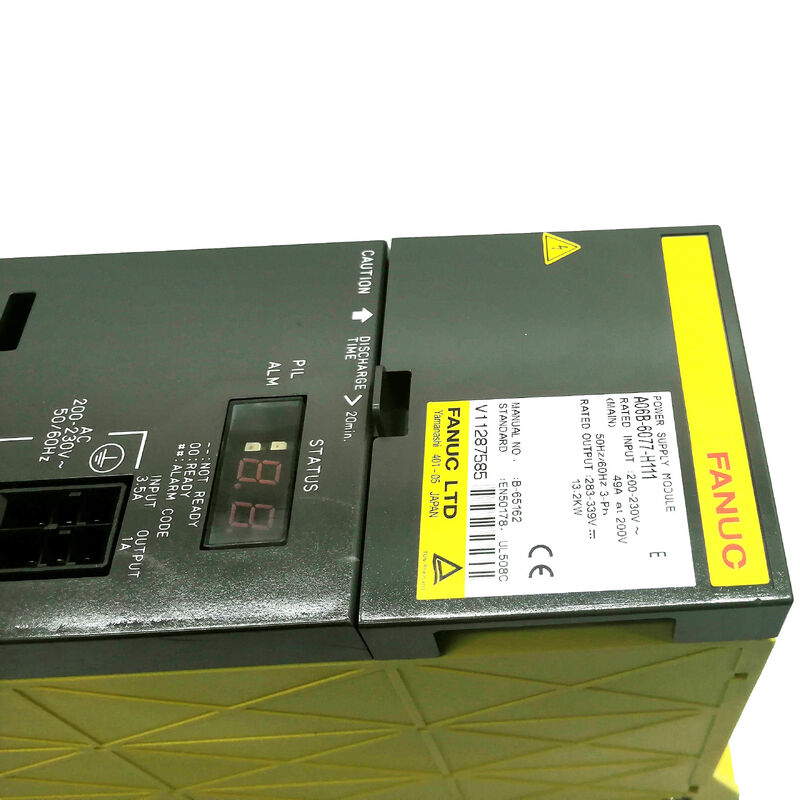
Fanuc A06B-6077-H111 | Alpha Power Supply Module — PSM-11, 200–230VAC / 13.8kW, 283–325VDC Output, Shared DC Bus for SVM and SPM Modules
Overview
The Fanuc A06B-6077-H111 is the PSM-11 power supply module — the mid-range unit in Fanuc's A06B-6077 alpha PSM series, responsible for converting three-phase AC mains into the 283–325V DC bus that powers all SVM servo amplifier modules and SPM spindle amplifier modules in the alpha drive stack.
Rated at 13.8kW continuous DC bus output from a 200–230V AC, 39A input, the PSM-11 is sized for machines with moderate total drive power demand — compact to mid-range machining centres, CNC lathes with a single spindle and three to four servo axes in the small alpha motor range, and similar production machine configurations.
The alpha PSM is the foundation of the entire alpha amplifier module system.
Without a functioning PSM supplying the DC bus, none of the SVM or SPM modules in the stack can operate.
The DC bus voltage rail — physically a copper bus bar running along the rear of the alpha amplifier mounting rail — connects the PSM's output to all modules in parallel.
Each SVM and SPM module draws its operating energy from this bus, and the PSM's output regulation holds the bus voltage within the 283–325V range under all load conditions from zero to full rated output.
The PSM-11's power regeneration design (PSM type, as opposed to PSMR resistance regeneration) returns the energy generated by decelerating servo and spindle motors to the AC power supply rather than dissipating it as heat in a resistance discharge unit.
When all axes decelerate simultaneously — at the end of a rapid traverse move, for example — the total regenerated energy flows back through the PSM and into the factory's AC supply, reducing the machine's net energy consumption.
This regeneration capability is why the PSM type is preferred for machines with frequent, high-energy deceleration events.
Key Specifications
| Parameter |
Value |
| Module Model |
PSM-11 |
| Input Voltage |
200–230V AC, 3-phase |
| Input Frequency |
50/60 Hz |
| Input Current |
39A at 200V AC |
| Output Voltage |
283–325V DC |
| Output Power |
13.8kW |
| Output Current |
49A |
| Wiring Board |
A20B-1006-047x |
| Control PCB |
A16B-2202-042x |
| Transistor Module |
One 150A module |
| Module Width |
90mm |
| Power Type |
PSM (power regeneration) |
DC Bus Architecture — PSM as System Foundation
Every component in the alpha amplifier system except the PSM itself draws operating energy from the shared DC bus that the PSM creates and regulates.
This architectural choice — one shared power supply feeding all drive modules from a common bus — provides several practical advantages over individual power supplies per drive: the total bus capacitance (from the PSM's large electrolytic capacitors plus the smaller capacitors in each SVM/SPM module) provides a reservoir of energy that smooths the instantaneous power demand fluctuations as axes accelerate and decelerate.
When one axis accelerates and demands peak current, a decelerating axis simultaneously pumps regenerated energy back into the bus — the PSM needs to supply only the net difference rather than the peak demand of each axis independently.
The 13.8kW rated output of the PSM-11 represents the maximum sustained power it can deliver to the bus. For machine configurations where the combined peak demand of all SVM and SPM modules exceeds 13.8kW, the PSM-11 is the wrong selection — DC link undervoltage alarms (AL-04) during high-demand motion sequences indicate the PSM is undersized for the machine's actual drive load.
PSM selection must account for the simultaneous peak demands of all modules, not just their continuous ratings.
The 90mm physical width of the PSM-11 matches the standard alpha amplifier module rail pitch, mounting alongside SVM and SPM modules in the same amplifier rail assembly. The external heatsink at the bottom of the unit — one of two physical configurations that Fanuc used over the PSM-11's production life — must match the existing machine's cabinet mounting cutout. When ordering a replacement module, confirming the heatsink type prevents a mechanical incompatibility that would require cabinet modification.
Power Regeneration — Energy Return During Deceleration
The PSM designation (as opposed to PSMR) identifies the power regeneration design. During motor deceleration, each SVM and SPM module generates voltage above the DC bus level as the motor acts as a generator. This energy flows back into the DC bus, raising bus voltage.
The PSM's regenerative circuit detects the elevated bus voltage and switches the active regeneration circuit to feed this energy back to the AC supply — reversing the normal power conversion direction and actually supplying power to the factory's three-phase AC supply during deceleration.
This active regeneration requires the AC supply to be present and in the correct phase during the regeneration event.
A loss of AC power during a regeneration event, or significant AC supply voltage fluctuations, can produce regeneration-related alarms (AL-06 or AL-07) that interrupt the machine cycle.
In installations where the supply quality is poor or where frequent brief power interruptions occur, verifying supply quality at the PSM input is an important step in diagnosing regeneration alarms.
FAQ
Q1: What is the difference between PSM (A06B-6077) and PSMR in the alpha power supply series?
PSM modules use active power regeneration — during motor deceleration, energy is returned to the AC supply through the active converter circuit. PSMR modules use resistance regeneration — deceleration energy is dissipated as heat in an external resistor unit (a separate regenerative discharge unit that must be connected to the PSMR).
The A06B-6077-H111 is the PSM (regeneration) type.
The PSM is generally preferred for machines with frequent high-energy decelerations because it does not heat the machine room and does not require the additional discharge resistor hardware. The PSMR is used where the AC supply cannot accept regenerated energy (for example, certain transformer configurations or generators).
Q2: How is the PSM-11 sized correctly for a machine — what information is needed?
PSM sizing requires knowing the combined peak power demand of all SVM and SPM modules that will operate simultaneously. Sum the rated input power of each SVM and SPM module (from their specifications), then add a margin for simultaneous acceleration events — typically 10–15% above the calculated sum.
The resulting total must fall within the PSM's rated output (13.8kW for the PSM-11). If the total exceeds the PSM-11 rating, the next larger PSM — the PSM-15 or PSM-18 — must be selected. Undersizing the PSM produces DC link undervoltage alarms (AL-04) during peak load conditions.
Q3: The PSM-11 has two heatsink variants — how are they distinguished?
The two heatsink types fit different cabinet mounting cutout geometries. The heatsink is the structure at the base of the module that extends through the cabinet panel into the heatsink cooling duct. The physical dimensions and mounting hole pattern differ between the two types.
To identify which type is installed, the module must be removed from the cabinet and the base heatsink assembly inspected.
When ordering a replacement, specify the heatsink type from visual inspection of the original module or from the machine builder's electrical cabinet drawings.
Q4: What alarm codes does the PSM-11 generate, and what do they indicate?
AL-01: Overcurrent in the main circuit input — check for short circuits in the DC bus wiring or failed output transistor. AL-02: Cooling fan failure — verify the internal fan is running before thermal damage occurs. AL-03: Main circuit heatsink overtemperature — check ambient temperature, fan operation, and heatsink airflow clearance. AL-04: DC link voltage drop — check AC input voltage, input fuses, and that the PSM is not undersized.
AL-05: Main capacitor not charged in time — typically indicates a failed charging circuit or input phase loss. AL-06: Abnormal AC input — check supply voltage levels and phase balance. AL-07: DC link overvoltage — often occurs during regeneration with a failed regenerative circuit or excessive deceleration load.
Q5: Can the PSM-11 operate on 50Hz and 60Hz supply without modification?
Yes. The PSM-11's main rectifier and switching circuit are compatible with both 50Hz and 60Hz three-phase supply without any internal modification. The module's control circuit is also frequency-compatible.
The rated input current (39A at 200V) applies to both frequencies — no derating is required for 50Hz operation compared to 60Hz.
The AC line filter and reactor (if fitted externally in the machine) must also be rated for both frequencies; consult the machine builder's electrical specification to verify that all AC input components are appropriate for the local supply frequency.



 Your message must be between 20-3,000 characters!