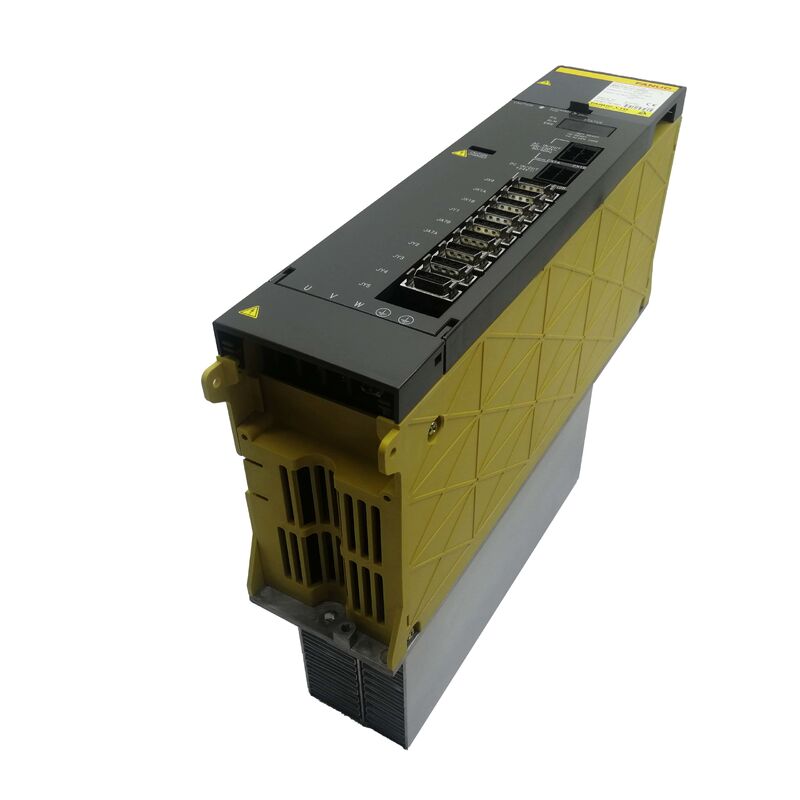
Fanuc A06B-6102-H211 | Alpha Spindle Amplifier Module — SPM-11, 283–325V / 17.5kW, 48A Output, Type 1 Interface, Cs Contouring, Rigid Tapping
Overview
The Fanuc A06B-6102-H211 is the SPM-11 spindle amplifier module in Fanuc's A06B-6102 alpha spindle amplifier series — an 11kW-class spindle drive rated at 48A output from a 17.5kW DC bus input.
The SPM-11 designation identifies a mid-range spindle module suited to machining centres and turning centres with spindle power requirements in the 7.5–11kW continuous range, a common specification for vertical machining centres in the 40–50-taper tool class and turning centres with 15–30cm chuck capacity.
The A06B-6102 series represents Fanuc's alpha spindle amplifier generation with the Type 1 interface — the HRV (High Response Vector) spindle control architecture that enabled advanced spindle functions unavailable in earlier spindle drive generations.
Type 1 interface specifically incorporates a high-resolution internal circuit that allows the CNC to use the spindle as a controlled position axis for Cs contouring control, rigid tapping, and spindle synchronisation without requiring a separate external position sensor.
The spindle motor's own built-in pulse coder provides the position feedback through the JY2 and JY4 connectors, and the drive's high-resolution internal processing converts this feedback into the position accuracy needed for servo-mode spindle operation.
At 48A rated output, the SPM-11 has substantial current headroom for spindle motor acceleration transients. Machine spindles accelerate from rest to cutting speed in one to several seconds — the peak current during this acceleration can reach two to three times the continuous rated value.
The 17.5kW rated input, combined with the alpha PSM's ability to deliver peak power from its DC bus capacitor bank, provides the energy needed for these acceleration events without producing bus undervoltage faults.
Key Specifications
| Parameter |
Value |
| Module Model |
SPM-11 |
| Interface |
Type 1 (HRV) |
| Rated Input |
283–325V DC bus, 17.5kW |
| Max Output Voltage |
230V AC |
| Rated Output Current |
48A |
| Spindle Functions |
Cs contouring, synchronisation, rigid tapping, orientation |
| CE Variant |
A06B-6102-H211#H520 |
| Compatible PSM |
Alpha PSM (shared DC bus) |
Type 1 Interface — Spindle as a Servo Axis
The Type 1 designation in the A06B-6102 series means the module incorporates the high-resolution internal circuit that transforms the spindle from a simple speed-controlled drive into a position-controlled axis capable of servo-mode operation.
This architectural capability underpins several machining functions that modern machining centres depend on.
Cs contouring control uses the spindle as a C-axis in turning operations, rotating the workpiece at a precisely commanded angular position while a milling or drilling tool moves in X and Y — this enables contoured features on a turning centre that would otherwise require a separate machining operation on a VMC.
Rigid tapping synchronises the spindle's angular position with the Z-axis linear advance of the tapping tool through each thread pitch, eliminating the floating chuck that pre-rigid-tapping systems required and enabling higher tapping speeds with better thread quality.
Spindle synchronisation coordinates two spindles on a twin-spindle lathe or sub-spindle turning centre, matching their speeds to enable workpiece transfer from main to sub-spindle without a mechanical steady.
All of these functions require the Type 1 interface's high-resolution position processing — lower-resolution or analog-interface spindle drives cannot implement them regardless of motor size.
SPM-11 in the Alpha Spindle Range
The A06B-6102 series covers spindle module output from SPM-2.2 (H202, for small spindle motors) up through the larger SPM models for high-powered machining centres. The SPM-11 sits in the mid-range — above the SPM-5.5 (H206, for small machine or sub-spindle applications) and below the SPM-15 and SPM-22 used on larger primary spindle drives.
This positioning matches the SPM-11 to the broad middle segment of CNC machining centres: 40-taper VMCs with spindle power in the 7.5–11kW range, turning centres with chuck sizes to 250mm, and horizontal machining centres in the smaller pallet classes.
Replacement of a failed SPM-11 on a production machine is straightforward in terms of physical swap-out — the module occupies a standard position in the alpha amplifier rail, connecting to the DC bus and to the CNC's spindle interface.
The spindle motor parameters stored in the CNC must match the installed motor model, and the CNC's spindle alarm history provides the fault code that identifies whether the failure was in the spindle drive, the spindle motor, or the motor's position coder.
FAQ
Q1: What spindle alarms on the A06B-6102-H211 indicate a module fault versus a motor fault?
The module's red LED alarm codes (AL-03 through AL-12) indicate faults within the drive hardware — DC link fuse, input fuse, power semiconductor overheat, DC bus overvoltage or overcurrent. AL-01 (motor overheat) and AL-02 (excess speed deviation) typically point to the motor or feedback system rather than the drive itself.
When AL-08 through AL-12 appear, the drive hardware is suspect.
Always check motor winding insulation to several hundred megaohms before replacing the module — a motor insulation failure that causes through-fault current to the drive's output stage is the most common root cause of DC link overcurrent (AL-12) and drive shutdown.
Q2: What is the #H520 suffix on the CE variant A06B-6102-H211#H520?
The #H520 suffix designates the CE-marked variant of the SPM-11 module, produced for the European market and conforming to CE electrical safety directives. The electrical specifications — rated input, output current, and spindle control functions — are identical to the base A06B-6102-H211.
CE marking indicates the module has been tested and documented for compliance with relevant EU directives covering low-voltage equipment and electromagnetic compatibility. For machines operating within the EU, the CE variant is the required part number; for other markets, the base H211 and #H520 are functionally interchangeable.
Q3: Does the SPM-11 support both Cs contouring and rigid tapping simultaneously?
No. Cs contouring control, rigid tapping, spindle synchronisation, and orientation are mutually exclusive operating modes — the CNC commands one mode at a time, and switching between them requires cancelling the active mode first.
The ER-11 through ER-22 alarm codes in the spindle drive specifically flag attempts to command a second mode while another is active.
This is a software control constraint, not a limitation of the module's hardware — the SPM-11 hardware supports all modes, but only one can be active at any given time within a machining program sequence.
Q4: Can the A06B-6102-H211 be used with any alpha spindle motor, or must the motor match the drive rating?
The SPM-11 drive at 48A output is sized for alpha series spindle motors in the 7.5–11kW continuous power class. Using a significantly larger spindle motor — one requiring sustained current above 48A under cutting load — will trigger overcurrent protection and produce spindle alarms during cutting operations.
The motor's rated current (from its nameplate or Fanuc's spindle motor specification) must be within the amplifier's rated output for reliable full-load operation.
The SPM-11 can drive smaller spindle motors (lower continuous current demand) without issue, though this is not the typical use case.
Q5: What PSM size is needed to support the A06B-6102-H211 in a full machine configuration?
The SPM-11's 17.5kW input demand must be accommodated within the PSM's total capacity alongside all SVM modules in the machine's axis amplifier stack.
A typical VMC with three axis SVM modules (totalling 2–6kW) plus an SPM-11 requires a PSM rated at approximately 20–25kW peak to handle simultaneous axis and spindle acceleration.
Fanuc's PSM selection procedure sums the peak demands of all modules to determine the minimum required PSM capacity — undersizing the PSM produces DC link undervoltage alarms specifically during the most demanding simultaneous motion sequences.


 Your message must be between 20-3,000 characters!