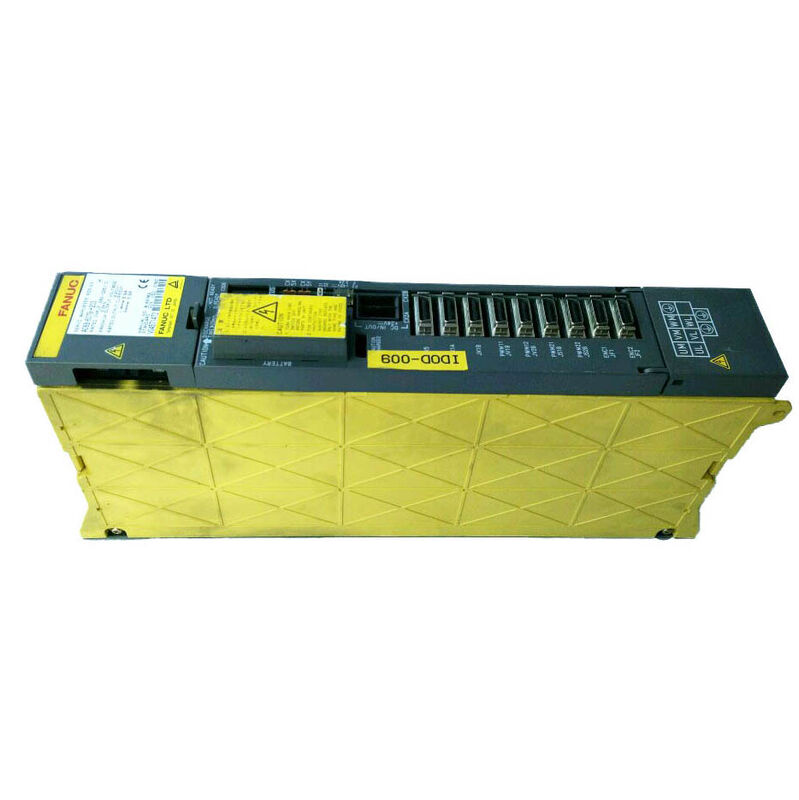
Fanuc A06B-6079-H101 | Alpha Servo Amplifier Module — SVM1-12, Single-Axis, 283–325V / 0.75kW, 3.0A Output, Type A/B PWM Interface
Overview
The Fanuc A06B-6079-H101 is the smallest single-axis module in Fanuc's A06B-6079 alpha servo amplifier series, designated SVM1-12, rated at 3.0A continuous output on its L-axis channel from a 0.75kW, 283–325V DC bus input.
This is the entry-level current class in the alpha SVM1 single-axis lineup, matched to the lightest Fanuc alpha motors in the α1/3000 and α2/3000 range.
It is the module specified when a machine axis requires only modest continuous current — compact CNC machining centres with light table and saddle drives, small robotic systems, and CNC wire EDM and sinker EDM machines where all axes run within the 3.0A envelope.
The SVM1-12 occupies 60mm of amplifier rail width, the narrowest format in the alpha SVM single-axis series.
This compact footprint is a practical cabinet design advantage for machine builders fitting multiple drives alongside a PSM (Power Supply Module) and spindle amplifier module.
In installations where three axes all require the same 3.0A continuous output, machine builders sometimes choose the SVM3-12/12/12 three-axis module for even greater compactness — but where individual axis sparing or selective axis replacement during fault diagnosis is important, three separate SVM1-12 modules provide complete fault isolation between axes.
A practical detail when ordering or servicing the A06B-6079-H101 is the CX5 battery port configuration. Fanuc fitted this module with either one or two CX5 battery ports depending on the machine configuration and control series — the port count determines how many absolute encoder axes the battery circuit supports.
A replacement module must match the original configuration, or the absolute encoder battery backup will not function correctly for all connected axes. This is not a performance parameter of the module itself but an important commissioning detail when swapping a failed unit.
Key Specifications
| Parameter |
Value |
| Module Model |
SVM1-12 |
| Axes |
Single (L channel) |
| Rated Input |
283–325V DC bus, 0.75kW |
| Max Output Voltage |
230V AC |
| Rated Output Current |
3.0A |
| Interface |
PWM Type A and Type B |
| Compatible Motors |
α1/3000, α2/3000 |
| Wiring Board |
A16B-2202-0740 |
| Control Card |
A20B-2001-093x |
| Module Width |
60mm |
| Compatible Controls |
FANUC 0-C/MD/MF, 15/16/18/21 |
SVM1-12 in the Alpha Module Architecture
The A06B-6079-H101 draws from the alpha PSM's shared DC bus and converts that bus energy into the three-phase sinusoidal motor current that drives the alpha servo motor.
The 0.75kW rated input power is the modest DC bus demand of this module at its 3.0A rated continuous output — significantly less than the multi-kilowatt demands of larger SVM1 modules in the same series.
For a machine that uses three SVM1-12 modules across its three axes, the total servo amplifier module demand on the PSM is 3 × 0.75kW = 2.25kW, leaving the majority of a standard PSM's capacity available for the spindle amplifier module peak demands during spindle acceleration.
The PWM Type A/B dual interface compatibility is a feature of the 60mm-class alpha modules that makes the A06B-6079-H101 serviceable across a wider range of CNC control generations.
Type A compatibility covers the earlier Series 0-C, 15A, 16A, 18A, and 21A controls; Type B covers Series 0-MD, 0-MF, 15B, 16B, 18B, and 21B.
The interface type is determined by the machine's CNC control generation and configured on the module through the appropriate wiring board variant or interface switch — when ordering a replacement, the existing machine's control type determines which interface configuration is required.
α1/3000 and α2/3000 — Matched Motor Class
The α1/3000 and α2/3000 are compact Fanuc alpha motors suited to light-duty CNC axes and precision positioning applications.
The α1/3000 (Model 1 alpha, 3000rpm rated speed) is the lightest motor in the alpha series axis motor family, used where axis mass and friction are low and the highest demand is fast, clean response to velocity commands rather than high sustained torque.
The α2/3000 provides a step up in torque at the same rated speed, broadening the applicable axis types while still operating well within the SVM1-12's 3.0A continuous rating.
For CNC EDM machines, these small alpha motors are the standard axis drive — EDM requires extremely precise, slow positioning over small distances with very low speed ripple, and the alpha series' sinusoidal PWM current regulation delivers the smooth, continuous motion that EDM surface quality depends on.
FAQ
Q1: What is the FSSB-equivalent of the A06B-6079-H101, and are they interchangeable?
The FSSB fibre optic interface equivalent of the SVM1-12 is the A06B-6096-H101. Both are SVM1-12 modules with 3.0A output at 0.75kW input. They are not directly interchangeable — the A06B-6079-H101 uses PWM serial communication to the CNC, while the A06B-6096-H101 uses the FSSB fibre optic bus.
The machine's CNC control type and interface wiring determine which is required. Installing the wrong variant produces communication errors between the CNC and the drive — always match the module to the machine's actual interface type.
Q2: What does specifying "1 or 2 CX5 battery ports" mean in practice?
The CX5 connector on the alpha servo module is the battery backup connection for the motor's absolute pulse coder.
A module with one CX5 port supports battery backup for one absolute encoder axis. A module with two CX5 ports supports battery backup for two axes — relevant in some machine configurations where the SVM1-12 is used in a specific wiring arrangement.
Providing the wrong port count in a replacement module means one or more axes will lose absolute position data on power-off and require re-homing. Identify the CX5 port count on the original module before ordering.
Q3: What is the typical machine type that uses the A06B-6079-H101?
The SVM1-12 is most commonly found on small CNC machining centres and vertical machining centres with compact alpha motor axis drives, CNC wire EDM machines where three or more axes each use small alpha motors for precise electrode positioning, and small robotic installations where individual axis modules are preferred over multi-axis modules for maintenance flexibility. It also appears in some CNC turning centre configurations as a C-axis or B-axis drive where the rotary axis motor is in the α1/α2 class.
Q4: Can the A06B-6079-H101 operate independently of the PSM with an external DC power supply?
No. Like all SVM module series drives, the H101 requires the DC bus voltage (283–325V) provided by the alpha PSM.
The PSM also supplies the control power and manages the regenerative braking function for the entire amplifier stack.
The H101 has no internal rectifier and cannot convert AC mains directly to its operating voltage.
In installations where the original PSM has failed, the PSM must be replaced before the SVM1-12 can be powered and tested.
Q5: What are the most common fault modes on the A06B-6079-H101?
IPM module failure (typically triggered by motor winding insulation breakdown causing through-fault current) is the most common sudden fault. Capacitor aging on the internal bus circuits produces erratic behaviour over time in older modules.
Battery pack discharge causes absolute position loss on power-off — this is a maintenance item, not a drive fault, but it generates alarms that interrupt production. The module's 7-segment LED display shows alarm codes that, combined with the CNC's SV-alarm number, identify the fault category.
Always test motor insulation to several hundred megaohms before attributing an overcurrent alarm to the module.


 Your message must be between 20-3,000 characters!