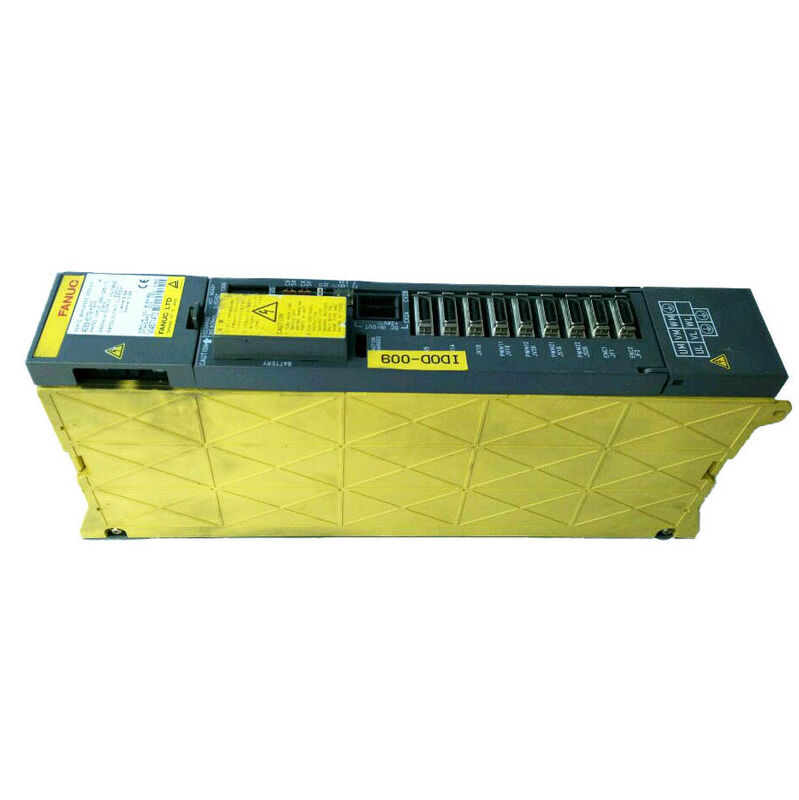
Fanuc A06B-6079-H108 | Single-Axis Alpha Servo Amplifier Module — SVM1-360, 115A Output, α100/α150 Motors, 283–325V Input, 230V Output, Type A/B Interface
Overview
The Fanuc A06B-6079-H108 is the largest single-axis servo amplifier module in the A06B-6079 alpha series — the SVM1-360, a 115-amp continuous output drive designed for the α100 and α150 alpha servo motors that power the heaviest machine tool axes in Fanuc's CNC ecosystem.
Where the smaller SVM modules in the A06B-6079 series handle the compact axis drives of machining centres and EDM machines, the H108 operates at the opposite end of the scale: large-format CNC machines where the axes carry significant structural mass, where ballscrew preload and guideway friction are substantial, and where the servo axis must deliver full torque during heavy cutting passes without current limiting.
The SVM1-360 naming convention follows the pattern used across the alpha series SVM family — SVM1 identifies a single-axis module, and 360 identifies the peak current class. At 115A continuous output into a 230V AC motor, the H108 is capable of driving motors in the 11–15kW continuous power range, covering the large axis drives found on horizontal boring mills, large-format machining centres, gantry-type machine tools, and heavy-duty punch and press brake equipment where Fanuc's large alpha servo motors provide the axis force capability these machines require.
Built in Fanuc's manufacturing facilities at the foot of Mt. Fuji in Japan, the A06B-6079-H108 has been installed in large CNC machine tools from the mid-1990s onward — a longevity that reflects both the robustness of the hardware and the continued operational life of the large machine tools it was designed to power.
Key Specifications
| Parameter |
Value |
| Module Model |
SVM1-360 |
| Axes |
Single (L channel) |
| Continuous Output |
Approx. 115A |
| Rated Input |
283–325V DC |
| Max Output Voltage |
230V AC |
| Compatible Motors |
α100, α150 |
| Control PCB |
A16B-2202-0991 |
| Wiring Board |
A20B-1006-0485 |
| Interface |
Type A or Type B |
| Application |
Large CNC machine tools, press machines |
SVM1-360 — Large Alpha Motor Class
The α100 and α150 motor designations in Fanuc's alpha servo motor range identify the motor's continuous torque rating — α100 for 100 Nm class continuous torque, α150 for 150 Nm class. These are physically large motors with heavy rotors and high pole count windings that require sustained high currents to develop and maintain torque across the operating speed range.
The H108's 115A output capability is specifically matched to these motor classes.
At this current level, the H108 requires its IPM (Intelligent Power Module) transistor assembly to dissipate significant heat even under normal operating conditions.
The module incorporates a dedicated heatsink and cooling fan to manage this thermal load. Fan operation is monitored — a stopped fan triggers a FAL (fan alarm) on the module's LED indicator, and continued operation without fan cooling risks thermal shutdown of the IPM. In high-duty-cycle applications, the cooling fan's operational status should be part of routine maintenance inspection.
Single-Axis Architecture and Component Layout
The SVM1-360's single-axis design concentrates the full 115A output capability into one axis channel on the L terminal connection. Unlike multi-axis SVM modules where the current capability is distributed across two or three smaller output stages, the H108 uses a single high-current IPM assembly for the full rated output.
This concentrated architecture makes the module physically wide relative to smaller SVM units — the PCB layout accommodates the large gate drive circuits, current measurement shunts, and bypass capacitance required for high-current PWM switching.
The control PCB A16B-2202-0991 and wiring board A20B-1006-0485 are specific to the SVM1-360 module and are not interchangeable with other alpha series SVM boards.
Repair specialists note that neither board is sold separately from Fanuc — component-level repair of the IPM transistor assembly, capacitors, fans, fuses, and pulse coder backup batteries is the practical service path for SVM1-360 maintenance.
FAQ
Q1: What machine types typically use the A06B-6079-H108?
The SVM1-360 is found on large CNC machine tools where axis mass and cutting forces require the higher torque capability of α100 or α150 motors.
Typical installations include horizontal boring mills with heavy spindle heads, large-format vertical machining centres with heavy column or table structures, gantry-type 5-axis machining centres, CNC punch presses where the heavy ram axis demands sustained high torque, and large-format press brake machines with CNC back gauge and ram position control.
The 115A output class is not common in standard machining centres — it specifically targets the high-force axis applications of large capital machine tools.
Q2: Can the A06B-6079-H108 operate with either Type A or Type B interface?
The module supports both Type A and Type B serial interface operation, with the active interface determined by the control system and wiring configuration of the specific machine installation.
Type A and Type B differ in the serial communication format between the CNC and the SVM — the correct type is defined by the CNC control generation and the machine builder's configuration. When sourcing a replacement H108, verify which interface type the machine uses before installation, as using the wrong interface configuration will result in servo communication alarms on the CNC.
Q3: What are the consequences of a stopped cooling fan on the SVM1-360?
At 115A output, the IPM transistor assembly generates substantial heat during normal operation.
A stopped fan (indicated by alarm code FAL on the 7-segment display) reduces heatsink cooling to natural convection only. At moderate loads, the drive may continue operating for a short time before the IPM's thermal protection triggers an overtemperature shutdown. At high-duty-cycle machining loads, thermal shutdown occurs faster.
Fan replacement on the A06B-6079-H108 is a standard maintenance item — spare fans are available separately from the main module and should be stocked as a routine spare part in facilities where this drive is in continuous production use.
Q4: How is the pulse coder backup battery managed on the H108?
The SVM1-360 carries an internal backup battery for the absolute pulse coder connected to the L axis motor.
This battery maintains the motor's absolute position memory during CNC power-down. Battery life is typically measured in years depending on usage cycle and ambient temperature.
A low battery warning appears on the CNC's operator display before the battery reaches critical voltage — the recommended replacement interval is before the warning appears, as a fully discharged battery causes the axis to lose its absolute position reference, requiring re-homing of the machine axis after battery replacement.
Q5: What separates the SVM1-360 from the smaller SVM1-320 in terms of application?
The SVM1-320 (approximately 80A output class) and SVM1-360 (approximately 115A output class) cover adjacent motor classes — the SVM1-320 serves the α40 and α80 motors, while the SVM1-360 serves the α100 and α150 motors.
The α100 and α150 motors are not only higher in continuous torque but also heavier in rotating inertia — they accelerate more slowly from the servo system's perspective, requiring the CNC's inertia compensation parameters to be set appropriately.
The selection between SVM1-320 and SVM1-360 is always determined by the motor model on the machine, not by the application's qualitative description — match the module to the motor nameplate.


 Your message must be between 20-3,000 characters!