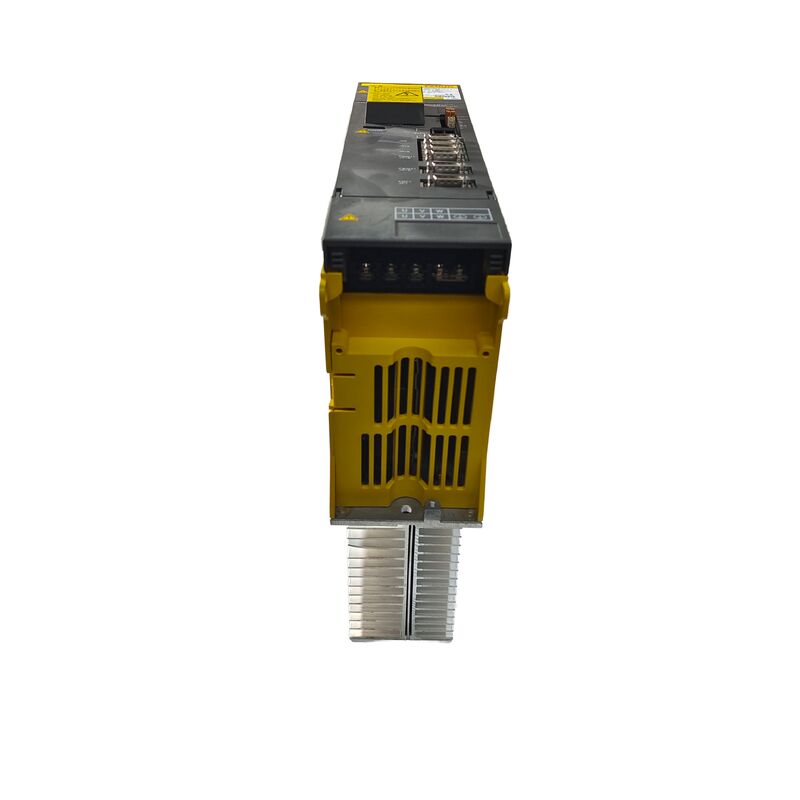
Fanuc A06B-6079-H202 | Alpha Servo Amplifier Module — SVM2-12/20, Dual-Axis, 283–325V, 3.0A (L) / 5.9A (M), Type A/B PWM Interface
Overview
The Fanuc A06B-6079-H202 is an asymmetric dual-axis alpha servo amplifier module, designated SVM2-12/20, delivering different continuous output currents on its two channels: 3.0A on the L axis and 5.9A on the M axis.
This asymmetric configuration is the distinguishing feature of the H202 within the SVM2 dual-axis family — unlike the H201 (SVM2-12/12, equal 3.0A on both channels) and the H203 (SVM2-20/20, equal 5.9A on both channels), the H202 is specifically designed for machine configurations where two axes genuinely require different motor current capacities.
In practical terms, this means one machine axis uses a small alpha motor in the α1/α2 class (drawing 3.0A or less continuous) while the other axis uses a mid-range motor in the αM2.5/α3/αC6 class (drawing up to 5.9A continuous).
This commonly occurs on machining centres where the table (X or Y) axis uses a lighter motor than the column or saddle (Z) axis due to the different mass and friction loads. Packaging both into a single SVM2 module rather than two separate SVM1 units saves cabinet space and reduces the number of DC bus connection points.
The 60mm module width is identical to the symmetric SVM2 variants because the asymmetry is handled within the same physical format by using different IPM module sizes for L and M channels.
The smaller 20A-class IPM on the L channel and the larger 50A-class IPM on the M channel occupy the same 60mm module frame — Fanuc's IPM selection optimises the module's efficiency by matching transistor capacity to actual channel demand rather than over-specifying all channels.
Key Specifications
| Parameter |
Value |
| Module Model |
SVM2-12/20 |
| Axes |
2 (L and M channels) |
| Rated Input |
283–325V DC bus |
| Max Output Voltage |
230V AC |
| L Axis Current |
3.0A rated |
| M Axis Current |
5.9A rated |
| Interface |
PWM Type A and Type B |
| L Channel Motors |
α1/3000, α2/3000 |
| M Channel Motors |
αM2.5/3000, α3/2000, αC6/2000 |
| Wiring Board |
A16B-2202-0751 |
| Module Width |
60mm |
| Compatible Controls |
FANUC 0-C/MD, 15/16/18/21 (A and B) |
Asymmetric Dual-Axis — When Two Axes Have Different Motors
The SVM2-12/20's value is most apparent in machines where matching both axes to the same motor class would either over-specify one axis (wasting current headroom) or under-specify the other (risking overcurrent alarms).
A concrete example: an X-axis table drive using an α1/3000 motor that draws 3.0A maximum, and a Y-axis saddle drive using an α3/2000 motor that draws up to 5.9A under full cutting load.
The SVM2-12/20 covers both axes correctly — the 3.0A L channel for the lighter X axis, the 5.9A M channel for the heavier Y axis — from a single 60mm module rather than requiring two separate SVM1 modules of different sizes.
This application logic extends to EDM machines, pick-and-place systems, and gantry positioners where one axis is lightly loaded (relative travel, low friction) while the other carries higher inertia or encounters greater resistance.
The machine builder selects the SVM2-12/20 as a deliberate efficiency choice — one module, two axes, correctly sized for each.
Type A/B Interface Flexibility
Like most 60mm-class alpha modules, the SVM2-12/20 supports both Type A and Type B PWM interface configurations.
This dual compatibility allows the same module part number to serve across a wider range of CNC control generations than type-specific variants.
The interface configuration is set by the machine's CNC control type, verified during installation from the machine builder's documentation or the CNC's servo interface card revision.
The wiring board (A16B-2202-0751) carries the interface configuration hardware.
The control card (A20B-2001-093x) processes PWM commands for both channels simultaneously. Neither board is sold separately; repair is performed at the complete module level by specialists with appropriate Fanuc test equipment.
FAQ
Q1: Can the L and M channels of the SVM2-12/20 be independently assigned to different machine axes?
Yes. The L and M channel designations correspond to the CNC's axis channel assignments, not to specific physical machine axes. The machine builder assigns machine axis labels (X, Y, Z, A, B, C) to the L and M channels through parameter settings in the CNC.
The 3.0A L channel is assigned to whichever machine axis uses the smaller motor, and the 5.9A M channel to the axis using the larger motor. This assignment is a parameter-level configuration, not a hardware constraint.
Q2: What happens if a motor with 5.9A demand is accidentally connected to the 3.0A L channel?
Under full machining load, the L channel's IPM module will be driven beyond its sustainable current range, triggering the IPM's internal over-current protection and generating an Alarm 8 (L-axis overcurrent or IPM alarm) on the module's LED.
The alarm protects the module from damage, but the axis cannot operate at full load.
The correct fix is to swap the motor connections so the 5.9A-demand motor is on the M channel. This is a wiring configuration error, not a module fault, and does not require module replacement.
Q3: How does the SVM2-12/20 (H202) differ from the SVM2-12/12 (H201) and SVM2-20/20 (H203)?
The H201 (SVM2-12/12) provides 3.0A on both L and M — for machines where both axes use small α1/α2 motors. The H202 (SVM2-12/20) provides 3.0A on L and 5.9A on M — for machines with mixed motor classes.
The H203 (SVM2-20/20) provides 5.9A on both L and M — for machines where both axes use mid-range αM2.5/α3 motors. Choose the H202 specifically when one axis is in the α1/α2 class and the other is in the αM2.5/α3/αC6 class.
Q4: What is the DC bus power demand of the SVM2-12/20, and how does it affect PSM selection?
The SVM2-12/20's combined input power draw from the DC bus reflects the sum of both channel demands — approximately 0.75kW for the L channel at 3.0A plus approximately 2.5kW for the M channel at 5.9A, totalling approximately 3.25kW at simultaneous full load.
This is less than the SVM2-20/20's 2.5kW, because the L channel's lighter load reduces the total. The PSM selection for the machine must account for this module's contribution alongside all other modules' peak demands to determine the correct PSM capacity.
Q5: What are the most common failure modes specific to the asymmetric IPM configuration?
Because the L and M channels use different IPM device sizes, a fault in one channel is specific to that IPM and does not damage the other channel's IPM.
The smaller L-channel IPM is more susceptible to damage from motor cable insulation faults on the L-axis motor because it has less current headroom above rated.
The larger M-channel IPM can sustain brief fault currents somewhat better before protection activates.
Regardless of which channel fails, the standard diagnostic sequence applies: disconnect the suspect motor's power cables, test motor insulation resistance to protective earth, and verify whether the alarm clears before condemning the module.


 Your message must be between 20-3,000 characters!