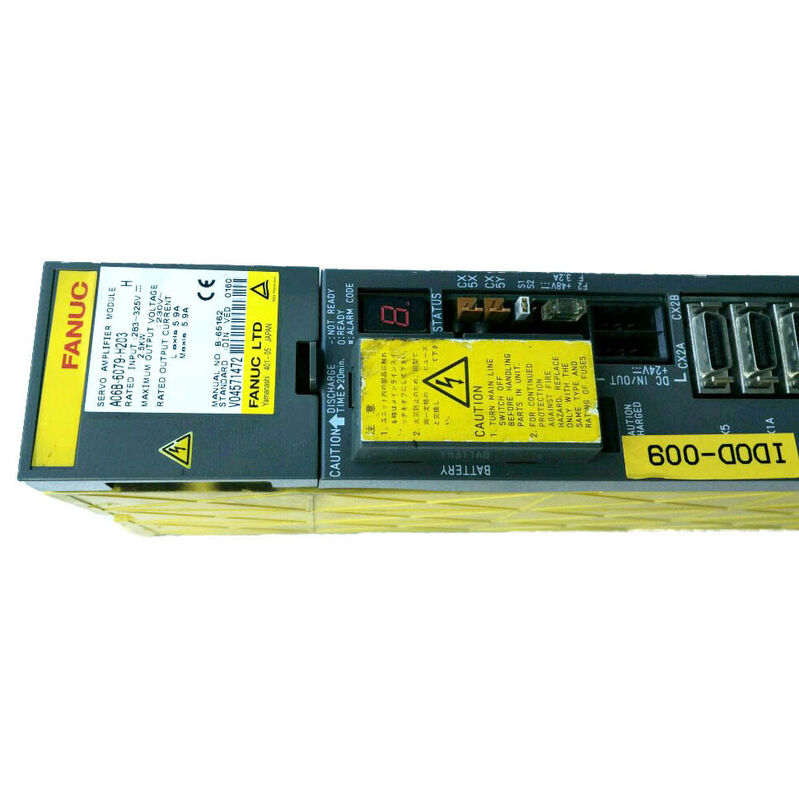
Fanuc A06B-6079-H203 | Alpha Servo Module — SVM2-20/20, 5.9A Dual-Axis, 283–325V / 2.5kW, IP20, CNC and Industrial Automation
Overview
The Fanuc A06B-6079-H203 delivers two independent channels of alpha series servo axis control in a single 60mm-wide module, each channel rated at 5.9A continuous output from a shared 2.5kW DC bus input. As the SVM2-20/20, it represents a meaningful step up in per-axis current capacity from the smaller SVM2-12/12 — nearly double the channel current in the same physical width — without requiring the wider 90mm module format that higher-current SVM2 variants need.
This current-per-width efficiency makes the SVM2-20/20 a well-suited module for the αM2.5 through αC6 motor class, which itself represents the range of mid-size alpha servo motors used on the broad middle tier of Fanuc CNC machine tools built during the alpha series production period.
Reliability in production environments comes from the IPM (Intelligent Power Module) technology inside the H203.
The two 50A-class IPM devices — one for the L axis, one for the M axis — each integrate the complete three-phase IGBT bridge, gate drivers, and over-current/over-temperature protection into a single sealed component.
This integration eliminates the solder joints and wire bonds between separate discrete transistors, gate resistors, and sensing circuits that were common failure points in earlier discrete-component servo drive designs.
The IPM's internal protection responds to fault conditions in microseconds — faster than external protection circuits could react — limiting damage from motor cable faults or motor winding failures before they propagate to other components in the module.
The IP20 protection rating reflects the module's installation environment: a closed electrical cabinet with controlled ambient temperature, free from direct contact with coolant or cutting fluid.
The alpha module system is not designed for splash or wash-down environments — the PSM, SVM, and SPM modules all share IP20 protection, relying on the machine's control cabinet for environmental isolation.
Key Specifications
| Parameter |
Value |
| Module Model |
SVM2-20/20 |
| Axes |
2 (L and M channels) |
| Rated Input |
283–325V DC bus, 2.5kW |
| Max Output Voltage |
230V AC |
| Output Current (L/M) |
5.9A rated each |
| Interface |
PWM Type A and Type B |
| Protection |
IP20 |
| Compatible Motors |
αM2.5/3000, α3/2000, αC6/2000 |
| IPM Modules |
Two 50A (one per channel) |
| Wiring Board |
A16B-2202-0752 |
| Control Card |
A20B-2001-0931 |
| Module Width |
60mm |
Sinusoidal PWM Control — Current Regulation Quality
The alpha series servo amplifier's sinusoidal PWM control generates motor phase currents that closely approximate a pure sine wave at the motor's operating frequency.
This sinusoidal current minimises torque ripple — the fluctuation in output torque at the motor shaft that occurs when the phase current deviates from ideal sinusoidal form.
Torque ripple at the axis level translates to velocity ripple, and velocity ripple at machining speeds produces surface finish variation on the workpiece.
For precision machining applications — fine milling, grinding operations, and high-speed contouring — the reduction of torque and velocity ripple that sinusoidal PWM provides directly improves surface finish quality compared to older trapezoidal commutation drive architectures.
The SVM2-20/20's control card (A20B-2001-0931) implements this current regulation algorithm for both L and M channels simultaneously, maintaining the sinusoidal output quality across both axes even during combined-axis contouring movements where both channels are active simultaneously.
CNC Integration — Position Loop Architecture
The A06B-6079-H203 operates within Fanuc's closed-loop servo architecture: the CNC's position controller calculates the required motor velocity for each axis at every servo cycle period, transmits this as a PWM command to the H203, and receives the motor's encoder position feedback through the CNC's position loop.
The H203 closes the velocity and current loops internally, at rates higher than the CNC's position loop update rate, producing smooth current waveforms that translate the CNC's position commands into precise mechanical motion.
This hierarchical loop structure — position loop in the CNC, velocity and current loops in the SVM module — is the fundamental reason that axis positioning accuracy is largely determined by the CNC's position control parameters rather than by the servo amplifier module alone.
Replacing a failed H203 with a correctly configured replacement restores the axis to its previous positioning performance without requiring changes to the CNC's servo parameters, provided the replacement module is configured for the same interface type and absolute encoder configuration as the original.
FAQ
Q1: The SVM2-20/20 and SVM2-12/20 (A06B-6079-H202) share similar designations — what is the difference?
The SVM2-12/20 provides 3.0A on the L axis and 5.9A on the M axis — an asymmetric dual-axis module used when the two machine axes have different motor current requirements.
The SVM2-20/20 provides 5.9A on both L and M, for machines where both axes use mid-range alpha motors with equal current demand. Select the H203 (SVM2-20/20) when both X and Y (or X and Z) axes use the same αM2.5 or α3-class motors. Select the H202 (SVM2-12/20) when one axis is lighter (α1 or α2 class) while the other requires the higher 5.9A.
Q2: Can the A06B-6079-H203 be used in a machine with an i-series FANUC control (Series 16i, 18i, 21i)?
The A06B-6079 series uses the original PWM Type A/B interface, which is distinct from the FSSB fibre optic interface used by the later A06B-6096 and A06B-6114 (alpha-i) series. Early Series 16i/18i/21i controls may have been configured with PWM Type B interface compatibility when paired with first-generation alpha drives, in which case the H203 is usable.
Later i-series controls configured exclusively for FSSB require the FSSB-equivalent SVM2-20/20 module (A06B-6096-H203).
Verify the machine's original interface type from the machine builder's documentation before ordering a replacement.
Q3: What is the IP20 rating, and what does it mean for installation?
IP20 provides protection against solid objects larger than 12.5mm (fingers) but no protection against liquids. The H203 must be installed inside a sealed control cabinet that protects it from coolant splash, chip dust, and condensation.
Direct exposure to machine cutting fluid or ambient humidity above the rated range will damage the IPM devices, PCBs, and connector contacts.
The cabinet's own IP rating — typically IP54 or IP65 on CNC machine tool cabinets — provides the environmental protection that the H203 itself does not.
Q4: How does the absolute encoder battery backup work on the A06B-6079-H203?
The CX5 connector on the wiring board connects a lithium battery that maintains the absolute position stored in the alpha servo motor's pulse coder during machine power-off. Without a functioning battery, the absolute position is lost on each power cycle and the axis must perform a reference return before machining can resume.
Battery replacement on a schedule consistent with Fanuc's recommended battery life (typically two to three years of continuous production use) prevents data loss.
The CNC displays a BAT alarm when battery voltage drops below the monitoring threshold — replace the battery before it fully discharges to avoid position data loss.
Q5: What is the practical repair approach when the A06B-6079-H203 develops an alarm 8 or 9?
Alarm 8 (L-axis overcurrent) or 9 (M-axis overcurrent) most commonly originates from motor winding insulation breakdown rather than a module fault. Begin diagnosis by powering off, disconnecting the motor cables for the alarming axis from the module's U/V/W terminals, and testing the motor's winding-to-earth insulation with a high-voltage insulation tester (500V DC).
Acceptable insulation is several hundred megaohms or higher. If insulation is low, the motor requires rewinding or replacement.
If insulation is acceptable, the fault is in the module's output stage — the IPM for the affected channel has failed and the module requires exchange or specialist repair. This sequence avoids the common error of replacing a healthy module when the root cause is a degraded motor.



 Your message must be between 20-3,000 characters!