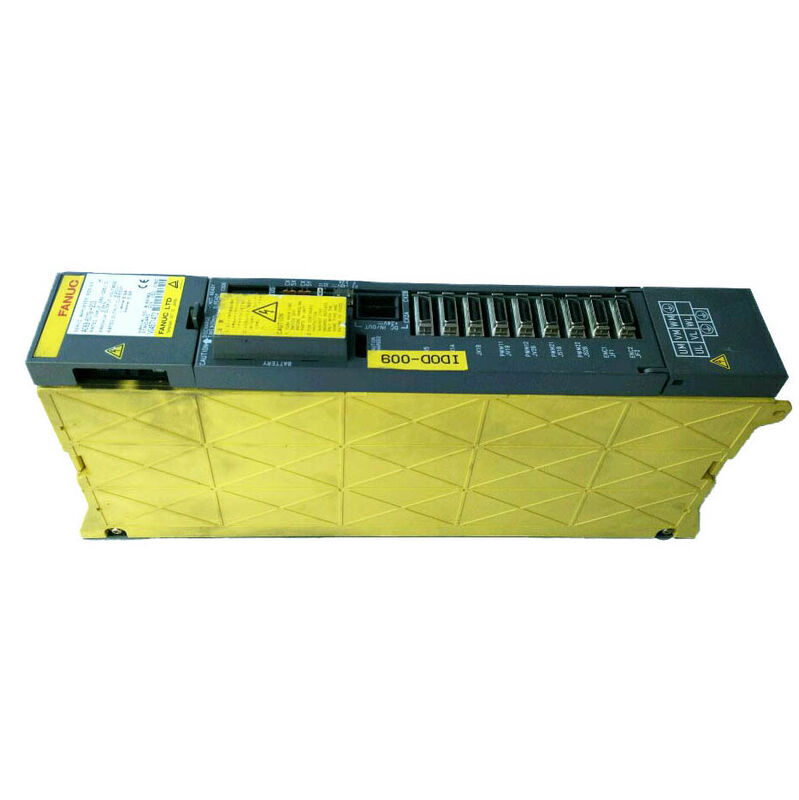
Fanuc A06B-6079-H208 | Alpha Servo Amplifier Module — SVM2-80/80, Dual-Axis, 283–325V / 9.5kW, 18.7A per Axis, Type A/B PWM Interface
Overview
The Fanuc A06B-6079-H208 is a dual-axis alpha series servo amplifier module, designated SVM2-80/80, delivering 18.7A rated continuous output on each of its L and M axis channels from a 9.5kW DC bus input.
It is the highest-current two-axis configuration in the A06B-6079 dual-axis SVM2 series — well above the 12.5A per axis of the SVM2-40/40 (H206), and sized specifically for the α22/2000 and larger alpha motors used on heavier CNC machine tool axes where sustained high current is a genuine machining requirement.
At 18.7A per axis, the SVM2-80/80 approaches the output level of the single-axis SVM1-80 module (18.7A), but delivers it to two independent axes from a single 90mm-wide module.
This equivalence in per-axis current within a narrower combined footprint (90mm vs 2 × 60mm = 120mm for two SVM1-80 modules) is the core practical advantage of the SVM2-80/80 format — two heavy axes in one module position, drawing from the shared DC bus through a single bus connection point.
The 9.5kW DC bus input rating reflects the substantial combined power demand of two α22-class axes at simultaneous full load.
In a machine with two SVM2-80/80 channels plus a spindle amplifier module, the total DC bus demand can exceed 25kW — requiring a PSM-18.5 or PSM-26 to sustain full simultaneous drive operation.
PSM selection for installations containing the SVM2-80/80 must be calculated from the actual combined peak demands rather than estimated from motor nameplate ratings alone.
Key Specifications
| Parameter |
Value |
| Module Model |
SVM2-80/80 |
| Axes |
2 (L and M channels) |
| Rated Input |
283–325V DC bus, 9.5kW |
| Max Output Voltage |
230V AC |
| Output Current (L) |
18.7A rated |
| Output Current (M) |
18.7A rated |
| Interface |
PWM Type A and Type B |
| Compatible Motors |
α22/2000 and larger alpha motors |
| Wiring Board |
A16B-2202-0774 |
| Control Card |
A20B-2001-0933 |
| Dimensions |
380 × 90 × 307 mm |
| Compatible Controls |
FANUC 16MC/MA, 18TA/MC, 21TB/MB, 16TB/TB, 18TB |
18.7A Dual-Axis Output — Heavy Axis Performance in a Two-Axis Module
The SVM2-80/80 occupies a specific niche within the alpha module family: two simultaneous heavy axis drives. The α22/2000 motor, the standard companion for this module, produces 22N·m of continuous torque at its 2000rpm rated speed — substantially more than the smaller α6 or α12 motors typical of lighter machine axes.
Axes driving large carriage masses, ballscrew systems with significant friction, or machining operations with high cutting forces demand this level of sustained torque, and the motor's rated current reflects this demand directly in the 18.7A per-axis output specification.
Two α22 axes on a mid-size CNC turning centre or horizontal machining centre — X and Z on a lathe, X and Y on an HMC — represent a typical SVM2-80/80 configuration. Both axes move simultaneously during contouring, both accelerate together at the start of rapid traverse moves, and both draw from the module's shared DC bus connection.
The 9.5kW module input reflects the combined sustained demand of these two axes at full continuous cutting load, while the IPM modules' peak current capability handles the acceleration transients without triggering overcurrent protection.
Mechanical Format — 90mm Width, Full-Size IPM Modules
The 380 × 90 × 307mm dimensions of the SVM2-80/80 reflect the physical requirements of 18.7A dual-axis output: the 90mm width accommodates the two large-format IPM modules side by side, the control card, the wiring board, and the bus bar connection hardware.
This is a significantly larger module than the 60mm narrow-body SVM2 variants — the added width is determined by the IPM devices' physical size at this current class.
The large-format IPM modules in the H208 integrate IGBT switching transistors rated for the peak currents demanded by α22 motor acceleration alongside the gate drive electronics and over-current, over-temperature protection circuits.
At 18.7A continuous, the internal heat generation is substantial — the module's external heatsink and internal fan work together to maintain the IPM junction temperatures within safe operating limits.
A failed cooling fan in the H208 leads to rapid thermal overload that, if not corrected, permanently damages the IPM modules.
CNC Control Compatibility — Mid-Generation FANUC Systems
The A06B-6079-H208 is documented as compatible with FANUC 16MC, 16MA, 18TA, 18MC, 21TB, 16TB, 18TB, and 21MB control systems — the CNC controls that dominated the mid-range machining centre and turning centre market during the alpha series' active production window.
These controls are still operating production machines in significant numbers globally, making the SVM2-80/80 a consistently sought spare part for maintenance rather than a historical relic.
Specific machine examples where the SVM2-80/80 appears include the Dainichi F25M and Mori Seiki SL-250 — both mid-size CNC lathes that use α22-class motors on their primary machining axes.
The combination of these machine types with this specific module reflects a design generation where dual-axis modules at this current class were a common solution for mid-range lathe and machining centre configurations.
FAQ
Q1: How does the SVM2-80/80 compare to using two separate SVM1-80 (A06B-6079-H105) modules?
Both approaches deliver 18.7A per axis using the same alpha PSM DC bus. The SVM2-80/80 occupies 90mm of rail vs 2 × 60mm = 120mm for two SVM1-80 units. The SVM2 uses fewer DC bus connection points and requires one fewer set of CNC interface cables.
The SVM1 pair provides complete fault isolation — a failed SVM1-80 on one axis can be replaced while the other axis continues operating.
The SVM2-80/80 shuts down both axes when either channel alarms. Machine builders generally prefer the SVM2 for compact cabinet design; service engineers sometimes prefer SVM1 pairs for maintenance flexibility on critical production machines.
Q2: What PSM size is required to support the A06B-6079-H208 in a full machine drive stack?
The SVM2-80/80 draws 9.5kW from the DC bus at combined full load. Add the PSM demands of all other modules: a typical mid-size lathe with one SVM2-80/80 (9.5kW), one SVM1-20 for the C-axis (1.25kW), and an SPM-11 spindle (17.5kW) totals 28.25kW peak demand.
This exceeds a standard PSM-18.5 and requires a PSM-26.
Always calculate from peak simultaneous module demands — the PSM must not be undersized or DC link undervoltage alarms (Alarm 5: LVDC) will appear during the machine's most demanding simultaneous motion sequences.
Q3: The cooling fan is internal — how is its condition monitored?
The module's alarm code 1 (FAL: fan alarm) activates when the internal fan stops or falls below minimum speed. On the CNC's operator display, this typically appears as an SV alarm with the fan failure code.
If the machine generates this alarm but clears it on power cycle and does not repeat immediately, the fan may be intermittently sticking — a worn bearing is the usual cause.
Fan failure should be addressed immediately because the H208's IPM modules at 18.7A generate thermal energy that exceeds the heatsink's passive cooling capacity within minutes of fan failure under load.
Q4: The H208 dimensions show 90mm width — does this affect its physical location in the alpha amplifier rail?
The 90mm width occupies the same type of alpha module rail as 60mm-wide SVM2 modules, but requires 90mm of unobstructed rail space (vs 60mm for the narrow modules). In cabinets originally designed for narrow SVM modules, adding an SVM2-80/80 requires verifying that 90mm of rail is available at the intended mounting position.
The module's 307mm depth is also significant — cabinet panel depth of at least 307mm behind the front panel is required, plus clearance for the DC bus connection at the rear.
Q5: What alarm pattern distinguishes an L-axis fault from an M-axis fault on the A06B-6079-H208?
The 7-segment LED display codes follow a channel-specific pattern: Alarm 8 (HCL) indicates L-axis overcurrent; Alarm 9 (HCM) indicates M-axis overcurrent. IPM-specific faults are indicated as 8. (IPML) for L-axis and 9. (IPMM) for M-axis.
Combined channel faults appear as lowercase letters: b (L+M overcurrent), C (M+N), d (L+N), E (all three).
These codes directly identify the affected channel, allowing the diagnostic sequence to focus immediately on the appropriate motor, cable, and output stage rather than testing both channels in sequence.
The CNC's axis alarm number cross-references the H208's channel code with the specific machine axis (X, Z, or other) that generated the fault.


 Your message must be between 20-3,000 characters!