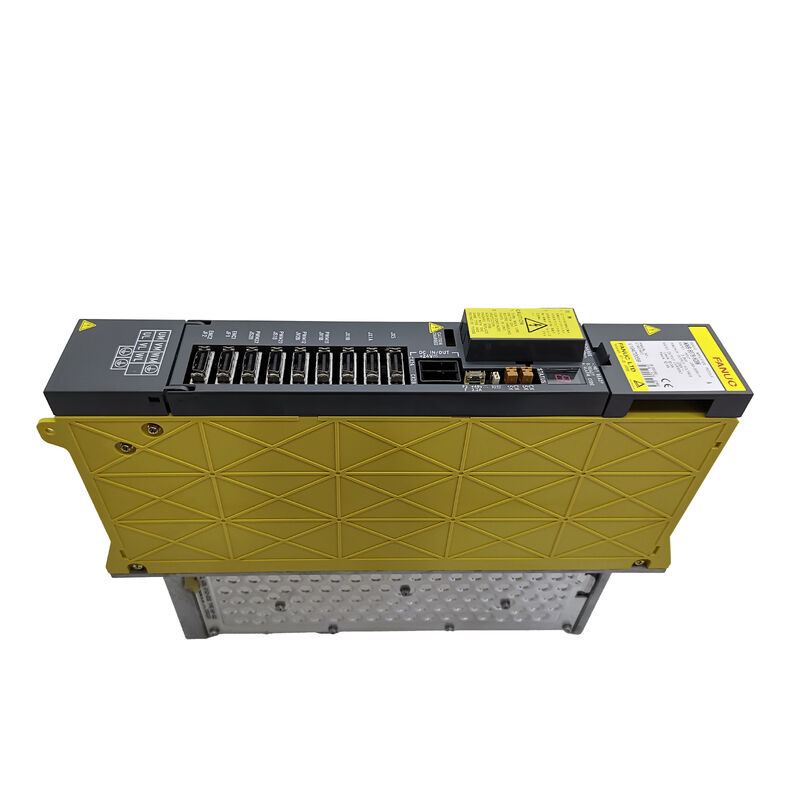
Fanuc A06B-6079-H301 | 3-Axis Alpha Servo Amplifier Module — SVM3-12/12/12, 283–325V / 1.85kW, 3.0A per Axis, Type A PWM Interface
Overview
The Fanuc A06B-6079-H301 is the smallest-current three-axis module in Fanuc's alpha servo amplifier series, designated SVM3-12/12/12. It delivers 3.0A rated continuous output on each of its three channels — L, M, and N — from a 1.85kW DC bus input, making it the standard drive module for three-axis CNC machines fitted with small alpha series motors in the α1/3000 and α2/2000 class.
The 90mm-wide module houses three 20A transistor output stages, a shared wiring board, and a single control card assembly, all powered from the alpha PSM's DC bus rail.
The SVM3 format consolidates three independent axis drives into one physical module. Rather than occupying three separate SVM1 positions in the amplifier rail, one SVM3-12/12/12 covers all three axes from a single 90mm slot.
This consolidation reduces DC bus connection points, simplifies the cable harness between the module stack and the CNC's axis interface, and produces a more compact drive cabinet for the small machines that typically use this drive — compact vertical machining centres, small horizontal machining centres, and CNC wire EDM and sinker EDM machines where all three axes carry light loads within the 3.0A per-axis envelope.
The Type A interface marks the H301 as a PWM-protocol module, communicating with the CNC via a serial PWM feedback loop rather than the FSSB fibre optic bus used in later alpha-i series modules.
FANUC 0-C, 0-MD, 0-MF, and early Series 15, 16, 18, and 21 controls all support this Type A interface, making the H301 compatible with a wide range of machine generations built during the alpha series' primary production era.
Key Specifications
| Parameter |
Value |
| Module Model |
SVM3-12/12/12 |
| Axes |
3 (L, M, N channels) |
| Rated Input |
283–325V DC bus, 1.85kW |
| Max Output Voltage |
230V AC |
| Output Current (L/M/N) |
3.0A rated each |
| Interface |
PWM Type A |
| Compatible Motors |
α1/3000, α2/2000 |
| Wiring Board |
A16B-2202-0780 |
| Transistor Modules |
Three 20A (one per channel) |
| Module Width |
90mm |
| Compatible Controls |
FANUC 0-C/MD/MF, 15/16/18/21 |
Three-Channel SVM3 Architecture — Space and Simplicity
In Fanuc's alpha series cabinet design, the PSM provides the DC bus and each SVM module draws from it in parallel. The SVM3-12/12/12 taps this bus at a single connection point for all three channels, while providing three independent motor output connections (U, V, W terminals for each of L, M, N).
The control card processes PWM commands from the CNC for all three axes and generates the gate signals for each output stage independently — a position error or current fault on the N axis, for example, does not directly affect the L or M axis control, though the module-level alarm response will stop all three channels until the fault is cleared.
The three 20A transistor modules inside the H301 provide peak current headroom above the 3.0A rated continuous output — acceleration transients on even small alpha motors can draw several times the continuous rated current for brief periods.
The 20A transistor rating sets the maximum instantaneous current each channel can handle, governed by the CNC's current limit parameters and the motor's own peak current specification. Operating within these boundaries is what protects both the transistors and the motor windings over the drive's service life.
α1/3000 and α2/2000 — Application Fit
The α1/3000 is Fanuc's compact light-duty alpha motor — low inertia, high speed, suited to small VMC table and saddle drives where rapid traverse speeds are important and cutting torque requirements are moderate.
The α2/2000 produces higher torque at a slightly lower rated speed, better suited to axes with greater carriage mass or higher friction in the drive train. Both motor models operate comfortably within the 3.0A continuous rating of the SVM3-12/12/12 under normal machining conditions on small machine tools.
For CNC EDM machines, the three-axis alpha servo configuration with the SVM3-12/12/12 is essentially the standard architecture — EDM requires precise, low-speed positioning rather than high-speed rapids, and the small alpha motors' accurate current control at low speeds produces the smooth electrode movement that EDM surface finish quality depends on.
FAQ
Q1: What is the difference between the A06B-6079-H301 (Type A) and A06B-6080-H301 (Type B) SVM3-12/12/12 modules?
Both are electrically identical SVM3-12/12/12 modules with the same 1.85kW input, 3.0A per axis output, and 230V output voltage.
The difference is the CNC serial interface: Type A (A06B-6079) for Series 0-C, 15A, 16A, 18A, 21A controls; Type B (A06B-6080) for Series 0-MD/MF, 15B, 16B, 18B, 21B controls. The absolute encoder battery connection topology also differs between types. Always confirm the control series' interface type before sourcing a replacement module.
Q2: Can one of the three channels be used as a spare while the other two run normally?
No. The SVM3 module has no provision for disabling individual channels while running others — all three channels are powered from the same DC bus and share the same control card power supply. In the event of a single-axis motor or cable fault, the module will alarm and shut down all three channels simultaneously.
Restoring operation on two axes while the third is inactive requires either isolating the faulty motor/cable or substituting two SVM1 modules for the two working axes, which is rarely practical in the field compared to swapping the complete SVM3 module.
Q3: What routine maintenance does the A06B-6079-H301 require?
The internal cooling fan is the primary maintenance item — fan failure leads to rapid thermal overload under load. Fan condition should be verified during scheduled machine maintenance by observation (audible operation, visual blade movement) and by monitoring the CNC's SV alarm history for thermal warnings.
The absolute encoder backup battery should be replaced on a schedule consistent with Fanuc's battery life specification — typically every two to three years in continuous production use. Transistor junction condition is not user-serviceable but repair facilities assess it during module refurbishment.
Q4: The wiring board A16B-2202-0780 — what is its role and is it available separately?
The A16B-2202-0780 is the internal wiring board that routes signals between the CNC interface, the control card, and the three output stage transistor modules.
It also carries the motor feedback and brake signal connectors.
Fanuc does not sell this board as a separate service part. Specialist repair facilities may carry it in service stock for component-level module repair.
For most field maintenance situations, complete module exchange is the practical approach — attempting PCB-level repair without proper test equipment and component stock is not recommended.
Q5: Alarm 8, 9, or A on the module LED — what is the diagnostic sequence?
These alarm codes indicate high current or short circuit in the drive output or motor. Begin by powering off and disconnecting the motor power cables from the module's U, V, W terminals. Power back on — if the alarm clears, the fault is in the motor or motor cable, not the module.
Check motor winding insulation resistance between each winding and protective earth (acceptable values are several hundred megaohms or higher).
If the alarm persists with motor cables disconnected, the fault is in the module's output stage — the module requires repair or exchange.
This test sequence avoids unnecessarily replacing a module that may be healthy while the root cause is a failing motor.


 Your message must be between 20-3,000 characters!