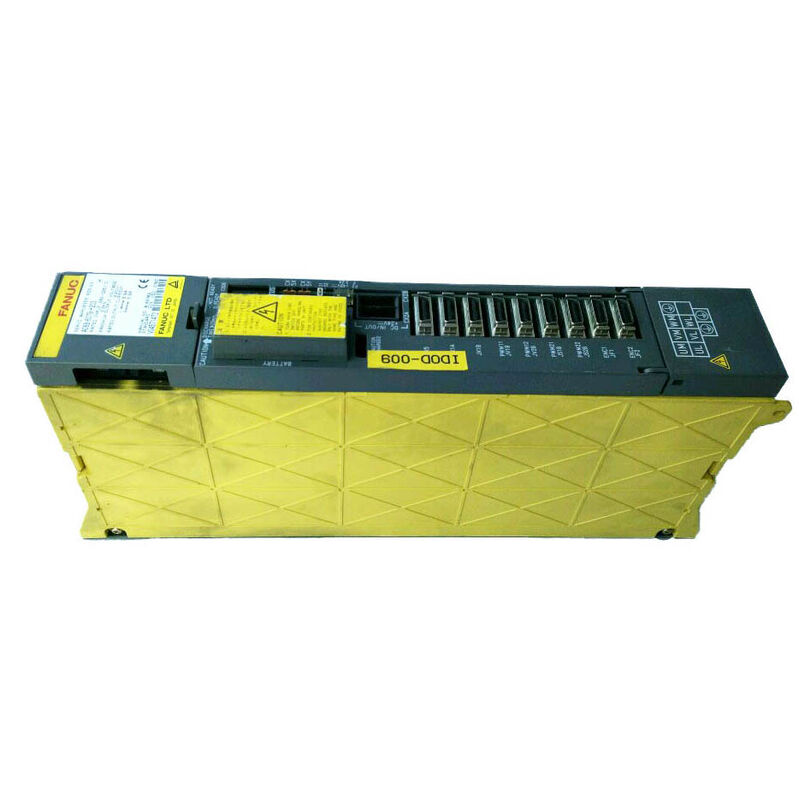
FANUC A06B-6079-H302 — Alpha SVM3-12/12/20: When Two Axes Are Light and One Is Not
The Thinking Behind Unequal Axes
A three-axis machining center is not three identical problems solved three times. The rotary B-axis indexing a tombstone fixture to the next face is doing something fundamentally different from the X and Y axes tracing a pocket contour. The Z-axis descending against gravity with a full spindle head carries inertia that a lighter cross-travel axis never encounters. A turret index axis on a turning center moves intermittently and briefly — its current demand profile has nothing in common with the Z-axis taking a heavy roughing pass.
Machine designers who understood this did not specify the same drive current for every axis simply because three outputs were available from a single module. They sized each channel to the motor it would drive, and they chose three-axis modules whose current combination matched the actual load distribution of the machine. The A06B-6079-H302 reflects exactly this thinking.
Designated SVM3-12/12/20, this module from FANUC's 6079 alpha series delivers 3.0A on the L and M axes — sufficient for alpha motors in the lighter end of the range — while stepping the N axis up to 5.9A to serve a motor handling meaningfully greater torque demand. Two channels sized for lighter work; one sized for the heavier axis. This is not a compromise or an odd variant — it is the correct engineering response to a specific and common machine load profile.
Sande Electric stocks the A06B-6079-H302 in new and used conditions, dispatching worldwide within 0–3 working days.
Module Architecture: The PSM Dependency That Defines the 6079 Family
Before discussing axis specifications, the installation architecture of the H302 deserves clear attention. This unit is an SVM — Servo amplifier Module — not a self-contained unit with its own rectifier. It connects to a shared DC bus supplied by a separately installed Power Supply Module (PSM) in the same drive cabinet. The PSM handles all AC-to-DC conversion for the cabinet. The SVM3-12/12/20 handles only the current control for its three axes.
This means the H302 has no AC input terminals. Incoming power arrives as DC bus voltage in the range of 283–325V, already rectified and filtered by the PSM upstream. If the PSM fails, the H302 — and every other SVM module sharing that bus — stops operating. If the H302 fails, the PSM and other modules continue working normally.
Anyone sourcing this module as a replacement must verify that the cabinet contains a functioning PSM before concluding the SVM module is the fault source. A cabinet-level DC bus undervoltage or bus charge failure will immobilize all SVM modules simultaneously, and this pattern — all axes alarming at once — is sometimes mistaken for a module failure when the PSM or bus wiring is the actual problem.
Where the H302 Sits: Reading the SVM3 Asymmetric Range
The SVM3-12/12/20 occupies a specific position in the 6079 three-axis module family that reflects its intended application:
|
Part Number
|
Designation
|
L Axis
|
M Axis
|
N Axis
|
Profile
|
|
A06B-6079-H301
|
SVM3-12/12/12
|
3.0A
|
3.0A
|
3.0A
|
All three axes light
|
|
A06B-6079-H302
|
SVM3-12/12/20
|
3.0A
|
3.0A
|
5.9A
|
Two light, N steps up
|
|
A06B-6079-H303
|
SVM3-12/20/20
|
3.0A
|
5.9A
|
5.9A
|
One light, two heavier
|
|
A06B-6079-H304
|
SVM3-20/20/20
|
5.9A
|
5.9A
|
5.9A
|
All three mid-range
|
|
A06B-6079-H305
|
SVM3-12/12/40
|
3.0A
|
3.0A
|
12.5A
|
Two light, N heavy
|
|
A06B-6079-H306
|
SVM3-12/20/40
|
3.0A
|
5.9A
|
12.5A
|
Stepped asymmetric
|
|
A06B-6079-H307
|
SVM3-20/20/40
|
5.9A
|
5.9A
|
12.5A
|
Two mid, N heavy
|
The H302 is the first step up from the all-light H301 — the minimum change that gives the N axis more current without upsizing the other two channels. Machines designed with this module typically assign L and M to axes driving α1/3000 or α2/3000 motors, while N drives an α2/3000 or α3/3000 in a higher-duty application, or occasionally an α4/4000 at moderate loads.
Fitting the all-equal H304 (20/20/20) on a machine designed around the H302 will not cause damage — the higher-current channels simply run at a fraction of their capacity on L and M. But sourcing the H304 as a substitute inflates cost and complicates future ordering by breaking the documentation match. The better approach is to identify and stock the correct part.
Why N Axis Gets the Upgrade: Common Machine Configurations
In the installations where the H302 was most commonly used, the N axis handled one of a few recurring scenarios.
On horizontal machining centers, L and M axes traverse the pallet in two horizontal directions while N carries vertical motion with the full spindle head weight. The gravitational component on the N axis alone pushes its average torque requirement above what an α1 or α2 motor needs, even at moderate cutting depths.
On turning centers with auxiliary axes, L and M might drive the tailstock and tool post positioning while N drives the main carriage taking the longitudinal turning pass — consistently the highest-current demand on the machine.
On multi-axis cells with a rotary C axis added to a three-axis base, the rotary axis often has a heavier motor to handle workpiece inertia during indexing, mapping naturally to the N channel with its higher current headroom.
None of these applications pushes N into the 40-class territory that would require an H305 or H306. The 5.9A of the 20-class N channel sits in the range where a mid-size alpha motor handles the job without the unit becoming physically larger or drawing significantly more from the shared PSM.
Technical Specifications
|
Parameter
|
Value
|
|
Part Number
|
A06B-6079-H302
|
|
Also Known As
|
A06B6079H302
|
|
FANUC Designation
|
SVM3-12/12/20 (Alpha Servo amplifier Module, 3-axis)
|
|
Series
|
FANUC 6079 Alpha SVM
|
|
Unit Type
|
SVM Module — requires external PSM (DC bus input)
|
|
Axis Count
|
3 (L, M, N)
|
|
Interface
|
PWM — Type A
|
|
DC Bus Input
|
283–325V DC (from alpha PSM)
|
|
Rated Output Voltage
|
230V AC
|
|
Rated Output Current
|
L: 3.0A (12-class) / M: 3.0A (12-class) / N: 5.9A (20-class)
|
|
Wiring Board
|
A16B-2202-0781
|
|
Compatible L/M Motors
|
α1/3000, α2/3000
|
|
Compatible N Motor
|
α2/3000, α3/3000, α4/4000
|
|
Compatible CNC
|
FANUC Series 15, 16, 18, 21 (non-i)
|
|
PSM Required
|
Yes (alpha PSM, A06B-6077 series)
|
|
FSSB Equivalent
|
A06B-6096-H302 (not interchangeable)
|
|
Operating Temperature
|
0°C to 55°C
|
|
Status
|
Discontinued
|
|
Origin
|
Japan
|
|
Certification
|
CE
|
|
Condition Available
|
New / Used (inspected)
|
|
MOQ
|
1 piece
|
|
Daily Supply Capacity
|
Up to 100 pcs
|
|
Dispatch
|
0–3 working days from confirmed payment
|
|
Packaging
|
Original packing
|
The 6079 vs 6096 Interface Split: Getting the Generation Right
The 6079 SVM3-12/12/20 has a direct counterpart in the next-generation alpha SVM family: the A06B-6096-H302, which carries the same SVM3-12/12/20 designation and identical axis current ratings but uses an FSSB fiber optic interface rather than Type A PWM. The two modules cannot be substituted for each other.
The 6079 H302 operates with FANUC Series 15, 16, 18, and 21 controls — the non-i generation — using a parallel cable bundle from the CNC's Type A servo interface board. The 6096 H302 operates with i-series controls (16i, 18i, 0i-C/D and similar) via plastic optical fiber cable. Installing a 6096 module on a machine with a non-i CNC, or a 6079 module on a machine with FSSB-equipped i-series CNC, produces an immediate communication fault on power-up.
The surest identification method remains the part number label on the installed module. The middle four digits — 6079 or 6096 — make the interface generation explicit regardless of whether the CNC cabinet documentation is available. If the label is damaged, the CNC model designation is the next most reliable check: non-i (Series 16, 18, 21 without the "i" suffix) requires 6079; i-series (16i, 18i, 21i) requires 6096.
Ordering, Payment & Shipping
Worldwide dispatch via DHL and FedEx within 0–3 working days of confirmed payment. Combined shipping is available on multi-item orders.
Accepted payment methods:
- Bank Transfer (T/T) — all order values
- PayPal — orders up to USD $500
- Western Union — all order values
Customs duties and import taxes are the buyer's responsibility at destination.
Warranty & Return Policy
|
Unit Condition
|
Warranty Period
|
|
New / Unused
|
12 months
|
|
Used / Inspected
|
3 months
|
Returns accepted for units arriving damaged, incomplete, not as described, or confirmed non-functional within 4 days of receipt. Warranty label must be intact. Return shipping is the buyer's responsibility. Returns for wrong orders or change of mind are not accepted.
Frequently Asked Questions
Q1: The N axis on my machine is tripping overcurrent alarms under heavy cuts, but the L and M axes are fine. Does this mean only the N-axis output stage inside the H302 has failed, and could I run the machine on just two axes while sourcing a replacement?
A: An N-axis-only overcurrent alarm that leaves L and M unaffected is consistent with a fault isolated to the N output stage — the three output stages inside the SVM3 module are independent from each other's current control circuitry, even though they share the DC bus. However, before concluding the module has failed, perform motor insulation resistance testing on the N-axis motor with the motor cable disconnected at the module end. An N-axis overcurrent alarm that appears immediately on axis enable — before any motion command is issued — almost always points to a motor winding fault or cable insulation breakdown rather than a module output stage failure. Replacing the module without confirming the motor's insulation integrity will result in the same alarm on the new unit if the motor is the actual fault. As for running on two axes: this depends entirely on the machine's operational requirements and what the N axis drives. The CNC can be configured to leave the N axis in an alarm-inhibited state for maintenance purposes on some machines, but this is machine-specific and should be verified with the OEM documentation.
Q2: I can find the 6096-H302 more easily than the 6079-H302 in the current market. Can I fit the FSSB module into my machine with a Series 18 (non-i) CNC if I also change the CNC's servo interface board?
A: In theory, changing the servo interface board inside the CNC from Type A to FSSB would allow communication with the 6096 module — but in practice this is rarely a straightforward board swap. The FSSB servo interface board for i-series CNC systems is a different hardware generation from the Type A board in a Series 18, and the CNC's software must also support FSSB servo communication. Series 18 controls do not natively support FSSB in their standard servo software; the upgrade path involves replacing the CNC itself rather than an internal board, which turns a module procurement decision into a full CNC upgrade project. For machines that need to remain in production on a Series 18 platform, sourcing the correct 6079 H302 is the appropriate path. If a machine's long-term roadmap includes a CNC upgrade anyway, that broader project is the right context for addressing the drive interface change.
Q3: My machine originally had a different SVM3 variant (specifically the H301, SVM3-12/12/12) installed. The N-axis motor was later upgraded to a larger model. Should I now fit the H302 as the replacement, or does changing the module require any other cabinet or CNC changes?
A: If the N-axis motor was legitimately upgraded to a model in the α2/3000–α4/4000 range and the CNC's N-axis servo parameters (motor code, parameter 2020) were updated to reflect the new motor, then installing the H302 in place of the H301 is mechanically and electrically straightforward — the DC bus input, interface cable, and motor power connections are identical between the two module variants. The key steps are: confirm that the upgraded N motor's rated current falls within the 5.9A output of the H302's N channel (not exceeding it); verify the CNC's N-axis motor code matches the actual motor model; and check that the PSM in the cabinet was already sized for the increased N-axis load from the motor upgrade. If the motor upgrade was done correctly with PSM and parameter attention at the time, the module swap is a direct fit.
Q4: After fitting a replacement H302, all three axes initialize correctly but the N axis shows position drift during fine contouring moves — the L and M axes track perfectly. What should be investigated?
A: N-axis position drift on a correctly initialized module, when L and M are tracking cleanly, narrows the problem to either the N-axis velocity loop tuning or the N-axis encoder feedback path. Start with the encoder: check that the N-axis encoder cable is fully seated at the module's N-axis feedback connector — not swapped with the L or M connector, which is possible if the cables are similar in appearance and were disturbed during the replacement. A partially seated encoder connector can produce an intermittent position signal that causes drift at low speeds without triggering a full encoder alarm. Next, verify that the N-axis velocity loop gain parameter (parameter 2043 or equivalent for your CNC series) was not altered during any previous troubleshooting — a velocity gain that is significantly lower than the motor model's specification will produce sluggish, drifting N-axis response even with correct position feedback. Compare the current parameter value against the motor specification table for the exact N-axis motor model before adjusting.
Q5: We operate four identical machines using this module. What is the recommended spare strategy given the 6079 series is discontinued?
A: With four identical machines and a discontinued part, the risk calculus favors holding at least two confirmed-working units on the shelf. One unit provides immediate swap capability for the first machine that fails; the second provides coverage while the replacement stock is being replenished — a procurement window that is unpredictable with discontinued legacy parts and can stretch from days to months depending on global surplus availability at the time of the failure. For facilities where these machines run production shifts, the downtime cost of waiting for a sourced unit typically exceeds the carrying cost of two stocked spares many times over. Some facilities with six or more identical machines hold three units. A further consideration: because the H302's L and M channels (3.0A) are more lightly stressed than the N channel (5.9A) in typical use, N-axis output stage failures tend to be more common than L or M failures in aging units. If your machines' N axes run aggressive duty cycles, factor this failure pattern into stocking quantity. Contact us to discuss multi-unit pricing and to confirm current stock depth before committing to a procurement plan.
Contact for availability and pricing: Ms. Amy — sales01@sande-elec.com | Tel: +86 18620505228


 Your message must be between 20-3,000 characters!