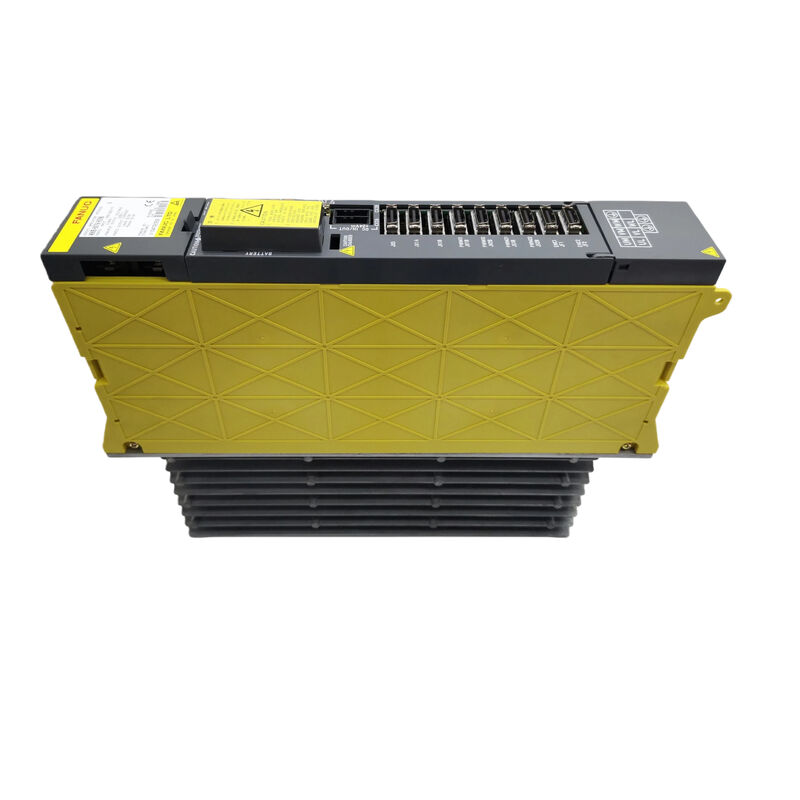
FANUC A06B-6079-H304 — Alpha SVM3-20/20/20: Three Axes Through a Shared Power Bus
The Architecture Comes First
Not all FANUC alpha servo amplifiers are the same kind of device. Some are self-contained units that connect directly to incoming AC power, rectify it internally, and drive their motors independently. Others are modules — purpose-built output stages that receive already-converted DC power from a shared supply and concentrate entirely on motor control. The A06B-6079-H304 belongs firmly in the second category, and understanding that distinction is the most important thing to know before ordering, installing, or troubleshooting this unit.
Designated SVM3-20/20/20 — Servo amplifier Module, three axes, 20-class on all three channels — the H304 receives its DC bus voltage from a Power Supply Module (PSM) that is installed separately in the same drive cabinet. The PSM handles the AC-to-DC conversion for the entire cabinet. The SVM3 handles nothing beyond current control for L, M, and N axes. It does not rectify. It does not have its own capacitor bank for the main bus. Disconnect the PSM, and every SVM module sharing that bus stops working immediately.
This architecture is not a limitation — it is a deliberate engineering trade-off that consolidates power conversion into a single efficient stage while allowing multiple SVM modules of different axis counts and current ratings to share a common energy pool. The trade-off is that an SVM3-20/20/20 is only half the installation. The other half is the PSM.
Sande Electric carries the A06B-6079-H304 in new and used conditions, shipping worldwide within 0–3 working days.
SVM vs SVU: The Distinction That Determines Your Entire Installation
Because FANUC used similar product labeling across its alpha servo amplifier families, a maintenance engineer sourcing a drive replacement can easily encounter both the 6079 SVM and the 6089 SVU in catalogs, sometimes listed side by side. They are not interchangeable, and the difference goes deeper than connector pinouts.
The table below captures the core split:
| Feature |
A06B-6079 (SVM Module) |
A06B-6089 (SVU Unit) |
| Architecture |
Module — requires external PSM |
Self-contained — built-in rectifier |
| DC Bus Source |
Shared PSM in cabinet |
Internal to the unit |
| AC Input |
Not applicable — DC input from bus |
Direct 200–230V AC connection |
| PSM Dependency |
Yes — cannot operate without PSM |
No — standalone AC-to-motor |
| Fault Isolation |
PSM failure = all modules offline |
Drive failure = one unit/axis group offline |
| Cabinet Design |
Centralized power supply bus |
Distributed, axis-local |
| Interface |
Type A (H304) |
Type A |
When a machine was designed around the 6079 SVM architecture, the entire cabinet — PSM, one or more SVM modules, cabling, and bus connections — reflects that choice. Replacing an H304 with an equivalent-current SVU would require adding a standalone AC power connection and eliminating the DC bus feed. That is a cabinet rewire, not a module swap.
The H304 Within the SVM3 Range: Why Three Equal Axes at 5.9A
The 6079 SVM3 family covers multiple three-axis current combinations. The H304 is the symmetric 20/20/20 variant — all three axes at 5.9A, all driving alpha motors in the α2/3000 through α4/4000 class. Its position among the other SVM3 variants reveals where it was intended to fit:
| Part Number |
Designation |
L |
M |
N |
| A06B-6079-H301 |
SVM3-12/12/12 |
3.0A |
3.0A |
3.0A |
| A06B-6079-H302 |
SVM3-12/12/20 |
3.0A |
3.0A |
5.9A |
| A06B-6079-H303 |
SVM3-12/20/20 |
3.0A |
5.9A |
5.9A |
| A06B-6079-H304 |
SVM3-20/20/20 |
5.9A |
5.9A |
5.9A |
| A06B-6079-H305 |
SVM3-12/12/40 |
3.0A |
3.0A |
12.5A |
| A06B-6079-H306 |
SVM3-12/20/40 |
3.0A |
5.9A |
12.5A |
| A06B-6079-H307 |
SVM3-20/20/40 |
5.9A |
5.9A |
12.5A |
The H304 is the top of the equal-current three-axis range before stepping into configurations with a higher-current N axis. Machining centers and turning centers where three axes carry similar-class motors under comparable duty — X, Y, and Z axes on a mid-range VMC, for example — are the natural home for this module. Where one axis genuinely needs more than 5.9A, the H305, H306, or H307 addresses that without changing the other axes.
Selecting the wrong variant from this list is a common source of errors when sourcing replacement modules. An H303 (12/20/20) on a machine that originally had an H304 (20/20/20) will under-drive the L-axis motor and trip L-axis overcurrent alarms under any meaningful cutting load. Always verify all three axis current requirements before ordering.
The 6079 vs 6096 Interface Trap: Same Module Name, Different Generations
The 6079 SVM family has a direct successor generation: the 6096 SVM with FSSB (Fanuc Serial Servo Bus). The two generations share identical model names — SVM3-20/20/20 — and nearly identical form factors. The difference is the servo interface between the CNC and the module.
The 6079 H304 uses a Type A parallel PWM interface, connecting to older FANUC CNC generations (Series 15, 16, 18, 21 non-i) via a parallel cable bundle from the CNC's servo interface board. The 6096 equivalent — also designated SVM3-20/20/20 but carrying order number A06B-6096-H304 — uses FSSB fiber optic interface, connecting via plastic optical fiber cable to i-series CNC controls.
The two are not cross-compatible. A 6096 module installed on a machine with a non-i CNC and Type A servo board will not communicate. A 6079 module installed on a machine configured for FSSB will similarly fail to initialize. If you are sourcing a replacement and know the machine runs a Series 16 or 18 (non-i) CNC, the 6079 H304 is the correct part. If the machine runs a 16i, 18i, or 0i-C/D, the 6096 H304 is required. The surest check is the part number on the installed module itself — the middle four digits of the A06B order number (6079 vs 6096) make the interface generation unambiguous.
Technical Specifications
| Parameter |
Value |
| Part Number |
A06B-6079-H304 |
| Also Known As |
A06B6079H304 |
| FANUC Designation |
SVM3-20/20/20 (Alpha Servo amplifier Module, 3-axis) |
| Series |
FANUC 6079 Alpha SVM |
| Unit Type |
SVM Module (requires external PSM power supply) |
| Axis Count |
3 (L, M, N axes) |
| Interface |
PWM — Type A |
| DC Bus Input |
283–325V DC (from shared PSM) |
| System Power |
3.7 kW |
| Rated Output Voltage |
230V AC |
| Rated Output Current |
L: 5.9A / M: 5.9A / N: 5.9A (all 20-class) |
| Wiring Board |
A16B-2202-0786 |
| Control PCB |
A20B-2001-0950 |
| Compatible Alpha Motors |
α2/3000, α3/3000, α4/4000 (all axes) |
| Compatible CNC |
FANUC Series 15, 16, 18, 21 (non-i) |
| PSM Required |
Yes (alpha PSM from A06B-6077 series) |
| FSSB Equivalent |
A06B-6096-H304 (not interchangeable) |
| Operating Temperature |
0°C to 55°C |
| Status |
Discontinued |
| Origin |
Japan |
| Certification |
CE |
| Condition Available |
New / Used (inspected) |
| MOQ |
1 piece |
| Daily Supply Capacity |
Up to 100 pcs |
| Dispatch |
0–3 working days from confirmed payment |
| Packaging |
Original packing |
PSM Sizing and the H304: What the Power Supply Module Must Handle
Installing or replacing an SVM3-20/20/20 raises a question that is easy to overlook: does the existing PSM have sufficient capacity to support the load? The H304 draws from the shared DC bus at up to 3.7kW under full simultaneous three-axis load. If additional SVM modules share the same PSM — which is the normal configuration in a multi-axis machining center — the PSM must be sized for the sum of all modules' peak power demand, not just the H304 alone.
FANUC's alpha PSM series (A06B-6077) comes in several power ratings. When adding a replacement H304 to a cabinet, confirm that the installed PSM's rated output capacity is not being exceeded by the sum of all SVM modules in the system. A PSM running above its thermal rating will show DC bus undervoltage alarms under heavy multi-axis cutting loads — an alarm pattern that looks like a module fault but originates in the power supply stage.
This calculation is most relevant when the H304 is being installed in place of a lower-current SVM3 variant (e.g., replacing an H301 three-axis 12/12/12 module with an H304 three-axis 20/20/20), where the total bus load increases. In a like-for-like H304 replacement, the existing PSM sizing remains valid.
Ordering, Payment & Shipping
Worldwide dispatch via DHL and FedEx within 0–3 working days of confirmed payment. Combined shipping is available for multi-unit orders.
Accepted payment methods:
- Bank Transfer (T/T) — all order values
- PayPal — orders up to USD $500
- Western Union — all order values
Import duties and taxes are the buyer's responsibility at destination.
Warranty & Return Policy
| Unit Condition |
Warranty Period |
| New / Unused |
12 months |
| Used / Inspected |
3 months |
Returns accepted for units arriving damaged, incomplete, not as described, or confirmed non-functional within 4 days of receipt. Warranty label must remain intact. Return shipping costs are borne by the buyer. Returns for ordering errors or change of mind are not accepted.
Frequently Asked Questions
Q1: My machine's SVM3-20/20/20 failed, and I'm seeing all three axes alarm simultaneously. Can the H304 module itself cause all three axes to fail at the same time, or should I be looking at the PSM first?
A: Both scenarios are possible, and the 7-segment LED on the module is the fastest diagnostic tool to distinguish them. If the LED shows a voltage-class alarm — specifically codes related to DC bus undervoltage or bus charge failure — the fault originates in the shared power supply path, meaning either the PSM itself, the DC bus fuse, or the bus wiring between the PSM and the SVM module. If the LED shows output-stage codes (overcurrent or IPM fault codes on individual axes), the module's output stages are more likely involved. A practical first check before condemning either component: verify the DC bus voltage at the SVM module's DC input terminals with a DMM while the system is powered up but before enabling axes. The bus should be within the 283–325V DC specification. If the bus voltage is low or absent while the PSM shows no fault of its own, check the bus wiring and fuse between them. If the bus voltage is correct and the module still fails to initialize, the module is the more likely fault source.
Q2: Is there a risk of accidentally ordering the 6096 H304 when I need the 6079 H304? They seem to show up together in search results.
A: Yes, this is one of the most common ordering mistakes in the alpha SVM family, precisely because both are designated SVM3-20/20/20 and look nearly identical physically. The definitive check is the six-digit order number in the middle of the FANUC part number: 6079 for Type A interface (your machine's variant if it runs Series 16 or 18 non-i), and 6096 for FSSB interface (required for 16i, 18i, and other i-series CNCs). If you are ordering based on a machine's CNC model, confirm whether the CNC designation ends in "-i" — a Series 16 is non-i, a Series 16i is the i-series. The servo interface board part number inside the CNC cabinet is another reliable indicator: boards in the A16B-2200-xxxx and A16B-2202-xxxx range typically indicate Type A (6079 compatible), while A16B-3200-xxxx boards are associated with FSSB (6096 compatible). When in doubt, share the full installed module's part number from the label with us before confirming your order.
Q3: The machine has three axes through this SVM3-20/20/20. After the module is replaced, does anything need to be re-initialized in the CNC parameters, or is it truly plug-and-play?
A: For a like-for-like replacement of the same module type (H304 for H304), the CNC servo parameters — motor codes, current limits, position gain, velocity loop gains — remain stored in the CNC itself and are not affected by the module swap. The SVM3-20/20/20 does not hold axis parameters internally. Once the replacement module is mechanically seated, the bus and interface cables are reconnected, and the system is powered up, the CNC will resume communicating with the new module using the existing parameter set. However, two things are worth confirming after power-up: first, that no axis shows a servo alarm related to parameter mismatch (which would indicate the motor code or current class parameter in the CNC does not match the motor actually connected), and second, that the CNC's reference return (home) function works correctly on all three axes after the first power cycle, since the absolute position data held in the CNC's battery-backed memory may need to be re-established if the machine was down for an extended period.
Q4: The machine uses this H304 on X, Y, and Z axes. The N-axis (Z) tends to run harder because it carries the spindle head weight. Should I consider a different SVM3 variant with a higher-current N axis, like the H307 (SVM3-20/20/40)?
A: Only if the Z-axis motor specification actually requires more than 5.9A. The decision should be driven by the motor nameplate and the CNC's servo axis parameters, not by operational perception alone. A Z axis carrying a heavy spindle head under gravity will see higher continuous torque demand than a horizontal axis — but whether this translates to current demand exceeding 5.9A depends entirely on the motor's rated current and how the machine's original OEM sized the drive for that axis. Check the Z-axis motor model plate and confirm its rated current against the 5.9A (20-class) output of the H304. If the motor is in the α4/4000 class or below and was originally paired with the H304, FANUC's motor-drive pairing table considers this a valid combination under the machine's normal duty cycle. If you are experiencing Z-axis thermal alarms or overcurrent trips under normal cutting loads with the correct motor parameters set, consult the servo parameter tuning before changing drive size — an over-aggressive acceleration ramp parameter on the Z axis can exceed the module's current rating even when the drive is correctly sized for the motor.
Q5: I need to source multiple H304 units as spares for a production line with several identical machines. What is the best way to ensure the units I receive are genuine FANUC?
A: Non-original or misrepresented FANUC drives do circulate in the surplus market, particularly for high-demand legacy parts. When sourcing multiple units, several physical checks on arrival reduce the risk significantly.
First, the FANUC label on the module should show clear, consistent printing with the full part number, a serial number, and country of origin (Japan).
The label should not show signs of reapplication — check the edges for lifting or misalignment with the module housing.
Second, the connector housings and board quality visible through any ventilation openings should be consistent with FANUC manufacturing standards — mismatched board silkscreen fonts or poorly seated components are warning signs.
Third, verify the unit against known-good PCB board numbers: the wiring board in a genuine H304 should be an A16B-2202-0786 and the control PCB an A20B-2001-0950. If a supplier cannot or will not confirm these board designations, treat that as a caution. Contact us before placing a multi-unit order to discuss inspection history and confirm part authenticity for your volume requirement.
Contact for availability and pricing: Ms. Amy — sales01@sande-elec.com | Tel: +86 18620505228


 Your message must be between 20-3,000 characters!