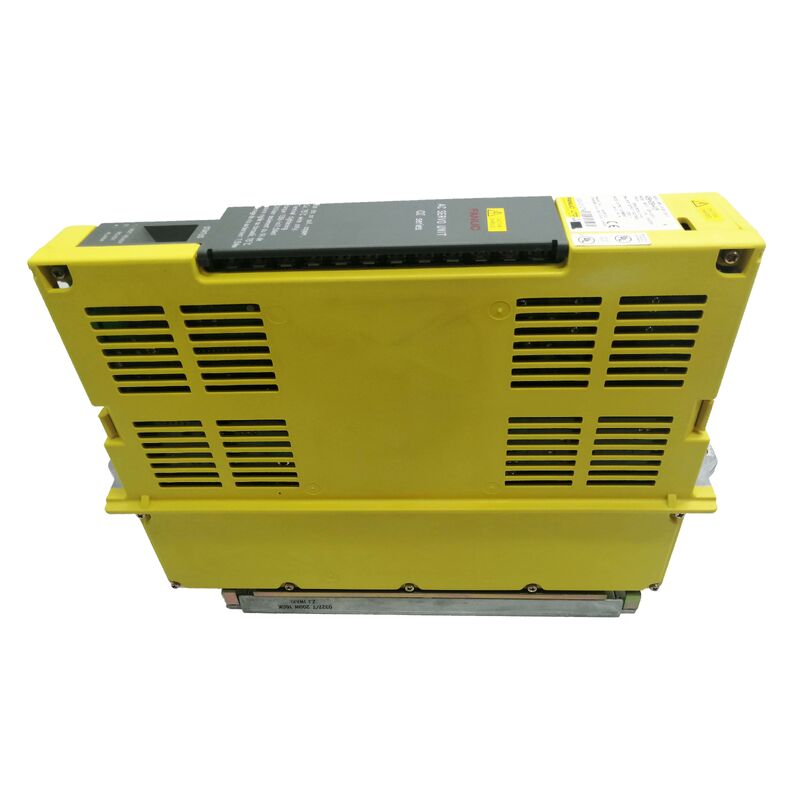
Fanuc A06B-6088-H230 | Alpha Spindle Amplifier Module — SPM-30, 283–325V / 35kW, 133A Output, Type 1 Interface, Model 30/P40 Spindle Motors
Overview
The Fanuc A06B-6088-H230 is the SPM-30 spindle amplifier module in Fanuc's A06B-6088 alpha spindle amplifier series — a high-power spindle drive rated at 133A output from a 35kW DC bus input.
At this power level, the SPM-30 sits at the upper end of the standard alpha spindle module range, designed for the Fanuc Model 30 and P40 spindle motors used on large-frame machining centres, heavy-duty turning centres, and high-speed milling machines where spindle power at full metal removal rate exceeds what the mid-range SPM-11 through SPM-22 modules can sustain.
The A06B-6088 series represents Fanuc's second-generation alpha spindle amplifiers, incorporating the HRV (High Response Vector) spindle control improvements that refined the original A06B-6078 series architecture.
While the Type 1 interface is retained — enabling the same advanced spindle functions (Cs contouring, rigid tapping, spindle synchronisation, orientation) as the first-generation modules — the A06B-6088's improved control card brings better speed regulation accuracy, lower torque ripple at cutting speeds, and enhanced dynamic response during spindle load transients compared to its predecessors.
At 133A, the SPM-30 requires substantial cooling infrastructure.
The 150mm module width accommodates two cooling systems — an internal fan for the control electronics and an external heatsink fan for the high-current output transistors — alongside the power PCB, firing board, and control card assembly.
The twin 7-segment LED display provides real-time module status and alarm code visibility without requiring a diagnostic tool.
Key Specifications
| Parameter |
Value |
| Module Model |
SPM-30 |
| Interface |
Type 1 |
| Rated Input |
283–325V DC bus, 35kW |
| Max Output Voltage |
230V AC |
| Rated Output Current |
133A |
| Compatible Motors |
Fanuc Model 30, P40 spindle motors |
| Power PCB |
A20B-1006-0489 / A20B-1006-048x |
| Firing Board |
A20B-2902-0390 |
| Control Card |
A16B-2202-043x / A16B-2203-033x |
| Module Width |
150mm |
| Cooling |
Dual fans + external heatsink |
| Software |
9D00 or 9D0A (specify) |
35kW — Power Class and Machine Application
The SPM-30's 35kW rated input positions it at the high end of the standard alpha module family. At this power level, the spindle motor draws 133A sustained current at full machining load — a current level that demands careful bus wiring, properly torqued output terminal connections, and clean DC bus power from a correctly sized PSM.
A machine installation using the SPM-30 alongside a full three-axis SVM stack can easily exceed 45kW total DC bus demand at simultaneous peak load; the alpha PSM selection for this system must come from a properly calculated peak demand sum.
The Fanuc Model 30 spindle motor that the A06B-6088-H230 drives is a high-torque, high-power spindle motor intended for heavy-duty machining operations — large-diameter milling cuts in steel, heavy turning operations on large forgings, and high-material-removal-rate roughing where spindle torque and power are the limiting factors.
The P40 motor is a high-speed variant suitable for applications where spindle speed range and power-at-speed characteristics take priority over maximum torque at low speeds.
Software Versions and Variant Selection
The #H500 and #H501 suffix variants of the A06B-6088-H230 carry different software versions — 9D00 and 9D0A respectively — that are incompatible with each other due to differences in spindle function availability and parameter structure.
When ordering a replacement SPM-30, the original module's suffix must be identified and matched. Fitting an incompatible software version produces alarm conditions or incorrect spindle behaviour that is not resolved by parameter adjustment alone.
The software version is marked on the module's label and on the internal control card.
This suffix incompatibility is a more critical ordering detail for the H230 than for many other Fanuc modules — it is not a minor revision difference but a functionally significant distinction.
Always specify the full part number including suffix when sourcing a replacement.
FAQ
Q1: What alarm codes specifically indicate an SPM-30 module fault versus a spindle motor fault?
Alarm 3 (Fuse on DC link blown) points to the SPM-30's internal output stage. Alarm 9 (Overheat main circuit) indicates the module's semiconductor devices have exceeded thermal limits.
Alarm 12 (Overcurrent in power circuit) is the most common sudden alarm and is most often caused by spindle motor insulation breakdown — test motor winding-to-earth insulation (acceptable: several hundred megaohms or higher) before condemning the amplifier.
Alarm 1 (Motor overheat) and Alarm 27 (Pulse coder disconnected) indicate motor or feedback system issues rather than the SPM-30 itself.
Q2: The SPM-30 uses two cooling fans — what happens if one fails?
The internal fan cools the control electronics; its failure is indicated by Alarm 56 (Inner cooling fan stopped). The external heatsink fan cools the output transistors; its failure leads to Alarm 9 (Overheat main circuit) as the transistor junction temperatures rise under load.
Either fan failure requires immediate attention — at 133A output, the thermal energy dissipated is substantial and component damage from sustained overtemperature is rapid.
Both fans should be checked during routine maintenance for correct rotation and audible abnormalities suggesting bearing wear.
Q3: The software versions 9D00 and 9D0A are described as incompatible — what specifically differs between them?
The software version controls the spindle's available functions, parameter sets, and communication protocol details with the CNC. Functions available in one version may not be present or may behave differently in the other.
Additionally, the CNC's spindle parameters are set for a specific software version — loading the wrong version into the machine's SPM installation produces parameter mismatches that generate alarms or cause the spindle to operate incorrectly even if the alarm is cleared.
There is no field modification to convert between versions; the correct suffix must be sourced.
Q4: What PSM is needed to power a system that includes the A06B-6088-H230?
The SPM-30 draws 35kW at full load. Add the DC bus demands of all SVM axis modules in the stack — typically 4–15kW total for a three-to-four-axis machine. The combined peak demand determines the minimum PSM rating.
A machine with an SPM-30 and three SVM modules totalling 10kW requires a PSM rated for at least 45kW peak — this falls into the PSM-37 or PSM-45 class (A06B-6087 series or equivalent).
Underrating the PSM produces DC link voltage drop alarms (AL-04) during spindle acceleration combined with axis motion.
Q5: The H230 module has a 150mm width — how is this handled in the amplifier cabinet?
The 150mm width requires 150mm of unobstructed rail space in the alpha amplifier mounting rack.
At this width, the module is typically positioned at one end of the amplifier rail to minimise interference with adjacent SVM modules.
Cable routing for the 133A motor output connections requires larger cross-section conductors than the lighter SVM motor cables, and the terminal block connection points must be torqued to specification — loose connections at 133A generate significant resistance heating that accelerates terminal degradation.


 Your message must be between 20-3,000 characters!