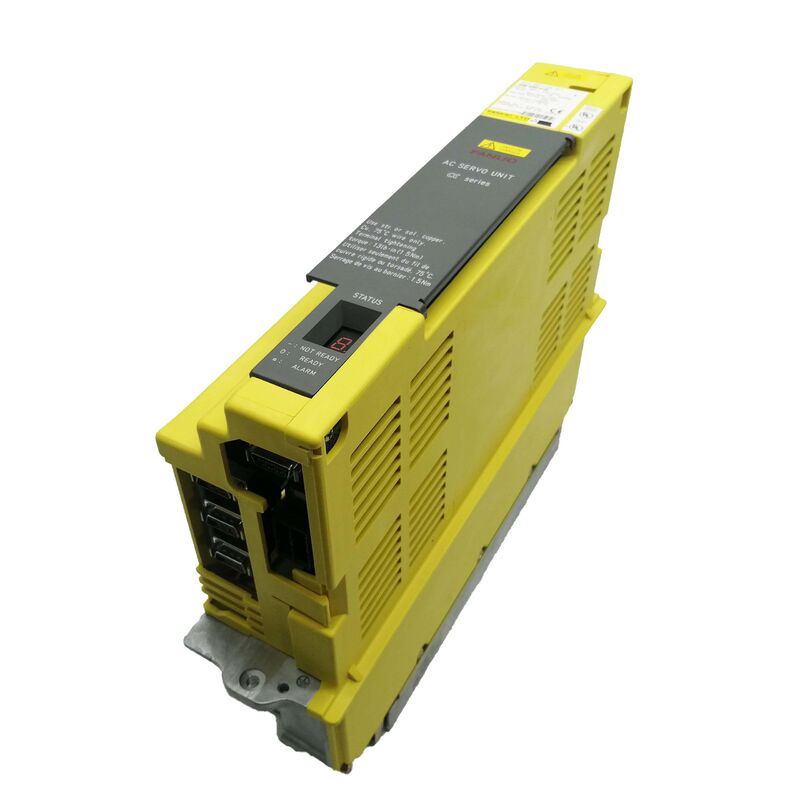
Fanuc A06B-6089-H104 | Alpha Servo Amplifier Unit — SVU1-40, Single-Axis, 200–230VAC / 13.4A Input, 12.5A / 230V Output, PWM Type B, Standalone Power Supply
Overview
The Fanuc A06B-6089-H104 is the SVU1-40 — the single-axis alpha servo amplifier unit rated at 12.5A continuous output from a 200–230VAC, 13.4A three-phase input. It occupies the middle tier of Fanuc's A06B-6089 SVU1 series, positioned above the SVU1-80's predecessor 18.7A unit and below the top SVU1-130 (52.2A), making it correctly sized for the α6/3000 and α12/2000 alpha servo motors that powered mid-size machining centres and turning centres during the active production years of the alpha series.
As with all SVU units, the H104's defining architectural feature is self-containment: three-phase AC mains in, PWM Type B interface cable to the CNC, and motor power out.
There is no DC bus connector and no dependency on an external PSM.
The SVU carries its own internal AC-to-DC rectifier that generates its internal bus voltage independently, which means it can be installed wherever three-phase AC power is available — adjacent to the motor, in a satellite cabinet, or anywhere else on the machine that suits the layout — without requiring a cable run back to the main drive rail.
The 12.5A continuous rating, supported by a 40A peak current capacity, reflects the motor class this unit serves.
An α6/3000 motor driving a mid-size machining centre axis draws sustained current in the 5–12.5A range during cutting passes, with acceleration peaks that the 40A IPM headroom absorbs cleanly.
The 4.4kW maximum output power sets the energy envelope within which the connected motor operates.
This combination of continuous and peak ratings matches the α6/α12 motor class well, producing controlled torque response without overcurrent alarm trips during typical machining duty cycles.
Key Specifications
| Parameter |
Value |
| Unit Model |
SVU1-40 |
| Axes |
Single (L channel) |
| Input Voltage |
200–230V AC, 3-phase |
| Input Current |
13.4A at 200V |
| Input Frequency |
50/60 Hz |
| Max Output Voltage |
230V AC |
| Rated Output Current |
12.5A |
| Peak Current |
40A |
| Max Output Power |
4.4kW |
| Interface |
PWM Type B |
| Compatible Motors |
α6/3000, α12/2000 class |
| Wiring Board |
A20B-2002-0040 |
| Control Board |
A20B-2002-0031 |
| Manual |
B-65192 |
| Power Supply |
Built-in standalone |
SVU1-40 in the Alpha Drive Ecosystem
The SVU1-40 sits at an interesting position within the alpha SVU lineup: it offers 12.5A per axis — the same continuous current as the SVM2-40/40 module (A06B-6079-H206) on each of its two channels — but as a standalone unit without the PSM dependency.
This makes the SVU1-40 suitable for machines where a single axis needs the 12.5A current class in a remote location, or where the machine design calls for a simpler single-axis installation rather than a full PSM/SVM stack.
The companion SVM module (A06B-6079-H103 or A06B-6096-H103 on the FSSB side) provides the same 9.4A SVM1-40S rating for this current class — the SVU1-40 at 12.5A is the standalone equivalent stepping into the next current bracket.
Machine builders working with the alpha ecosystem who need the 12.5A class in a standalone format select the SVU1-40; those building a central drive rail with multiple axes at this current class use SVM modules and a shared PSM.
PWM Type B Interface and Compatible Controls
The PWM Type B interface of the SVU1-40 places it squarely in the generation of Fanuc CNC controls that use Type B for servo communication: Series 0-D, 0-MF, 16B, 18B, and 21B. The Type B protocol governs position command transmission and feedback between the CNC's axis interface card and the SVU1-40.
Each SVU unit connects directly to the CNC via its own dedicated PWM cable — unlike the FSSB ring topology of later i-series drives, each PWM SVU is a point-to-point connection.
The B-65192 manual covers the commissioning and maintenance procedure for this unit, including the servo parameter initialisation steps and the switch configurations for Type B operation.
Setting the interface switch on the SVU-40 to Type B (vs Type A) is the first configuration step after physical installation.
FAQ
Q1: The A06B-6089-H104 has a 40A peak current — does this mean it continuously supplies 40A?
No. The 12.5A is the rated continuous output — the current the unit can sustain indefinitely within its thermal limits.
The 40A peak is the short-duration current limit that the IPM module allows during motor acceleration transients.
This peak current flows for fractions of a second during rapid axis starts; sustained operation at 40A would exceed the unit's thermal capacity.
The IPM's own internal overcurrent protection prevents sustained peak-level current from damaging the output transistors.
Q2: Which alpha servo motors specifically pair with the SVU1-40?
The 12.5A continuous output matches α6/3000 class motors (used on lighter mid-size axes) and α12/2000 class motors (used on heavier mid-size axes where the 12N·m continuous torque at 2000rpm suits the machine load).
Both motor classes draw rated current within the 12.5A envelope during full continuous cutting.
Motors smaller than the α6 class — α1, α2, α3 — work with the SVU1-40 at a fraction of its current capacity; motors larger than the α12 class exceed the 12.5A continuous rating and require the SVU1-80 or SVU1-130.
Q3: How does the SVU1-40 differ from the SVM1-40S (A06B-6096-H103) beyond the interface?
The SVU1-40 (H104) is a standalone unit with built-in AC-to-DC power supply and 12.5A rated output; the SVM1-40S (H103) is an FSSB-interface rail module with 9.4A rated output that draws power from a shared alpha PSM. The SVU1-40 is architecturally independent; the SVM1-40S is architecturally integrated.
The SVU1-40 is also in a higher current class (12.5A vs 9.4A). Both drive mid-range alpha motors, but the SVU1-40 covers the larger motors in that class. Replace the SVU1-40 with another SVU1-40; substitution with an SVM requires an entire system architecture change.
Q4: What alarm codes indicate faults in the SVU1-40?
The 7-segment LED on the unit's front panel displays alarm codes. Alarm 8 (overcurrent/IPM alarm) is the most common, typically caused by motor winding insulation breakdown — disconnect motor cables and test insulation resistance before condemning the unit. Alarm 5 indicates low DC link voltage; check the three-phase AC input supply and internal fuses.
Alarm 1 indicates internal fan fault or low 5V supply.
All alarm codes for the SVU1-40 are documented in the B-65192 manual. Address any fan failure immediately — at 12.5A continuous output, the unit generates substantial heat that the fan must dissipate.
Q5: Is the regenerative discharge capacity of the SVU1-40 important to know for installation?
Yes. The 100W regenerative discharge capacity (without external resistor) is relevant for axes that decelerate rapidly from high speed — more deceleration energy than 100W regenerated back to the internal bus requires an external regenerative discharge resistor to prevent DC bus overvoltage.
Axes with high inertia or frequent high-speed reversals may exceed this limit during normal production cycles.
If the machine generates DC link overvoltage alarms during deceleration, the regenerative discharge capacity is being exceeded and a correctly sized discharge resistor should be added to the installation.


 Your message must be between 20-3,000 characters!