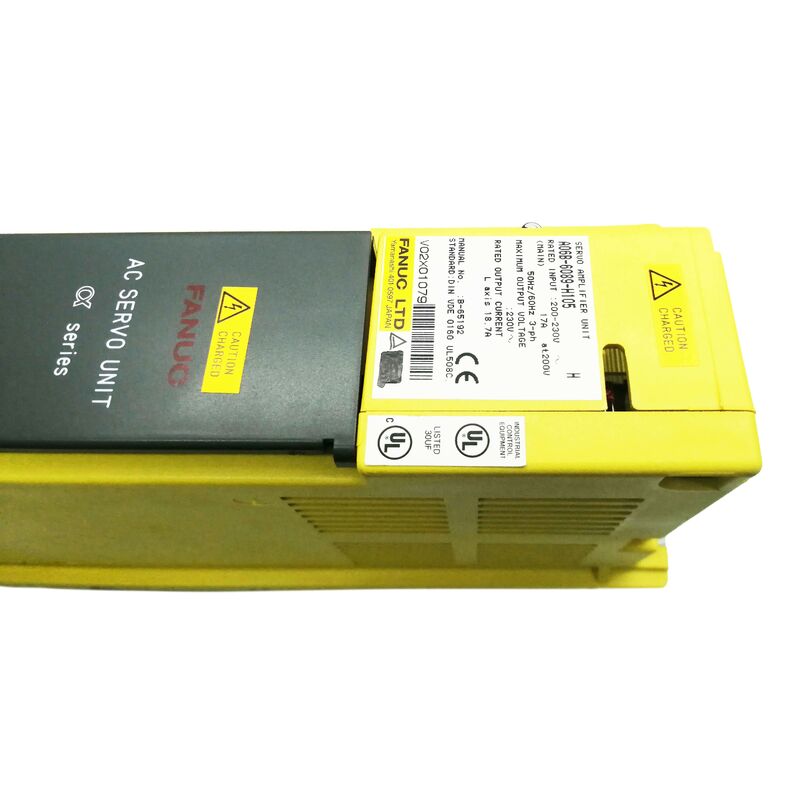
Fanuc A06B-6089-H105 | Alpha Servo Amplifier Unit — SVU1-80, Single-Axis, 200–230VAC / 17A Input, 18.7A / 230V Output, PWM Type B, Built-In Power Supply
Overview
The Fanuc A06B-6089-H105 is the SVU1-80 — the high-powered variant of the single-axis standalone SVU series from Fanuc's A06B-6089 alpha amplifier family, delivering 18.7A continuous output on its single L-axis channel from a 200–230VAC, 17A three-phase input.
Like all SVU units, the H105 integrates its own power supply: three-phase AC input is rectified and converted to an internal DC bus within the unit, making it entirely self-contained and eliminating the dependency on an external alpha PSM that the SVM module architecture requires.
At 18.7A rated continuous output, the SVU1-80 matches the single-axis SVM1-80 module (A06B-6079-H105) in output current capacity — the difference is entirely architectural. The SVM1-80 draws from a shared DC bus created by a central PSM; the SVU1-80 creates its own internal bus from an independent AC feed.
This difference makes the H105 the appropriate choice when an axis must be located remotely from the central drive cabinet, or when the machine design calls for a single independent axis drive without the overhead of a full PSM/SVM stack.
A single IPM (Intelligent Power Module) forms the output stage of the SVU1-80.
At 18.7A, this IPM delivers the sinusoidal PWM motor current that the alpha series' velocity and current control algorithms produce — the same current regulation quality as the SVM module series, just from a self-contained package rather than a rail-mounted module.
The wiring board (A20B-2002-0041) and control board (A20B-2002-0031) are the internal PCBs that handle interface, control, and protection functions.
Key Specifications
| Parameter |
Value |
| Unit Model |
SVU1-80 |
| Axes |
Single (L channel) |
| Input Voltage |
200–230V AC, 3-phase |
| Input Current |
17A at 200V AC |
| Input Frequency |
50/60 Hz |
| Max Output Voltage |
230V AC |
| Rated Output Current |
18.7A |
| Interface |
PWM Type B |
| Compatible Motor |
α12 class |
| Wiring Board |
A20B-2002-0041 |
| Control Board |
A20B-2002-0031 |
| Internal IPM |
One IPM module |
| Power Supply |
Built-in standalone |
Standalone SVU vs SVM Module — When Each Applies
The choice between an SVU and a SVM+PSM solution for a given axis comes down to installation geography and system architecture.
In a machine where all axes are grouped close to a central control cabinet, the SVM/PSM approach is typically more economical — one PSM serves multiple SVM modules, reducing the total number of power conversion stages in the system.
When an axis is remote — mechanically separated from the main drive cluster by the machine structure — running high-current DC bus cables to a central PSM is impractical, and each SVU unit with its own AC feed and local installation becomes the engineering preference.
The SVU1-80 was designed for exactly this scenario: a single axis that draws 18.7A continuous current but sits at a machine location where routing a DC bus cable would be impractical.
The AC input (17A at 200V, three-phase) can be brought to the SVU from the machine's main distribution board using standard three-phase wiring rather than the heavier, more expensive DC bus bar that a PSM-to-SVM installation requires.
α12 Motor Compatibility
The α12/2000 motor — Fanuc's alpha series motor with 12N·m continuous torque at 2000rpm rated speed — is the standard companion for the SVU1-80.
At 18.7A rated output, the SVU1-80 matches the α12's rated current draw at continuous full-load operation, with the IPM module's peak current capability handling the acceleration transients that briefly exceed the 18.7A continuous rating during axis rapid traverse initiation.
The α12 motor appears on heavier machine tool axes than the smaller α6 or α3 motors: column drives on mid-size machining centres, pallet shuttle drives on horizontal machining centres, and higher-torque C-axis or rotary table drives where the axis load and inertia exceeds the capability of the lighter alpha motor range.
FAQ
Q1: The SVU1-80 and the SVU1-130 are both in the A06B-6089 series — when is each appropriate?
The SVU1-80 (H105, 18.7A) matches α12-class motors; the SVU1-130 (H106, 52.2A) matches α40-class motors.
The choice is made by the motor's rated current demand: if the motor's rated continuous current falls within 18.7A, the SVU1-80 is correctly sized.
If the motor requires up to 52.2A sustained current, the SVU1-130 is required.
Using the SVU1-80 on an α40 motor would cause immediate overcurrent alarms under load because the motor draws more than the H105 can sustain. The motor nameplate current or Fanuc's motor specification table is the definitive source for this comparison.
Q2: Does the PWM Type B interface limit which CNC controls can use the A06B-6089-H105?
Yes. Type B interface is used with FANUC Series 0 Model D (fitted with a Type B axes card), Series 16B, 18B, and 21B controls.
Type A controls (Series 0-C, 16A, 18A, 21A) are not compatible with the A06B-6089 SVU series directly.
If a machine uses a Type A control but requires the SVU architecture, the SVUC (servo amplifier unit with C-series interface) variants or different drive family would need to be considered. Always confirm the existing control's interface type before ordering a replacement SVU unit.
Q3: How is the SVU1-80 wired into a machine's electrical cabinet?
The SVU1-80 requires three connections: (1) three-phase AC mains input to its power terminals, (2) the CNC's PWM serial interface cable to the axis control connector, and (3) the motor's three-phase output (U/V/W) and encoder feedback cable.
The unit has no DC bus connector. It can be mounted inside a cabinet alongside other equipment or at a remote location near the motor, provided adequate ventilation clearance exists around the unit's cooling surfaces.
The PWM interface cable from the CNC has a maximum length determined by the Fanuc connection manual for the specific control series.
Q4: What routine maintenance does the SVU1-80 require during service intervals?
The primary maintenance items are: verifying the internal cooling fan is operating (a blocked or failed fan leads to thermal overload alarms and potentially permanent IPM damage); replacing the absolute encoder backup battery on the schedule appropriate for the machine's production use (typically every two to three years); and inspecting the motor power cable insulation resistance periodically.
Fan replacement and battery replacement are field-serviceable tasks. IPM and PCB-level faults require specialist repair with appropriate test equipment.
Q5: What alarm diagnostics are available on the SVU1-80?
The SVU unit displays alarm codes on its 7-segment LED display panel, visible on the front of the unit.
Alarm 1 indicates cooling fan failure or low 5V control voltage. Alarm 5 indicates low DC link voltage — check the AC input supply voltage and input fuses. Alarm 8 (or 8.) indicates L-axis overcurrent or IPM module alarm.
For Alarm 8, the standard diagnostic sequence is to disconnect the motor's U/V/W cables from the SVU output terminals and test motor insulation resistance to protective earth (hundreds of megaohms is acceptable).
If the alarm clears with cables disconnected, the fault source is the motor or cable, not the SVU. If it persists, the IPM or output stage in the SVU unit requires investigation.



 Your message must be between 20-3,000 characters!