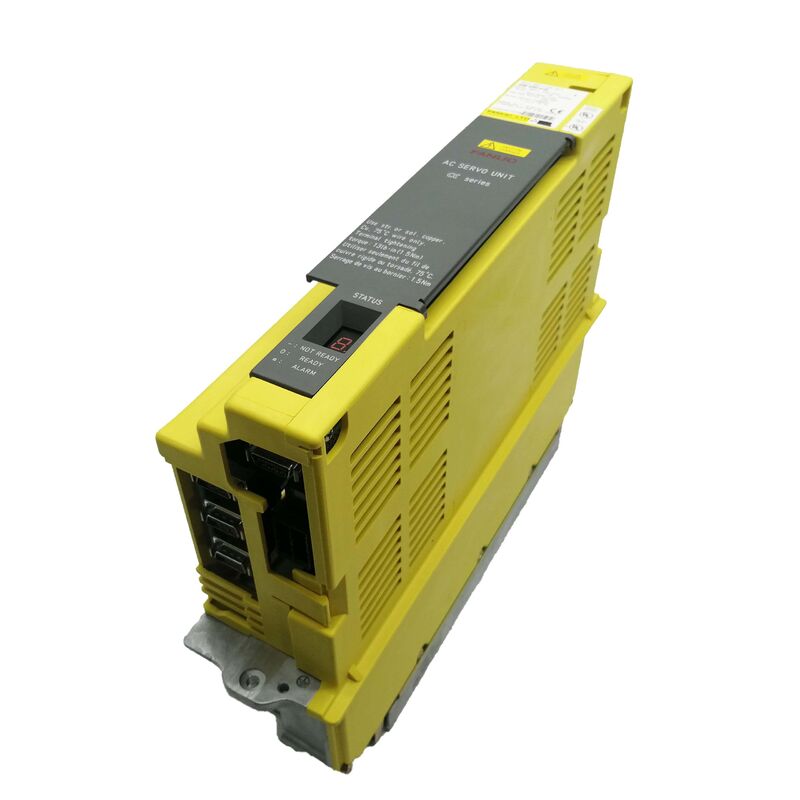
Fanuc A06B-6089-H106 | Alpha Servo Amplifier Unit — SVU1-130, Single-Axis, 200–230VAC / 27A Input, 52.2A / 230V Output, PWM Type B, Standalone Power Supply
Overview
The Fanuc A06B-6089-H106 is the SVU1-130 — the largest single-axis unit in Fanuc's A06B-6089 alpha servo amplifier unit (SVU) series, rated at 52.2A continuous output from a 200–230VAC, 27A input.
The SVU series is architecturally distinct from the SVM module series: where the SVM modules depend on an external PSM (Power Supply Module) to provide the shared DC bus, the SVU units contain their own integrated power supply, rectifying their own AC mains input directly and generating the internal DC bus from which the output stage operates.
This standalone design gives the SVU complete location freedom within the machine — wherever three-phase AC power is available, an SVU can be mounted, connected to the CNC by the PWM interface cable alone.
The SVU1-130's 52.2A output capacity places it solidly in the heavy-axis class for a standalone alpha servo unit. Its standard motor pairing is the α40/3000 — a large-frame alpha servo motor producing sustained high torque at rated speed, used on heavy CNC machine tool axes where ballscrew diameter, carriage mass, and cutting forces demand sustained current above what lighter servo motors can provide.
The three IGBT transistors inside the H106 (compared to the single IPM modules in smaller SVU units) reflect the design headroom required for this current level.
As the top of the SVU1 single-axis series, the H106 is by definition the highest-current standalone alpha unit available.
This characteristic makes it a logical choice for machine tools where a specific axis demands high continuous current but the machine builder wants to avoid the additional infrastructure of a full SVM/PSM stack for that single heavy axis — positioning the SVU directly at the motor location with a short power cable rather than routing high-current motor wiring across the full machine length.
Key Specifications
| Parameter |
Value |
| Unit Model |
SVU1-130 |
| Axes |
Single (L channel) |
| Input Voltage |
200–230V AC, 3-phase |
| Input Current |
27A at 200V AC |
| Input Frequency |
50/60 Hz |
| Max Output Voltage |
230V AC |
| Rated Output Current |
52.2A |
| Interface |
PWM Type B |
| Compatible Motor |
α40/3000 class |
| Wiring Board |
A20B-2002-0050 |
| Control Board |
A20B-2002-003x |
| Internal Transistors |
Three IGBTs |
| Power Supply |
Built-in (standalone) |
SVU Architecture — Built-In Power, Remote Installation Flexibility
The defining feature of any SVU unit — and the reason this product family exists alongside the SVM/PSM module system — is the integrated AC-to-DC converter.
The SVU's internal power section receives three-phase AC input, rectifies it to an internal DC bus voltage, and feeds this to the IGBT output stage that drives the servo motor. This integration eliminates the dependency on a central PSM for the axis the SVU covers.
In practical machine tool design, this translates to installation options that the SVM system cannot provide. A large rotary table mounted at the far end of a machine bed, an independently mounted Z-axis ballscrew assembly, or a gantry crossbeam slide — each of these can have its own SVU unit mounted locally, connected to the machine's electrical cabinet only by the PWM interface cable and an AC power feed.
The motor power cable is short — just from the SVU to the adjacent motor — rather than running the full machine length from a central cabinet.
The SVU1-130's three IGBT transistors (vs the single IPM in the smaller SVU1-80) provide the current capacity and peak current headroom that the α40 motor's acceleration characteristics require.
These transistors and the internal fuses are the primary serviceable components within the unit; the wiring board and control board are not sold separately but are addressed during specialist repair.
PWM Type B Interface
The A06B-6089-H106 uses the PWM Type B communication protocol — the same alpha series serial PWM interface used by the A06B-6080 SVM Type B modules.
The machine's CNC control series determines whether Type B is correct: Series 0-D, 16B, 18B, and 21B controls use Type B, while Series 0-C, 16A, 18A, and 21A use Type A.
The SVU1-130 communicates with the CNC through a dedicated PWM cable from the CNC's servo axis interface card. This is a point-to-point connection — one cable per axis — rather than the shared serial bus used by later FSSB-based amplifier systems.
Testing of the SVU1-130 should be performed on a Series 0 Model D control with a Type B axes card, which is the primary control generation this unit was designed for.
Tested units that have been verified on this control generation with an appropriate α40-class motor will have validated not only the output stage transistors but also the control board's PWM decode and current regulation functions.
FAQ
Q1: The A06B-6089-H106 has a built-in power supply — does it still need a connection to the alpha PSM?
No. The SVU unit's built-in power supply operates entirely from its own three-phase AC input connection. It has no DC bus connector and requires no external PSM. The CNC connects to the SVU via the PWM interface cable only.
Power to the unit is three-phase AC from the machine's power distribution, separate from the drive cabinet's alpha module rail.
This is the fundamental design distinction between the SVU (self-contained) and the SVM (requires PSM DC bus).
Q2: What is the α40/3000 motor, and why does the SVU1-130 specifically match it?
The α40/3000 is a large-frame alpha series AC servo motor rated at 40N·m continuous torque at 3000rpm — one of the largest alpha series motors in the standard product range.
It draws sustained high current at full machining load, requiring the 52.2A continuous output rating of the SVU1-130 to sustain torque without drive overcurrent alarms during cutting operations.
Using a smaller SVU unit on an α40 motor would produce overcurrent alarms under full-load conditions. The match between motor rated current and amplifier output rating is the essential compatibility parameter.
Q3: How does the SVU1-130 compare to the SVU1-80 (A06B-6089-H105) from the same series?
Both are single-axis standalone alpha servo units with built-in power supplies and PWM Type B interface. The SVU1-80 provides 18.7A output (matched to α12-class motors) from a 17A input, with a single IPM transistor.
The SVU1-130 provides 52.2A output (matched to α40-class motors) from a 27A input, with three IGBT transistors.
The SVU1-130 is approximately three times the current output of the SVU1-80, sized for proportionally heavier machine axes. Both have similar physical packaging — the standalone SVU format — but the H106 is physically larger to accommodate its three-transistor output stage.
Q4: What alarm codes indicate a fault in the A06B-6089-H106?
The SVU unit's 7-segment LED displays alarm codes that are specific to the SVU series. Common codes include: Alarm 1 (internal fan fault or low 5V), Alarm 3 (DC bus fuse blown or overcurrent), Alarm 5 (DC link low voltage — check AC input), Alarm 8 (L-axis overcurrent — check motor insulation to hundreds of megaohms), and Alarm 9 (L-axis IPM alarm). The standard first step for Alarm 8 or 9 is to disconnect the motor power cables and test motor insulation resistance.
If the alarm clears with cables disconnected, the fault is in the motor or cable, not the SVU unit.
Q5: Can the A06B-6089-H106 be repaired, or is exchange the only option?
Repair is available from specialists. The three IGBT transistors are the most commonly replaced components — they fail when motor insulation breakdown causes through-fault current to the output stage. Internal fuses and the cooling fan are routine service parts.
The wiring board (A20B-2002-0050) and control board (A20B-2002-003x) are not sold by Fanuc separately, but specialist repair facilities carry them as service inventory and address board-level faults during reconditioning.
Exchange — supplying the failed unit and receiving a tested, warranted refurbished SVU1-130 — is the fastest route back to production for a machine-down situation.


 Your message must be between 20-3,000 characters!