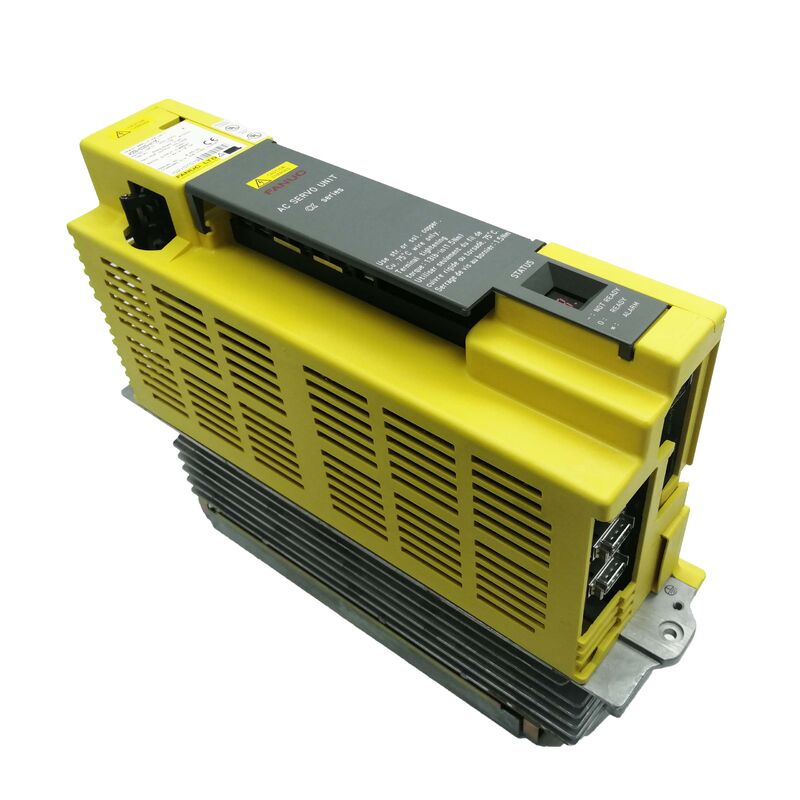
FANUC A06B-6089-H201 Alpha Servo Amplifier SVU2-12/12
Overview
The A06B-6089-H201 is a 2-axis FANUC Alpha servo amplifier officially designated SVU2-12/12 in the Alpha-series descriptions manual.
The manual lists it as a balanced dual-axis model with Group A / Group A motor pairing, and the corresponding specification table assigns 3.0 Arms rated current and 12 Apeak current limit to both the L-axis and M-axis.
That balanced structure is the real identity of the H201. It is not simply “a two-axis alpha drive.” It is a very specific dual-axis amplifier where both channels sit in the same low-current class.
For technical buyers, that matters because it tells you exactly what kind of machine architecture this model belongs to: one amplifier body serving two matched servo channels rather than two unequal axes or a larger mixed-capacity arrangement.
Technical Data
| Parameter |
Value |
| Part Number |
A06B-6089-H201 |
| Manufacturer |
FANUC |
| Product Type |
Servo Amplifier |
| Series |
Alpha |
| Model Class |
SVU2-12/12 |
| Axis Configuration |
2-Axis |
| L-Axis Rated Current |
3.0 Arms |
| L-Axis Current Limit |
12 Apeak |
| M-Axis Rated Current |
3.0 Arms |
| M-Axis Current Limit |
12 Apeak |
| Applied Motor Group |
Group A / Group A |
Application and Typical Use
In practical machine applications, the H201 is a good fit for dual-feed axis arrangements where both channels require comparable current capacity. That typically points to CNC axis systems in which two lighter-duty axes are grouped into one amplifier body rather than separated into individual single-axis units.
This application description is an inference from the model’s official 12/12 designation and balanced current table.
That makes the A06B-6089-H201 especially valuable in legacy FANUC Alpha systems where the original machine builder designed the cabinet, motor pairing, and drive topology around this exact two-axis class.
In those cases, an exact H201 replacement helps preserve the original axis structure, reduces wiring changes, and keeps the machine closer to its intended control logic. For maintenance teams, that often translates into shorter recommissioning time and fewer avoidable mismatches after installation.
This is an engineering inference based on the official dual-axis model class and current structure.
Why This Model Matters in Service Work
One reason the H201 remains useful is that it solves a very specific replacement problem. If the installed machine was built around a balanced 12/12 dual-axis amplifier, replacing it with a different dual-axis class can alter the electrical fit of the two servo channels even if the amplifier looks similar.
For older Alpha systems, that precision matters. The value of the H201 is not that it is broadly universal, but that it keeps the original two-axis current balance intact.
This is an inference from the model’s official designation and spec table.
Another practical benefit is simplicity. Compared with a larger mixed-capacity amplifier, a balanced 12/12 module can be easier to validate in systems where both axes belong to the same motor class.
That does not remove the need to verify the installed part number, but it does make the product easier to position for buyers who want a clean, exact, model-for-model replacement. This is an engineering inference based on the manual’s Group A / Group A classification.
FAQ
Q1: What is the exact FANUC designation for A06B-6089-H201?
The Alpha descriptions manual identifies it as SVU2-12/12. That means it is a dual-axis Alpha servo amplifier with two matched 12-class channels.
This official designation is far more useful than a generic sales phrase because it tells a technician how the amplifier is organized electrically.
Q2: What does the 12/12 structure mean in real machine use?
It means both servo channels are rated in the same class: 3.0 Arms rated current and 12 Apeak current limit on both axes. In practice, that makes the unit appropriate for machines where two lighter-duty axes share one amplifier body and require essentially the same output class.
That is the key reason the H201 is different from mixed models such as 12/20 or 12/40.
Q3: What kind of applications does this model suit best?
It best suits CNC servo layouts where two comparable feed axes are grouped together in one Alpha amplifier.
A common example would be legacy machine configurations in which paired axes were originally designed around a low-current, balanced dual-axis amplifier.
That application statement is an inference from the official 12/12 designation and current table, not a line copied from a marketing brochure.
Q4: Why is exact model matching important for H201?
Because in the Alpha family, the current pairing is part of the product identity.
A two-axis amplifier is not interchangeable simply because it is also dual-axis. If the original machine expects a balanced 12/12 amplifier, replacing it with a different class can affect the electrical fit of the axis channels and complicate startup.
The official spec table is exactly what allows a buyer to avoid that mistake.
Q5: What should be checked before ordering this part?
The installed order specification should be confirmed first, followed by the machine’s motor pairing, axis arrangement, and panel wiring context.
Since the manual ties this model to Group A / Group A applications, that grouping is also useful during verification. In service work, the safest approach is always to match the exact amplifier class before assuming compatibility from appearance alone.


 Your message must be between 20-3,000 characters!