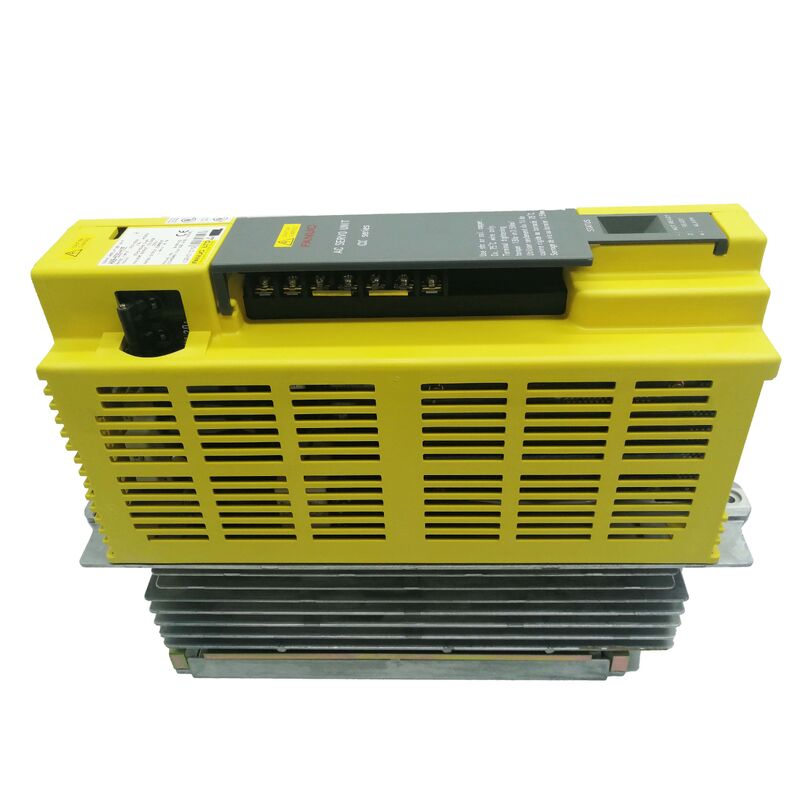
FANUC A06B-6089-H101 — Alpha SVU1-12: The Single-Axis Foundation
One Axis. One Unit. Complete.
When a machine builder specifies a CNC axis drive installation, two philosophies compete. The first consolidates multiple axes into shared modules that draw from a common DC bus — efficient in terms of cabinet space and energy recovery, but tightly coupled: one power supply failure grounds every axis on that bus. The second treats each axis as an independent electrical entity, each with its own rectifier, its own AC feed, its own fault boundary. The A06B-6089-H101 is built around the second philosophy.
Designated SVU1-12 within the FANUC alpha series, this is a single-axis servo amplifier unit driving the L axis at a rated output of 3.0A. The "SVU" designation tells you it is a Servo amplifier Unit — a self-contained design with an integrated rectifier converting incoming three-phase AC directly to the internal DC bus, with no dependency on an external power supply module. The "1" indicates a single axis. The "12" is the current class: 3.0A continuous, appropriate for alpha motors in the α1/3000 to α2/3000 range.
What this means practically is straightforward: bring 200–230V three-phase AC to the unit, connect the motor power cable, run the encoder feedback, wire the PWM interface to the CNC, and the axis is operational. There is nothing else to install, no bus to configure, no shared components to verify first. If this unit fails, only this axis stops. The rest of the machine keeps running.
Sande Electric carries the A06B-6089-H101 in new and used condition, with worldwide dispatch within 0–3 working days.
Where SVU1-12 Fits: The 6089 Single-Axis Range
Within the 6089 SVU1 sub-family, FANUC offered two current classes. The H101 runs at 3.0A (12-class), and the H102 runs at 5.9A (20-class, designated SVU1-20). Both units are physically similar and share the same PWM Type A interface. The selection between them comes down entirely to the connected motor.
The 3.0A rating of the H101 matches motors in the lighter end of the alpha catalog — specifically the α1/3000 and α2/3000. These are compact motors used on axes with lower torque demands: small lathes, auxiliary rotary axes, tool magazines on machining centers, or any application where the mechanical load is modest and rapid traverses are short. Attempting to run a physically larger alpha motor on the H101 is not a viable substitution — the motor will draw more current than the amplifier's output stage can sustain, and the thermal protection will shut the axis down under any meaningful load.
The H102 (SVU1-20) handles the next tier up: α2/3000, α3/3000, α4/4000. If the installed motor on your machine is in this class, the H101 is not the right part. Motor nameplate data and the CNC's servo axis motor code (parameter 2020) are the two fastest ways to confirm which SVU1 variant the machine actually needs before ordering.
The Architecture Behind the Unit: Why PWM Type A Still Matters
The A06B-6089-H101 uses a PWM Type A interface to communicate with the CNC. This is the parallel digital interface that FANUC's earlier CNC generations used before the fiber optic FSSB (Fanuc Serial Servo Bus) was introduced. On machines with Series 15, 16, 18, or 21 controls — the non-i generations — the servo control board inside the CNC outputs PWM signals that travel via a cable bundle directly to the amplifier unit. The alpha SVU family was designed for exactly this interface.
The Type A designation matters because FANUC also built units with a Type B interface, and the two are not electrically interchangeable despite sharing similar form factors in some cases. Type A uses specific pin assignments and signal protocols that differ from Type B; substituting one for the other will result in immediate communication faults between the CNC and the drive, not just degraded performance. When identifying whether a machine uses Type A or Type B, the fastest confirmation is to look at the CNC's servo interface board designation — the board generation will indicate which interface type it supports.
For the 6089 H1xx range, all units use Type A. There is no Type B variant within the SVU1 sub-family.
Technical Specifications
| Parameter |
Value |
| Part Number |
A06B-6089-H101 |
| Also Known As |
A06B6089H101 |
| FANUC Designation |
SVU1-12 (Alpha Servo amplifier Unit, 1-axis) |
| Series |
FANUC 6089 Alpha SVU |
| Axis Count |
1 (L axis) |
| Interface |
PWM — Type A |
| Unit Type |
SVU (self-contained with built-in rectifier) |
| Rated Input Voltage |
200–230V AC, 3-phase, 50/60Hz |
| Rated Output Current |
3.0A (12-class) |
| Max Output Voltage |
230V AC |
| Compatible Alpha Motors |
α1/3000, α2/3000 |
| Compatible CNC |
FANUC Series 15, 16, 18, 21 (non-i) |
| External Power Supply Required |
No |
| Operating Temperature |
0°C to 55°C |
| Status |
Discontinued |
| Origin |
Japan |
| Certification |
CE |
| Condition Available |
New Factory Seal / Used (inspected) |
| MOQ |
1 piece |
| Daily Supply Capacity |
Up to 100 pcs |
| Dispatch |
0–3 working days from confirmed payment |
| Packaging |
Original packing |
Single-Axis vs Multi-Axis SVU: A Practical Installation Consideration
The 6089 family also includes the SVU2 (two-axis) and SVU3 (three-axis) variants. Given that a multi-axis unit handles more axes per enclosure, the SVU2 and SVU3 look attractive from a cabinet economy standpoint. So why would a machine builder or maintenance engineer choose multiple SVU1 units instead?
A few scenarios favor the single-axis approach. First, physical proximity: a machining center where each axis drive is mounted in a small enclosure near the servo motor, rather than consolidated in a central cabinet, benefits from shorter motor power cables and simpler cable routing. The SVU1 is small enough to mount in tight spaces close to the axis it drives. Second, fault isolation: with separate SVU1 units per axis, a failed drive takes down only that axis. The machine may still be able to run partially or in single-axis mode while the failed unit is sourced and replaced. With a three-axis SVU3, one component failure grounds all three axes simultaneously. Third, replacement logistics: SVU1 units of identical type are interchangeable between axes, making a single spare unit a backup for any L-axis drive on the machine rather than a backup for a specific multi-axis combination.
For any machine that runs continuously in production, the fault isolation argument alone often justifies single-axis architecture.
7-Segment LED Alarm Reference: SVU1-12 Fault Codes
The A06B-6089-H101 displays fault codes on the 7-segment LED visible on the unit's front panel. When the machine stops unexpectedly and the servo alarm screen on the CNC reports a servo fault, checking this display directly on the drive is the fastest first diagnostic step. Common codes include:
- 1 — Overvoltage on the DC bus (check incoming AC voltage and regeneration conditions)
- 2 — Undervoltage on the DC bus (check three-phase input voltage at the unit terminals)
- 3 — DC bus undervoltage after initial charge (input phase loss or fuse condition)
- 8 — Overcurrent on the L axis (motor winding or cable insulation issue; check before replacing the unit)
- A — IPM (Intelligent Power Module) fault on the output stage (unit hardware fault)
- 9 — Regenerative discharge circuit overload (regeneration exceeding unit capacity; check deceleration duty cycle)
An "8" or overcurrent alarm on an SVU1-12 that occurs immediately on axis enable — rather than after some period of motion — almost always indicates a winding fault in the connected motor or a cable insulation breakdown, not a failed amplifier. Motor insulation resistance testing (megger test between motor winding leads and motor frame, with motor cable disconnected at the drive end) is the correct first step before condemning the H101 itself.
Ordering, Payment & Shipping
Global dispatch via DHL and FedEx within 0–3 working days of confirmed payment. Combined shipping is available when ordering multiple units.
Accepted payment methods:
- Bank Transfer (T/T) — any order value
- PayPal — orders up to USD $500
- Western Union — any order value
Import duties and taxes are the responsibility of the buyer at destination.
Warranty & Return Policy
| Unit Condition |
Warranty Period |
| New / Unused (New Factory Seal) |
12 months |
| Used / Inspected |
3 months |
Returns are accepted when a unit arrives damaged, incomplete, or not as described — or when the unit is confirmed non-functional within 4 days of receipt. The warranty label must be intact on any returned item. Return shipping costs are the buyer's responsibility. Returns for incorrect ordering or change of mind are not accepted.
Frequently Asked Questions
Q1: How do I confirm whether my machine needs an H101 (SVU1-12, 3.0A) or an H102 (SVU1-20, 5.9A)?
A: The definitive check is the motor model plate on the axis motor currently installed on the machine. If the motor is an α1/3000 or α2/3000, the H101 is the correct match. If the motor is an α2/3000 used in a higher-demand application, or an α3/3000, α4/4000, or above, the H102 (SVU1-20, 5.9A) is required. A secondary check is the CNC servo parameter screen — navigate to servo parameters and read parameter 2020 (motor code) for the affected axis. Cross-reference this code against the motor code table in the machine's servo documentation; the code will indicate the motor model, which directly tells you which current class amplifier is needed. Do not assume the installed amplifier is the correct specification for the machine — previous maintenance may have fitted an incorrect replacement.
Q2: What does "New Factory Seal" condition mean for this unit, and how does it differ from a used inspected unit?
A: New Factory Seal (NFS) means the unit was never installed or powered up in a machine. It was taken from sealed original FANUC packaging and has remained in controlled storage. The unit retains its original FANUC warranty label, all connector covers, and the packaging materials as shipped from the factory. This condition carries our 12-month warehouse warranty. A used inspected unit, by contrast, was previously installed in production equipment, removed (either due to machine upgrade, machine retirement, or troubleshooting), and has been tested across all electrical parameters before being offered for resale. Used units carry a 3-month warranty. For machines in continuous production with high uptime requirements, NFS stock eliminates any uncertainty about prior operating history and is the recommended choice.
Q3: The PWM interface cable between my CNC and the A06B-6089-H101 appears intact, but the CNC shows a servo communication alarm immediately on power-up. What should be checked before concluding the drive is at fault?
A: PWM interface alarms on startup without any prior motion are more often a connection issue than a drive hardware failure. Check in this order: first, verify the interface cable connector is fully seated at both the CNC servo board and the SVU1 unit — partial seating of a multi-pin connector can disconnect one or more signal lines that the drive needs to confirm communication. Second, inspect the connector housing at both ends for bent or pushed-back pins; a pin that looks seated from the outside may have receded from contact on the inside. Third, if the machine has been sitting unused, check for corrosion on the connector contacts — the PWM interface operates at low signal levels where even light oxidation can interrupt communication. Clean contacts with an appropriate contact cleaner if corrosion is visible. Only after confirming the cable and connectors are fully sound should the drive itself be treated as the fault source.
Q4: Can an A06B-6089-H101 (SVU1-12) drive a beta series motor instead of an alpha motor as a temporary measure?
A: Not without risk, and generally not recommended even temporarily. The 6089 SVU family is specified for alpha series motors, and the motor code parameters in the CNC are configured accordingly. Beta series motors have different electrical characteristics — different winding inductance, different encoder feedback protocols, and different current loop tuning parameters. Running a beta motor on an alpha SVU can result in oscillation, runaway current, or servo faults depending on how far the motor parameters diverge from the alpha profile the amplifier's control stage expects. Even if the motor physically runs without immediate alarm, the drive is operating outside its designed parameter set and may produce inaccurate position and velocity control. The correct approach when an alpha motor is unavailable is to wait for the correct motor rather than bridge with an incompatible type.
Q5: Is there a direct modern FANUC replacement for the A06B-6089-H101 that can be substituted without changing the CNC?
A: No direct drop-in replacement exists in current FANUC production. The 6089 SVU family uses a PWM Type A interface tied to older CNC generations (Series 15, 16, 18, 21 non-i). Modern FANUC drives use FSSB fiber optic interface and require i-series CNCs. Substituting a modern drive for an H101 on a machine with a non-i CNC would require replacing the CNC's servo interface board, which in most cases means replacing the CNC itself — a capital project, not a component swap. The practical solution for keeping machines running on these legacy systems is to maintain on-hand stock of tested H101 units. Given the manufacturing age of the 6089 series, new factory seal stock is becoming less available over time; securing a reserve of two or three units for high-utilization machines is a reasonable maintenance strategy. Contact us to discuss multi-unit pricing if your facility operates several machines of this type.
Contact for availability and pricing: Ms. Amy — sales01@sande-elec.com | Skype: sandesales01 | Tel: +86 18620505228


 Your message must be between 20-3,000 characters!