Home
>
Products
>
Servo Motor Driver
>
There's a particular class of CNC machine that puts identical demands on two axes simultaneously: twin-column machining centers, dual-pallet horizontal mills, synchronized twin-spindle lathes where X and Y axes share load profiles, or any configuration where a machine builder paired two motors of the same size on a single amplifier to save cabinet space and simplify wiring. The A06B-6090-H244 was engineered precisely for that configuration.
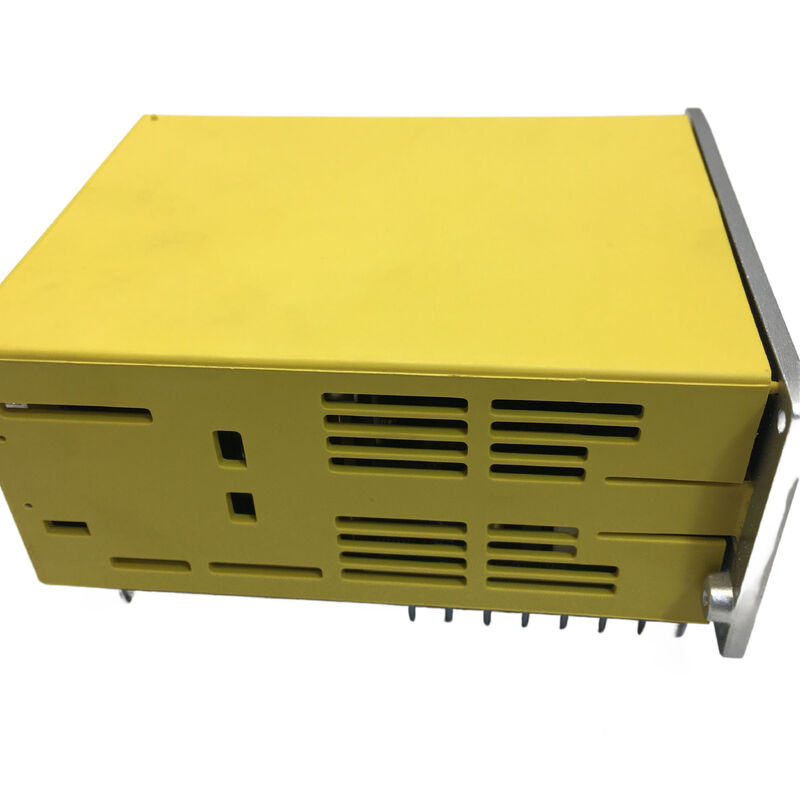
Designated SVUC2-40/40 in FANUC's Alpha C amplifier series, this unit drives two axes — L and M — at identical 8.7A rated output on each channel. Both channels are equal. There's no asymmetry, no "heavy" primary axis paired with a lighter secondary. The 40/40 designation spells it out directly: the same current class, the same drive capability, on both outputs. For machines built around matched α12 servo motors running in parallel applications, this drive is the correct and original equipment choice.
Sande Electric stocks the A06B-6090-H244 in new and used conditions for worldwide dispatch within 0–3 working days.
Understanding the A06B-6090-H244 requires placing it in context. FANUC's servo amplifier evolution moved through several distinct generations, each with different interface architectures:
The 6066 series was the original alpha C generation, introduced in the late 1980s and used through the early 1990s. It used a Type B PWM interface. The 6090 series — which includes the H244 — is the direct successor to the 6066. It uses a Type A PWM interface. Both generations share the "SVUC" designation and outwardly similar cabinet sizes, but the interface pinout and signal protocol differ between the two series. A6090 unit is not a plug-in replacement for a 6066 unit on the same CNC without interface verification.
What came after the 6090 was the shift to FSSB — Fiber Optic Serial Servo Bus — which defines the 6096, 6114, 6117, 6130, and later alpha i series. FSSB replaced the parallel PWM wiring with a single fiber optic chain, dramatically simplifying multi-axis cabling. The 6090 series sits in the PWM era: more capable than the earliest analog drives, already digital in its motor control, but predating the fiber optic architecture that now dominates modern FANUC CNC installations.
For machines still running on CNC systems that predate the FSSB transition — Series 15, 16, 18, and 21 non-i variants in particular — the 6090 is often the correct part. The 6096 and 6114 modules are not interchangeable with 6090 units on these older controls.
Within the 6090 alpha C series, the suffix structure carries specific information. Breaking down H244:
The "2" in SVUC2-40/40 indicates this is a two-axis module — both L and M channel outputs are present and active. Single-axis versions in the same family carry different designations. The "40/40" describes the current class of each axis: both the L-axis and M-axis operate in the 40-class, corresponding to 8.7A rated continuous output per channel.
For comparison, the H246 is SVUC2-40/80 — the L axis remains at 8.7A but the M axis steps up to a higher current class, suitable for machines where the two axes drive motors of different sizes. The H266 is SVUC2-80/80 — both axes at the larger current class. The H244 is the most symmetrical configuration in the dual-axis range: both axes identical, both feeding matched motors, both sharing the same 17A total input draw from the incoming three-phase line.
| Parameter | Detail |
|---|---|
| Part Number | A06B-6090-H244 |
| Also Known As | A06B6090H244 |
| FANUC Designation | SVUC2-40/40 (Alpha C Servo Unit, 2-axis) |
| Series | FANUC 6090 Alpha C |
| Interface Type | PWM — Type A |
| Axis Count | 2 axes (L and M) |
| Rated Input Voltage | 200–230V AC, 3-phase, 50/60Hz |
| Rated Input Current | 17A (at 200V) |
| Rated Output Current | L axis: 8.7A / M axis: 8.7A |
| Max Output Voltage | 230V AC |
| Rated Power | 9.5 kW |
| Control Card (Top) | A20B-2002-0032 |
| Power Card (Base) | A20B-2002-0157 |
| Compatible Motors | FANUC α12/2000 (L and M axes, matched pair typical) |
| Compatible CNC | FANUC Series 15, 16, 18, 21 (and compatible i-series via Type A) |
| Predecessor Unit | A06B-6066-H244 (Type B interface — not directly interchangeable) |
| Status | Discontinued; 6090 series no longer in FANUC production |
| Manufacturer | FANUC, Japan |
| Certification | CE |
| Condition Available | New / Used (inspected) |
| MOQ | 1 piece |
| Daily Supply Capacity | Up to 100 pcs |
| Dispatch | 0–3 working days from confirmed payment |
| Packaging | Original packing |
Machine builders chose dual-axis amplifier modules for two reasons: cabinet space and cable routing efficiency. A single SVUC2-40/40 occupies one slot in the drive cabinet and connects to the CNC via a single axis interface, while its two output channels each run separate power cables to their respective motors. Versus two independent single-axis units, this halves the number of control-side interface connections and reduces the cabinet footprint for the servo section.
The tradeoff is interdependency. With the H244, an L-axis fault that shuts down the amplifier also takes the M axis offline — both channels share the same DC link, the same control power supply, and the same front-panel LED display. When troubleshooting, it's important to determine whether an alarm originated from the L channel, the M channel, or a shared internal component before replacing the unit.
The front LED display on the SVUC2 uses a 7-segment format to indicate both alarm codes and, when running normally, operating status. For units exhibiting intermittent alarms, watching the LED at the moment of fault trigger — before the CNC alarm screen updates — often gives the most accurate first indication of which channel or which internal circuit is involved.
| LED Code | Alarm | Description |
|---|---|---|
| 1 | HV | Over voltage |
| 2 | LV | Low control power voltage |
| 3 | LVDC | Low DC link voltage |
| 4 | DCSW | Regenerative control circuit fault |
| 5 | DCOH | Over-regenerative discharge |
| 7 | DBRLY | Dynamic brake circuit failure |
| 8 | HCL | L-axis over current |
| 9 | HCM | M-axis over current |
| 8. (dot) | IPML | L-axis IPM alarm |
| 9. (dot) | IPMM | M-axis IPM alarm |
| b | — | L & M axes over current (simultaneous) |
| b. (dot) | — | L & M axes IPM alarm (simultaneous) |
Alarm codes 8 and 9 appearing with a decimal point (8., 9.) indicate an IPM (Intelligent Power Module) alarm rather than a simple over-current condition. IPM alarms typically involve the internal transistor modules detecting abnormal thermal or current conditions at the device level, which is distinct from a wiring or motor fault triggering the external current sensor. The distinction matters for diagnosis: an HCL or HCM (no dot) on startup points toward motor wiring or motor insulation checks first; an IPM alarm (dotted code) warrants inspection of the transistor modules and their thermal path.
The A06B-6090-H244 is the documented replacement for the A06B-6066-H244 in terms of function and current class. Both are SVUC2-40/40 dual-axis units driving matched α12 motors at 8.7A per channel. The critical caveat is interface compatibility.
The 6066 series used Type B PWM interface wiring on its control connector. The 6090 series uses Type A. On CNC controllers that were originally built for the 6066 Type B interface — predominantly early-production Series 15 and 16 machines from the late 1980s and early 1990s — the 6090 cannot simply be substituted without confirming that the CNC's servo amplifier interface matches Type A pinout, or without an interface adapter cable. FANUC did not offer an official exchange between these two series specifically because of this connector incompatibility.
For machines already running a 6090 H244 and needing a direct replacement, this distinction is moot — the replacement unit connects identically. The interface question only arises when someone attempts to source a 6090 as an upgrade or substitute for an original 6066 installation.
New-old-stock A06B-6090-H244 units are genuine FANUC product in original packaging, never installed. Given that the 6090 series has been discontinued for many years, true new stock is the preferred option for machines that must maintain continuous operation — there is no new production to fall back on, and every genuinely new unit in the supply chain represents diminishing inventory. New units carry a 12-month warehouse warranty.
Used inspected units are sourced from decommissioned machines, verified for both L and M axis functionality, and offered with a 3-month warranty. The common failure modes on used 6090-series units found in repair records include capacitor degradation, leaky electrolytics on the control card, and failed output transistors — all age-related failures predictable from units that have been in service for 15–30 years. Confirm the inspection standard with us before ordering if the machine's operational requirements are demanding.
Worldwide dispatch via DHL and FedEx within 0–3 working days of confirmed payment. Combined shipping is available on multi-item orders.
Payment options:
Import duties and local taxes are the buyer's responsibility at the destination.
| Condition | Warranty Period |
|---|---|
| New / Unused | 12 months |
| Used / Inspected | 3 months |
Returns accepted for units arriving damaged, incomplete, not as described, or confirmed non-functional within 4 days of receipt. The unit must be returned in original condition with warranty label intact. Return shipping is the buyer's responsibility. No returns for incorrect orders or change of mind.
Q1: The A06B-6090-H244 is listed as replacing the A06B-6066-H244. Are they interchangeable on any machine running the original 6066?
A: The two units share the SVUC2-40/40 current class and drive the same motors, but they use different control interface wiring — the 6066 uses a Type B PWM interface and the 6090 uses Type A. On a machine that was originally built with the 6066 and has a Type B interface connector from the CNC to the amplifier, you cannot simply plug in a 6090 without verifying or adapting the interface wiring. For machines already running a 6090 H244 — the far more common situation today, since most surviving machines of this vintage were updated at some point — a replacement H244 of the same 6090 series connects directly without any interface modification.
Q2: Both L and M axes on my machine stopped together and the LED shows alarm "b". What does that indicate, and where should I start troubleshooting?
A: Alarm "b" on the 7-segment LED represents simultaneous over-current on both the L and M axes at the same time, which on a dual-axis module typically points to a shared fault rather than two independent channel failures. The first places to check are the DC link and the incoming power: alarm 3 (LVDC) or alarm 1 (HV) conditions can precede or accompany an "b" alarm if the DC bus is collapsing under load. If the DC link is healthy, check whether both motor power cables have a common ground fault or if there is a short in the shared cabinet wiring. If you see "b." with a decimal point rather than a plain "b", that indicates an IPM-level alarm on both channels simultaneously — in that case the IGBT modules inside the unit are the more likely failure point and the unit typically requires repair or replacement.
Q3: Does the A06B-6090-H244 require a separate power supply module, like the 6114 alpha i SVM does with its aiPS?
A: No. The 6090 SVUC series is a self-contained unit — it rectifies its own incoming three-phase AC and generates the DC link voltage internally. This is the same architecture as the 6093 beta SVU series: the drive connects directly to three-phase AC input and does not depend on an external shared power supply bus. This makes installation straightforward — incoming three-phase AC power and motor cables are the primary connections, along with the control interface to the CNC. The only external accessory sometimes used with 6090 units is a separate regenerative discharge unit when the machine's duty cycle generates more regenerative energy than the drive's internal regeneration circuit can absorb.
Q4: My machine uses α12 motors on both axes. Is the H244 the right unit, or should I consider the H246 (SVUC2-40/80)?
A: The H244 is the correct choice for matched α12 motors on both L and M axes. The α12 motor falls within the 40-class current range, and the H244 provides equal 8.7A rated output on both channels — precisely suited to that motor pairing. The H246 (SVUC2-40/80) is the right choice only when the two axes use motors of different sizes: the 40-class motor on the L axis and a larger motor requiring the 80-class current on the M axis. If both axes drive identical α12 motors, the asymmetric H246 offers no advantage and introduces unnecessary complexity. Confirm your motor model numbers from the machine's wiring documentation before ordering.
Q5: The 6090 series is discontinued. If this unit fails again in a few years, what are the realistic long-term options?
A: The 6090 series has been out of production for many years and will not return. For ongoing maintenance of machines running the H244, there are three realistic paths. First, stocking a spare unit now while used and new-old-stock examples are still available in the market — this is the most straightforward and the most common approach for production-critical machines. Second, if the CNC system itself is being upgraded or replaced, the servo drive architecture can be updated in the same project, since newer CNCs and drive families are not constrained by 6090 parts availability. Third, some specialist repair services can rebuild failed 6090 units by replacing failed capacitors and IGBT modules — the known failure components — extending the unit's service life without requiring a full replacement. Contact us about current stock availability; given the age of these units, stock positions can change quickly.
Contact for availability and pricing: Ms. Amy — sales01@sande-elec.com | Skype: sandesales01 | Tel: +86 18620505228
Contact Us at Any Time