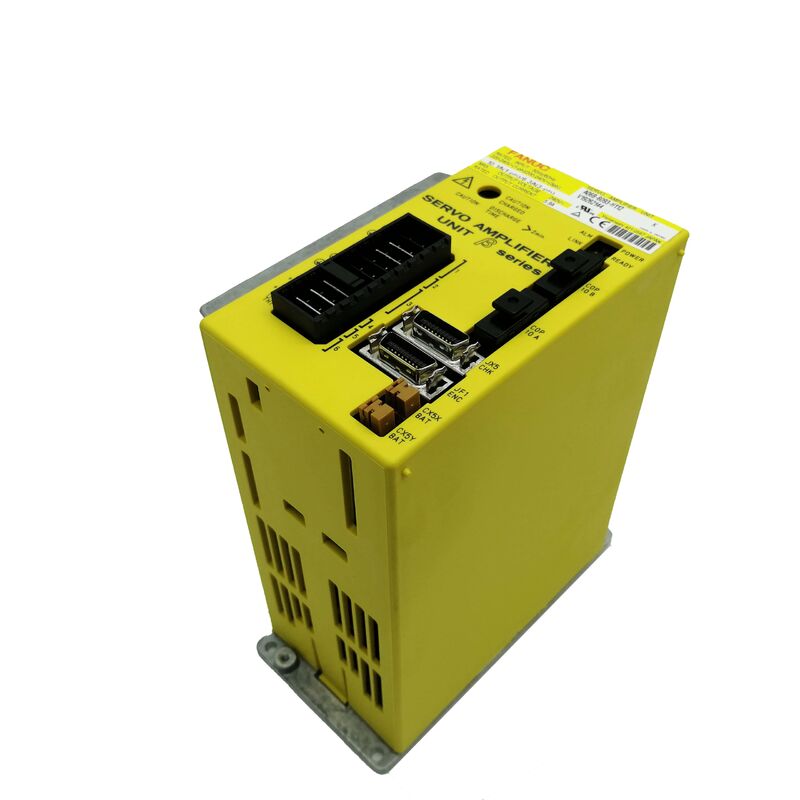
FANUC A06B-6093-H112 — Beta SVU-20 FSSB, The Mid-Range Standalone Drive with On-Board Parameter Storage
Picking the wrong current class is the most avoidable sourcing mistake in the 6093 series. The SVU-20 and the SVU-40 are physically similar, mount in the same places, and run on the same FSSB fiber optic interface — but the motors they drive are different, and the current headroom is not interchangeable. The A06B-6093-H112 is the SVU-20 unit: 5.9A rated output, the mid-point in the 6093 FSSB range, and the right choice for the beta motor class it's matched to.
There's a second thing about this unit that affects every replacement job, and it's easy to miss: parameters in the 6093 beta series are stored in the drive itself, not in the CNC. When this unit fails and needs to be swapped, the servo parameters travel out the door with the old unit unless they've been saved beforehand. Understanding this before you order matters as much as confirming the part number.
Sande Electric stocks the A06B-6093-H112 in new and inspected-used condition, with worldwide dispatch in 0–3 working days.
The SVU-20 in the 6093 FSSB Current Ladder
The H11x FSSB sub-family of the 6093 series covers four output tiers, each matched to a different class of beta (and small alpha) servo motor:
H111 — SVU-4 — smallest, for lightest beta motors in minimal-load applications
H112 — SVU-20 — mid-low range, 5.9A rated, for beta motors in the 20-class
H113 — SVU-40 — mid-high range, 12.5A rated, for beta motors in the 40-class
H114 — SVU-80 — highest current, 15A rated, for the heaviest beta motors
The H112 SVU-20 is matched specifically to FANUC beta motors in the mid-low class: the b2/3000, b3/3000, and similar motors that appear on lighter-load auxiliary axes. These are typically the smaller rotary indexers, lighter ATC mechanisms, or secondary positioning axes on compact machine tools — axes where the torque and inertia requirements don't justify stepping up to the 40-class.
Using an H113 (SVU-40) in a position designed for the H112 won't damage anything in most cases, but it's an over-specification. Using an H111 (SVU-4) would be under-specified and would generate overcurrent alarms. The H112 is the correct unit for machines where the axis drive position was designed around SVU-20 current capacity.
What "Parameters Stored in the Drive" Actually Means
Most FANUC servo system experience involves the alpha SVM series, where servo parameters live in the CNC's parameter memory. Replace a failed SVM module and the parameters stay in the CNC — the new module picks them up on first initialization.
The 6093 beta SVU series works differently. In these units, the servo axis parameters are held in the drive itself. When you remove the old drive, the parameter set leaves with it. Installing a new H112 without first restoring parameters means the axis will not behave correctly until the parameter set has been written back to the new unit.
The backup and restore procedure depends on the CNC series. For controllers in the 16i, 18i, 21i, 20i, and PowerMate-iD/iH families, parameters are saved and restored via the Power Mate CNC Manager (PMM) function in the CNC's menu. The key PMM parameters that govern this process include parameter 960.0 (SLV — number of slaves displayed), 960.1 and 960.2 (MD1/MD2 — destination for parameter input/output), and 960.3 (PMN — PMM enabled/disabled status). Before the original H112 is removed, the parameter backup should be written either to the CNC's part program storage or to a memory card, depending on the MD1/MD2 setting.
This is not unique to the H112 — it applies to all 6093 beta SVU units. But it's worth stating plainly because it's the step most often skipped by engineers who are accustomed to replacing alpha SVM modules and assume the same rules apply.
H112 vs H102: The SVU-20 Interface Split
The SVU-20 current class appears twice in the 6093 series, split by interface type. The H112 uses FSSB — the same fiber optic servo bus used in FANUC's alpha series. The H102 uses Type B — a different interface protocol, sometimes also called PWM interface in some FANUC documentation.
Both are single-axis standalone SVU-20 units with identical current ratings and the same built-in power supply architecture. The physical dimensions are similar. But the communication cable is different, the connector arrangement differs, and the CNC configuration must match the interface type of the installed unit.
If the machine's servo cable to that axis position is an optical fiber (TOCP200 type), the replacement must be the H112. If it's an electrical interface cable for Type B, the unit is the H102. Installing the wrong interface type produces an immediate communication fault on power-up and the axis will not operate. Confirm the cable type at the drive connection point before placing an order.
Technical Specifications
| Parameter |
Detail |
| Part Number |
A06B-6093-H112 |
| Also Known As |
A06B6093H112 |
| FANUC Designation |
SVU-20 / SVU1-20 (Beta Servo Unit, FSSB) |
| Series |
FANUC 6093 Beta — H11x FSSB Sub-family |
| Unit Type |
SVU (standalone with built-in power supply) |
| Axis Count |
Single-axis |
| Input Voltage (single-phase) |
220–240V AC, 10.1A, 50/60 Hz |
| Input Voltage (three-phase) |
200–240V AC, 50/60 Hz |
| Rated Output Current |
5.9A |
| Max Output Voltage |
240V AC |
| Control Interface |
FSSB (Fiber Optic Serial Servo Bus) |
| Parameter Storage |
On-board (in drive, not in CNC) |
| Features |
Leakage detection, alarm system |
| Compatible Motors |
FANUC Beta b2/3000, b3/3000 series (20-class) |
| Compatible CNC |
FANUC 15, 16, 18, 20, 21 and i series |
| Manufacturer |
FANUC, Japan |
| Certification |
CE |
| Condition Available |
New / Used (inspected) |
| MOQ |
1 piece |
| Daily Supply Capacity |
Up to 100 pcs |
| Dispatch |
0–3 working days from confirmed payment |
| Packaging |
Original packing |
New Stock vs Used Stock: How to Think About This Unit
The SVU-20 drives lighter auxiliary axes — axes that cycle intermittently rather than continuously. A rotary indexer that moves once per part cycle, or an ATC that actuates for a few seconds at each tool change, accumulates far fewer operational hours than a primary machining axis running full-cycle all day. This usage pattern means that used units sourced from decommissioned machines are often in genuinely good condition, with limited wear on the power components.
New-old-stock H112 units are genuine unused FANUC product and carry a 12-month warehouse warranty — the right choice where maximum reliability margin or an upcoming long maintenance interval is a priority.
Used inspected units carry a 3-month warranty and represent a practical option for cost-sensitive repairs, backup inventory, or situations where the machine's planned lifespan doesn't justify the premium of new stock.
Contact us to confirm current availability on both conditions before ordering.
Ordering, Payment & Shipping
Worldwide dispatch via DHL and FedEx within 0–3 working days of confirmed payment. Combined shipping is available across multiple items.
Payment:
- Bank Transfer (T/T) — all order values
- PayPal — orders up to $500
- Western Union — all order values
Import duties and local taxes are the buyer's responsibility at destination.
Warranty & Returns
| Condition |
Warranty Period |
| New / Unused |
12 months |
| Used / Inspected |
3 months |
Returns are accepted for units that arrive damaged, incomplete, not as described, or are confirmed non-functional within 4 days of receipt. The unit must be returned in its original condition with the warranty label intact; return shipping is at the buyer's cost. Warranty does not cover damage caused by incorrect installation, wrong motor pairing, or physical damage after delivery.
Frequently Asked Questions
Q1: The H112 and H102 are both SVU-20 rated — can I use one to replace the other? No. Despite sharing the SVU-20 current class and identical rated output current of 5.9A, the H112 and H102 use fundamentally different communication interfaces. The H112 connects to the CNC via FSSB optical fiber; the H102 uses the Type B interface (electrical serial connection). These interfaces use different connectors, different cable types, and different CNC configuration parameters. Installing an H102 in a position wired for FSSB, or vice versa, results in an immediate communication fault — the CNC will not recognize the drive. Before ordering, physically identify the cable type at the drive mount position: optical fiber means H112; the electrical Type B cable means H102. The label on the original failed unit, if still visible, will also state the interface type.
Q2: I've heard beta SVU drives store parameters internally. What exactly does that mean for a replacement job? It means the axis servo parameters — the tuning data that tells the drive how to behave with its specific motor — are stored in non-volatile memory inside the H112 unit itself, not in the CNC controller. When the original drive is removed, those parameters leave with it unless they were previously backed up. To save the parameters, the CNC must be connected to the drive while it is still operational (or at least powered), and the backup is performed through the Power Mate CNC Manager function in the CNC menu. The backup can be saved to the CNC's part program storage or a memory card depending on the parameter destination setting. Once the new H112 is installed and powered, the saved parameters are written back to the new unit through the same PMM interface. Skipping this backup step means the axis will either not initialize correctly or will run with incorrect tuning after the swap, requiring manual re-parameterization from the machine's documentation.
Q3: After installing a replacement H112, the axis homes correctly but runs with noticeably more vibration than before. What's the likely cause? In the majority of cases, this indicates that the servo parameters were not successfully transferred to the new unit, or were restored from an outdated backup. The H112 is factory-tuned with default parameters that may not match the specific motor, load inertia, and mechanical characteristics of the machine's axis. Servo loop gains — particularly the velocity loop gain and position loop gain — must match the original tuned values for the axis to run smoothly. Check the currently active parameters against the saved backup: discrepancies in the velocity loop proportional gain (parameter 2021), integral gain (2022), and position loop gain (2084 in typical 16i/18i systems) are the most common sources of post-replacement vibration. If no parameter backup exists, the machine documentation's parameter list is the reference, or a trained FANUC service engineer can re-tune the axis from scratch.
Q4: My machine uses a 16i CNC. After the parameter restore, the PMM screen shows the axis but indicates a "slave parameter not match" type warning. Is the drive faulty? Not necessarily. This warning typically means that some parameters in the newly installed drive do not match what the CNC expects based on its own stored records of the last known drive state. This can happen when: the backup was taken at a different point than when the drive was last tuned; the replacement drive has a slightly different firmware revision that changed certain parameter ranges; or the restore process completed only partially. The first step is to verify that the full parameter set was written to the new unit — go back through the PMM restore process and confirm each parameter group was accepted without error messages. If the mismatch persists for specific parameters, compare the values shown in the warning against the machine's original commissioning documentation and correct them manually. This type of discrepancy is resolved through parameter correction and does not indicate a hardware fault in the new unit.
Q5: Is it possible to use a higher-rated FSSB unit — say, an H113 (SVU-40) — as a temporary standby for an H112 position if a correct H112 isn't immediately available? Electrically, an H113 can drive a 20-class beta motor without damaging it — the drive has more current headroom than the motor will ever demand, and the motor won't draw beyond its own design limits regardless of what the drive is capable of delivering. However, the CNC's servo amplifier identification system reads the drive's ID data over FSSB during initialization, and if the drive's maximum current specification doesn't match the configuration the CNC axis was set up for, alarm 466 (motor/amp combination error) may be triggered, preventing the axis from enabling. Whether this happens depends on how strictly the specific CNC version enforces the motor-amplifier combination check. In practice, a temporary substitution sometimes works for basic positioning tests, but it is not a certified compatible swap and should not be treated as a permanent solution. Confirm with your CNC parameters before attempting; if alarm 466 appears, the axis will not enable until a correctly rated H112 is installed.
Contact for availability and pricing: Ms. Amy — sales01@sande-elec.com | Skype: sandesales01 | Tel: +86 18620505228


 Your message must be between 20-3,000 characters!