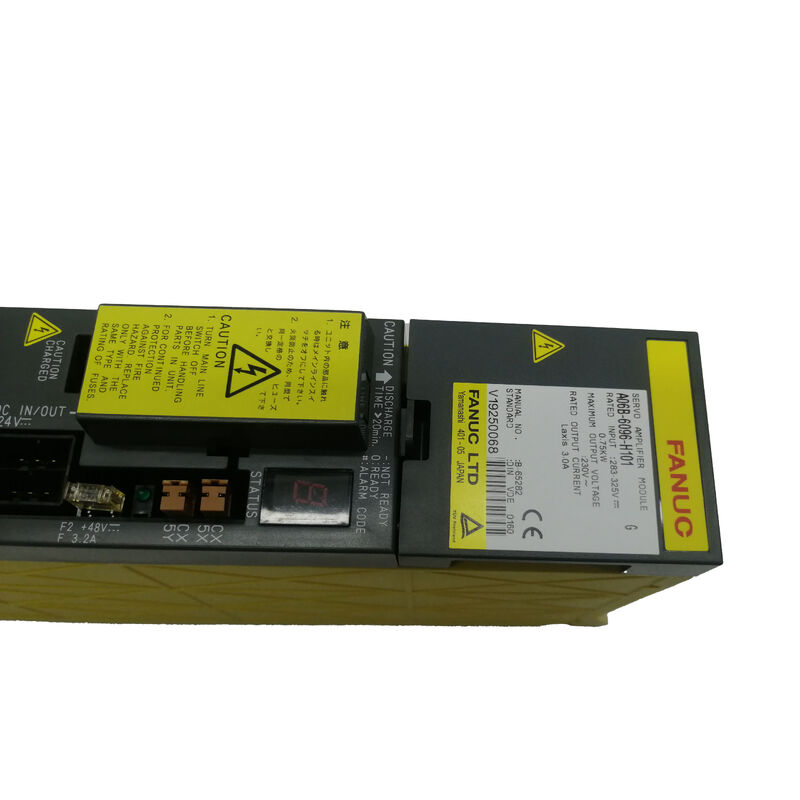
FANUC A06B-6096-H101 Servo Amplifier Module — SVM1-12, Alpha FSSB Single-Axis, 200V Platform
There's a straightforward reason why the A06B-6096-H101 still sees regular demand despite being neither the newest nor the most powerful drive FANUC ever made: the machines it was designed for are still running.
Vertical machining centers, lathes, and grinding machines built with FANUC 16i, 18i, and 21i controllers — and their 30i/31i successors — put this amplifier on axes that have been cycling reliably for years, sometimes decades.
When one eventually fails, finding a compatible replacement fast is what matters.
The H101 is designated SVM1-12 within FANUC's 6096 Alpha series — a single-axis module handling a 3.0A rated output at 230V, sized for the lighter axis loads on smaller machines. Sande Electric stocks this module in both new and used (inspected) condition, with worldwide dispatch in 0–3 working days.
The 6096 Series: When FANUC Moved to Fiber Optics
To understand what makes the 6096 series distinct, it helps to know where it sits in FANUC's servo amplifier history.
Before the 6096, FANUC's standard alpha servo module for CNC use was the 6079 series. The 6079 communicated with the CNC via a conventional current-based interface — electrical signals carried between the CNC servo card and the amplifier over copper wiring.
It worked reliably, but as CNC systems grew more demanding and multi-axis configurations became common, the wiring complexity and communication bandwidth of analog interfaces became limiting factors.
The 6096 series replaced the 6079 with one fundamental change: the servo communication interface switched to FSSB — the Fiber Optic Serial Servo Bus. Data between the CNC and each drive module now travels over optical fiber rather than electrical conductors.
Noise immunity improves, communication speed increases, and wiring between the CNC rack and drive cabinet is simplified considerably.
FANUC made this transition with deliberate continuity in mind. The physical module dimensions, the DC bus architecture, the power supply requirements, and even the model naming convention (SVM1, SVM2, SVM3 for single, dual, and triple-axis) carried over from the 6079.
The distinction in the drawing numbers — 6079 for the current SVM and 6096 for FSSB SVM — is the technical marker, but operationally the machines using 6096 modules look very similar to those that used 6079.
The 6096 occupied this position until the 6117 Alpha i series arrived, bringing HRV3 current control and a slimmer module form factor.
The 6096 does support HRV3 — provided the correct matching board combination is fitted — but that's the extent of the capability overlap. Structurally, the 6096 belongs to the earlier generation.
SVM1-12: Smallest in the Family, but Right for Its Job
Within the 6096 single-axis range, the H101 is the entry model.
The current scale across the family runs from the SVM1-12 (H101, 3A output) through the SVM1-20, SVM1-40S/L, SVM1-80, SVM1-130, SVM1-240, up to the SVM1-360 — a broad range covering everything from small positional axes on compact lathes to heavy-load primary axes on large machining centers.
The SVM1-12 was matched to the smaller alpha servo motors at the time of machine build — typically models like the alpha a1/3000 or a2/2000.
These motors drive auxiliary axes, short-travel axes, and positioning axes on machines where the mechanical load is moderate.
A 3A continuous rated drive is sufficient for those duties, and running a higher-rated module in its place isn't harmful, but it's unnecessary and generally unavailable as a stock item configured for the same slot size.
Technical Specifications
| Parameter |
Detail |
| Part Number |
A06B-6096-H101 |
| Also Known As |
A06B6096H101 |
| FANUC Designation |
SVM1-12 (Alpha Servo Module) |
| Series |
FANUC 6096 Alpha FSSB |
| Axis Count |
Single-axis |
| Rated Input |
283–325V DC, 0.75 kW |
| Rated Output Current |
3.0 A |
| Rated Output Voltage |
230V AC |
| Control Interface |
FSSB (Fiber Optic Serial Servo Bus) |
| HRV Support |
HRV3 capable (with matching A16B-2202-074X + A20B-2100-054X boards) |
| Internal Wiring Board |
A16B-2202-0740 (later version) |
| Internal Control PCB |
A20B-2100-0540 (late) / A20B-2100-0250 (early) |
| Compatible Motors |
Alpha a1/3000, a2/2000 and equivalent alpha series AC servo motors |
| Compatible CNC |
FANUC 16i, 18i, 21i; 30i, 31i, 32i series |
| Power Supply Required |
Alpha PS or aiPS (200V series) DC bus |
| Operating Frequency |
50 / 60 Hz |
| Operating Temperature |
0°C to 55°C |
| Weight |
Approx. 2.27 kg |
| Manufacturer |
FANUC, Japan |
| Certification |
CE |
| Condition Available |
New / Used (inspected) |
| MOQ |
1 piece |
| Daily Supply Capacity |
Up to 100 pcs |
| Dispatch |
0–3 working days from confirmed payment |
| Packaging |
Original packing |
Early vs. Late PCB Revisions — Why It Matters for Repair
One detail worth knowing before ordering a used H101: the A06B-6096-H101 was produced in two distinct internal board configurations.
Early units used the A20B-2100-0250 control PCB; later production switched to the A20B-2100-0540. Both are the same control architecture but different board revisions.
For a straightforward module replacement, this distinction rarely matters — the whole module is swapped as a unit.
Where it becomes relevant is in component-level repair: if someone has replaced just the control board in a unit, the board revision should match what the wiring board is expecting.
Mixed board combinations from incompatible revision pairings can produce spurious alarm conditions.
When ordering a used unit from us, we supply the module as a complete assembly. We do not supply individual internal boards separately.
New vs. Used: Choosing the Right Condition
New units are genuine FANUC stock, untouched, with a 12-month warranty from our warehouse.
For facilities that classify any axis-down situation as a production emergency, removing service-history uncertainty is worth the price premium.
Used (inspected) units carry a 3-month warranty and are practical for maintenance departments stocking spares against a future failure rather than responding to one already in progress. The SVM1-12 drives small axis loads — their typical duty cycles are undemanding compared to heavier axis drives — and well-maintained used units have proven reliable as working spares.
Contact us to confirm availability on the specific condition you need before ordering.
Ordering, Payment & Shipping
Worldwide dispatch via DHL and FedEx within 0–3 working days of payment confirmation. Combined shipping is available on multiple-item orders.
Payment accepted:
- Bank Transfer (T/T) — all order values
- PayPal — orders up to $500
- Western Union — all order values
Buyers are responsible for any applicable import duties or local taxes at the destination country.
Warranty & Returns
| Condition |
Warranty Period |
| New / Unused |
12 months |
| Used / Inspected |
3 months |
Returns accepted if units arrive damaged, incomplete, not as described, or are confirmed non-functional within 4 days of receipt. Original condition with warranty label intact is required. Return shipping is at the buyer's cost.
Failures caused by incorrect installation, wiring errors, or physical damage post-delivery are excluded from warranty coverage.
Frequently Asked Questions
Q1: What is the practical difference between the 6079 and 6096 series, and are they interchangeable on the same machine?
The 6079 and 6096 serve the same functional role — single, dual, or triple-axis servo amplification in a 200V alpha series cabinet — but they use fundamentally different communication interfaces.
The 6079 uses a current-based servo interface; the 6096 uses FSSB, which transmits servo data over optical fiber. The CNC servo card determines which interface is present on the machine: a controller fitted with an FSSB servo card requires 6096-series modules, while an older system without FSSB cannot use them.
The two families are not interchangeable without changing the CNC servo card as well. If your machine originally had a 6079 module, you need a 6079 replacement; if it had a 6096, you need a 6096.
Q2: The H101 is the SVM1-12 with 3A output — can a higher-rated 6096 module (such as an H102 or H103) substitute in an emergency?
In terms of fitting into the same cabinet slot and communicating over the same FSSB link, a higher-rated 6096 module would connect.
The question is whether the higher current rating creates any issue — and typically it doesn't, since the current output of the amplifier is dictated by the motor load and the CNC's parameter-set current limits, not the amplifier's maximum rating alone.
That said, a controlled substitution like this should only be done with awareness of parameter settings: the CNC's amplifier model parameter may need updating to reflect the new current rating, or the drive may report a configuration mismatch on power-up.
For permanent replacement, sourcing the correct H101 is the clean solution. For a temporary production recovery, a higher-rated substitute is sometimes used with appropriate parameter adjustment — but this should be treated as a short-term measure.
Q3: My FANUC controller shows servo alarm 9 on the axis driven by this module — where should I start investigating?
Servo alarm 9 in FANUC systems typically indicates an overload condition on the axis — the drive has been drawing excessive current for longer than the thermal protection threshold allows.
Before assuming the amplifier has failed, check whether the mechanical load on that axis has changed: worn or contaminated ballscrews, stuck way wipers, over-tightened gibs, or a failing motor bearing all increase the current demand on the drive and can trigger overload alarms on a drive that is otherwise functional.
Run the axis manually at low feedrate and observe whether the motor moves smoothly or with noticeable resistance.
If the axis has normal mechanical behavior and the alarm returns immediately after reset without motion commanded, the fault is more likely in the drive's power stage or its internal thermistor circuit. In that scenario, module replacement becomes the appropriate course of action.
Q4: Does this amplifier require any parameter changes after replacement, or is it truly plug-and-play?
The servo parameters that govern axis behavior — position loop gain, velocity loop gain, current limit, motor type — are stored in the CNC's memory, not in the drive module. Replacing the amplifier module with the same part number leaves those parameters intact and unaffected.
In most cases, a like-for-like H101 swap requires no parameter changes at all.
The exception is when the replacement unit has a different board revision than the original. In early FANUC 16i/18i/21i systems, the amplifier model parameter in the CNC identifies both the drive and the interface version; if the replacement unit's hardware revision doesn't match what the parameter expects, a configuration alarm may appear.
This is resolved by updating the relevant amplifier model parameter — the specific parameter number depends on the CNC model and software version.
Backing up all CNC parameters before any hardware swap is good practice regardless, as it gives you a complete restore point if anything needs to be adjusted.
Q5: Are there any common failure modes specific to the SVM1-12 that are worth knowing before installation?
The A06B-6096-H101 shares the same general failure patterns as other alpha FSSB series modules.
The internal electrolytic capacitors on the control PCB age over time, particularly in environments with higher ambient temperatures or poor cabinet ventilation — capacitor-related faults often manifest as erratic axis behavior or intermittent alarms before becoming a hard failure.
The fiber optic connectors (COP10A/COP10B on the FSSB chain) are worth inspecting before condemning the module itself: a contaminated or bent fiber cable connector at the drive end can cause FSSB communication errors that look like a drive fault.
Clean the fiber connectors with an appropriate optical cleaning tool and verify the cable is properly seated before replacement. Finally, on older used units, the wiring board connectors can develop intermittent contact from years of thermal cycling — re-seating the internal connectors during installation is a minor step that avoids unnecessary callbacks.
Check availability or request a quote: Contact Ms. Amy — sales01@sande-elec.com | Tel: +86 18620505228


 Your message must be between 20-3,000 characters!