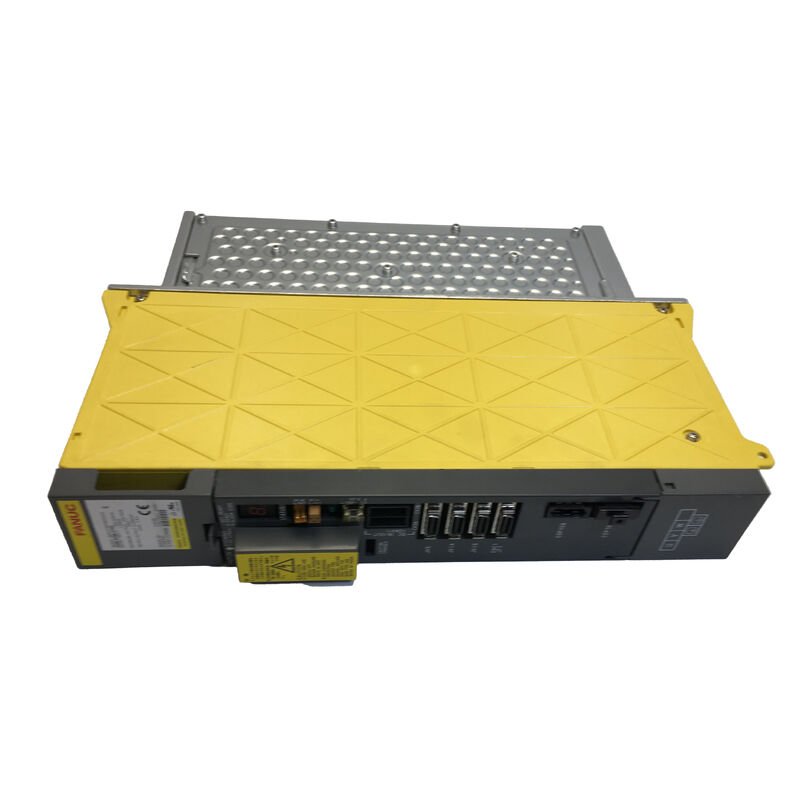
FANUC A06B-6096-H106 AC Servo Amplifier Unit — Product Description
The Single-Axis Module in a Family Built Around Multi-Axis Thinking
The A06B-6096 series earned its place in CNC drive cabinets largely through multi-axis modules — units that control two or three servo axes from a single physical assembly, reducing cabinet volume and simplifying power distribution. That design philosophy is reflected in the 6096 variants most commonly seen in the field: the three-axis H302, the dual-axis H202 and H207.
So when a maintenance engineer encounters an H106 label on a failed drive and starts searching, the first question is sometimes whether the "1" in the suffix really does mean what it appears to mean. It does. The A06B-6096-H106 is a single-axis servo amplifier — one physical unit, one servo axis, sharing the same series generation and analog interface architecture as the multi-axis modules but dedicated entirely to driving a single motor. It belongs to the 6096 family in every meaningful sense: same controller compatibility, same era, same interface protocol. It just controls one axis instead of two or three.
This page serves buyers who know the part number and want to understand exactly what they're sourcing. Manufactured in Japan by FANUC Corporation, CE certified, available in new original and tested refurbished condition. MOQ: 1 piece.
Reading "HIO6": The Dual OCR Substitution in This Suffix
The page title on this product listing reads "AO6B-6O96-HIO6" — the OCR-derived string that search engines encounter when scanners, older catalogs, or low-resolution label photography process this part number. Two separate character substitutions occur in the suffix alone:
The digit 1 in "H106" is read as the letter I, producing "HI06." The digit 0 in "H106" is read as the letter O, producing "HIO6." The combined result is "HIO6" — a string that looks, at first glance, like it contains two letters and two digits, which is an unusual pattern that occasionally causes buyers to question whether they've transcribed the number correctly.
They haven't made an error. "HIO6" and "H106" refer to the same unit. FANUC servo amplifier suffix codes contain only the letter H followed by numeric digits — no letters appear after H in the actual part number. If your documentation, scanned label, or search string shows "HIO6," the physical label on the unit will read H106, and that is the correct form to use for all ordering and cross-referencing purposes.
The H106 Suffix: Axis Count and Current Tier
Within the A06B-6096 naming convention, the suffix digits after H encode two pieces of information that determine exactly which variant is required.
"1" — The leading digit identifies this as a single-axis module. Unlike the H202, H207, and H302, which drive two or three axes respectively from shared power stages, the H106 has one set of drive output connections and one set of motor feedback inputs. It controls one servo axis — completely, independently, and exclusively.
"06" — The two trailing digits designate the current output tier for this specific variant. This is the "06" tier within the single-axis 6096 group, matching a defined range of motor current ratings. The motors paired with an H106 were specified to this current tier when the machine was built, and the CNC controller's servo parameter data is configured accordingly. Replacing an H106 with a different current-tier single-axis 6096 variant is not a transparent substitution — it requires parameter adjustment and motor compatibility verification, not just a physical swap.
| Variant |
Axis Config |
Current Tier |
Notes |
| A06B-6096-H106 |
Single-axis |
06 |
This unit |
| A06B-6096-H202 |
Dual-axis |
02 |
Different axis count and tier |
| A06B-6096-H207 |
Dual-axis |
07 |
Different axis count and tier |
| A06B-6096-H302 |
Three-axis |
02 |
Different axis count and tier |
The H106 shares no interchangeability with any of the dual-axis or three-axis variants in this table. Axis count is not a negotiable parameter.
Specifications
| Parameter |
Detail |
| Part Number |
A06B-6096-H106 |
| Also Referenced As |
A06B6096H106 / AO6B-6O96-HIO6 (OCR variant — "I" = digit 1, "O" = digit 0) |
| Drive Series |
FANUC A06B-6096 Series AC Servo Amplifier |
| Axis Configuration |
Single-axis module |
| Current Rating Tier |
H106 (tier 06) |
| Manufacturer |
FANUC Corporation |
| Country of Origin |
Japan |
| Certification |
CE |
| Compatible Controller Families |
FANUC Series 0, 6, 10, 11, 12 (analog servo interface) |
| Condition Available |
New (Original) / Tested Refurbished |
| Minimum Order Quantity |
1 piece |
| Supply Capacity |
Up to 100 pcs/day |
Where a Single-Axis 6096 Module Fits In Practice
Understanding why a machine uses single-axis rather than multi-axis 6096 modules helps maintenance teams confirm they have the right component — and anticipate the fault isolation process when a failure occurs.
Axis-count configurations that don't divide evenly into two or three. A machine with four axes might use one three-axis module for the primary X/Y/Z group and one single-axis module for a fourth supplementary axis. A two-axis machine configured specifically around single-axis modules rather than one dual-axis unit might do so for reasons of cabinet layout, independent axis isolation, or because the machine builder's standard at the time preferred this arrangement. In either case, the single-axis H106 is not a lesser or backup configuration — it is the intended design.
Axis groups where independent fault isolation was a design priority. A single-axis module fails cleanly and independently. When it develops a fault, only the one axis it controls is affected. For certain machine configurations — particularly those where the axes have different operational roles or where losing one axis while retaining others has distinct operational value — this independence was a deliberate engineering choice.
Mixed-tier axis groups. In some machines, different axes run motors of meaningfully different power levels. A single-axis module at a specific current tier can be selected for one axis while a different-tier unit handles another axis, giving each axis exactly the current specification it needs. This is simpler to implement with individual single-axis modules than with multi-axis modules where all channels share the same current tier.
In all these configurations, the H106's failure produces a clear symptom: the single axis it controls becomes inoperative while all axes driven by other modules continue normally. That clean fault boundary is, in itself, a diagnostic asset.
Single-Axis 6096 vs Single-Axis 6093: Not the Same Thing
A point worth addressing directly: the A06B-6093 series also produces single-axis servo amplifier units, and for buyers who have encountered both series, the question of whether they can substitute for each other occasionally arises.
They cannot. The 6096 and 6093 series are distinct product generations with different physical form factors, different connector configurations, and different internal architectures. A single-axis 6096 module and a single-axis 6093 module may share the same axis count, but that is where the similarity ends. The interface protocol, the connector pinout, the mounting hardware, and the parameter structure in the CNC controller are all generation-specific. A machine fitted with an H106 requires an H106 or another 6096-series variant as its replacement — the 6093 series is not an option.
Condition, Warranty, and Returns
New / original units carry a 12-month warranty. These are uninstalled factory-production units, appropriate for machines in active production environments where warranty coverage and component provenance are priorities.
Tested refurbished units carry a 3-month warranty, recovered from decommissioned or retooled equipment and verified through functional testing before listing. For planned spare stock or cost-sensitive replacement scenarios, tested refurbished units provide a confirmed working component at reduced acquisition cost.
Report physical damage, incomplete delivery, or description mismatches on the day of arrival or the following business day. Units found non-functional within 4 days of receipt are eligible for return. Warranty does not cover damage from incorrect installation, motor-side fault energy, or parameter errors applied after delivery. Returns are not accepted for wrong-item orders or change-of-mind situations — always verify the H106 suffix from the physical label on the failed unit before placing an order.
Ordering and Shipping
Dispatch: 2 to 4 working days from confirmed payment, Guangzhou warehouse.
Carriers: DHL and FedEx for international delivery. Local warehouse collection in Guangzhou available by prior arrangement.
Combined shipping: When sourcing the H106 alongside other servo amplifiers, cables, or controller components for the same machine overhaul, combined shipping can be arranged before payment to reduce overall logistics cost.
Payment: T/T bank transfer for all order values. PayPal and Western Union accepted up to USD $500.
Import costs: All destination-country customs duties, taxes, and import fees are the buyer's responsibility. Contact the team before ordering if your country has known DHL/FedEx service limitations.
Frequently Asked Questions
Q1: The OCR version of this part number reads "HIO6" — how do I know for certain whether the "I" is the letter I or the digit 1, and the "O" is the letter O or the digit 0?
The reliable way to resolve this is to look at the physical label on the installed or failed unit under good lighting with a magnifier if necessary. FANUC's part number convention uses only numeric digits after the letter H in servo amplifier suffixes — no alphabetic characters appear in that position. If your label reads "HIO6," both ambiguous characters are numeric: the "I" is the digit 1 and the "O" is the digit 0, making the correct part number H106. A secondary confirmation method is to look at the full part number on the label: A06B-6096-H106 contains six separate instances of the digit zero and one instance of the digit 1, all of which can appear as their letter counterparts under poor OCR conditions. Cross-referencing your label string against the known correct format A06B-6096-H106 usually resolves any remaining ambiguity. If the label on the unit is genuinely unreadable, the servo parameter data in the CNC controller's memory encodes the drive type that was installed, and reading the relevant parameters from the controller's display can confirm the correct variant.
Q2: My machine uses one H106 and one H302 in the same drive cabinet. The H106 axis has failed. Should I replace only the H106, or investigate whether the H302 could also be affected?
Replace the H106 as the primary action. In a cabinet configuration where a single-axis and a three-axis module operate independently, a fault in the H106 is electrically isolated from the H302 by the nature of the separate module architecture — they share an AC power supply but their individual drive stages operate independently. Unless the failure event involved a physical event like a power surge, coolant ingress, or electrical discharge that could affect multiple modules simultaneously, the H302 servicing the healthy axes does not require replacement. After installing the H106 replacement, run all axes through a complete traverse cycle at reduced feedrate before returning to production, watching for any alarm codes or abnormal behavior on the H302 axes — this confirms that the power event that caused the H106 failure didn't leave latent damage in adjacent hardware. If all axes run cleanly, the H302 is almost certainly unaffected.
Q3: Is the A06B-6096-H106 the same as A06B-6096-H104? They look similar and I've seen both mentioned in documentation for the same machine series.
H106 and H104 are related but distinct variants within the 6096 single-axis group. The leading "1" in both suffixes confirms both are single-axis modules, but the trailing digits "06" and "04" represent different current output tiers. Each tier is matched to specific motor current ratings, and the CNC controller parameters are configured for the specific tier installed at commissioning. Substituting H104 for H106 or vice versa is not a like-for-like replacement — it requires verifying motor compatibility with the replacement tier and adjusting the relevant servo parameters in the controller. For a straightforward maintenance replacement, the safest and simplest path is to source the H106 exactly as installed. If only the H104 is available and the H106 cannot be sourced, consult the machine's parameter documentation before proceeding with the substitution, and be prepared to retune the axis after installation.
Q4: We're sourcing the A06B-6096-H106 for a machine that's running one production shift. The machine has been reliable for years and this is the first servo drive failure. What does the failure of a single-axis module typically indicate about the rest of the control system?
A first-ever drive failure after years of reliable service is generally a localized event rather than a signal of broader system deterioration. Servo amplifier components — particularly electrolytic capacitors and power transistor junctions — have finite service lives that are measured in cumulative operating hours and thermal cycles, and these components can reach end-of-life independently of everything else in the cabinet. A single module failure after a long service history more likely reflects that the H106 has reached the end of its component life cycle than that the control system as a whole is failing. The more informative indicator is what happens after the replacement: if the machine resumes normal operation and runs without further incidents over the following six to twelve months, the failure was indeed isolated. If additional failures occur in other modules or the control system within a short period after the H106 replacement, that pattern suggests broader capacitor aging or deterioration in the cabinet environment, and a more comprehensive inspection of the remaining drive hardware is warranted.
Q5: We have an opportunity to purchase a small lot of used A06B-6096-H106 units from a facility that has just decommissioned several identical machines. Is bulk acquisition a sound strategy for legacy drive spares?
It is a sound strategy with a few conditions attached. Acquiring multiple units from a known source — particularly a source where you can verify the machine history, the conditions under which the drives were operated, and the reason for decommission — is considerably more predictable than purchasing individual units from anonymous secondary market sources over time. The key questions to ask before committing to a lot purchase are whether all units came from the same machine generation (ensuring consistent current tier specifications), whether any of the units were removed due to faults rather than scheduled decommission, and whether the drives have been stored in controlled conditions since removal. Units from a planned decommission that have been stored dry and temperature-stable are a different proposition from units that have sat in an outdoor container for eighteen months. For a facility running multiple machines with H106 drives, a verified lot from a single known source can provide several years of spare coverage at a cost that is difficult to match through individual sourcing — but only if the provenance and storage history have been adequately verified before purchase.
Single axis. Confirmed series. Ready to ship.


 Your message must be between 20-3,000 characters!