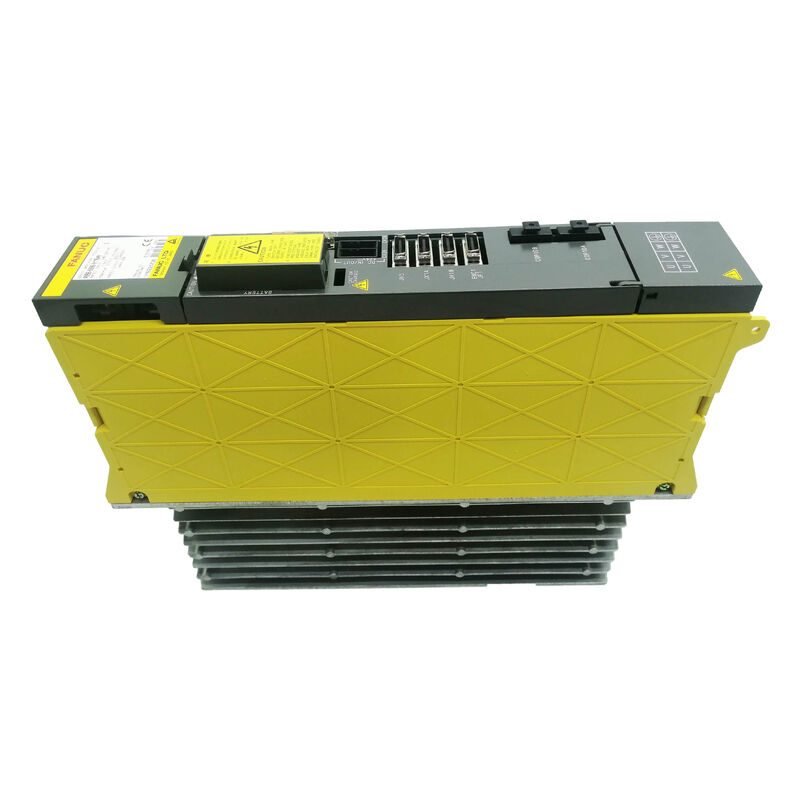
FANUC A06B-6096-H206 | Alpha SVM2-40/40 Dual-Axis Servo Module — 12.5A / 12.5A / FSSB / Series 16i / 18i / 21i
Part Number: A06B-6096-H206
Manufacturer: FANUC Corporation (Japan)
Product Type: Dual-Axis AC Servo Amplifier Module — Alpha Series
SVM2-40/40 — Two Axes at Equal Current Class
The A06B-6096-H206 is the SVM2-40/40 — the symmetric dual-axis Alpha servo module, with both L and M axes at identical 12.5A rated output. The 40/40 designation means both channels drive motors of the same current class at matched capability. This is the configuration for machine tools where two axes carry equivalent load profiles — twin axes sharing a single amplifier slot in the cabinet.
The A06B-6096 series uses FSSB fibre-optic communication between the CNC and the drive module. This is the key difference from the earlier 6090 and 6066 Alpha C series, which used parallel PWM interface wiring. The 6096 SVM also draws from a shared DC bus supplied by a companion PSM (Power Supply Module), rather than self-rectifying its own AC input as the earlier 6090 SVUC series did. These two changes — FSSB communication and shared DC bus — define the 6096 as the Alpha SVM generation matched to Series 16i/18i/21i i-series CNC systems.
H206 in the A06B-6096 Dual-Axis Range
The suffix encodes current class per channel. The H206 at 12.5A per channel is a higher-capacity variant within the SVM2 family. For axes driving motors that require more current than smaller SVM2 variants provide, H206 is the correct specification. For asymmetric motor pairs (where L and M axes drive motors of different sizes), asymmetric SVM2 variants with different per-channel current ratings would be specified. H206 is for matched pairs.
Confirm the installed module's part number from its own label — adjacent suffixes within the SVM2 family differ in current class. The physical form may appear similar but the electrical specification differs.
Key Specifications
| Parameter |
Value |
| Part Number |
A06B-6096-H206 |
| Designation |
SVM2-40/40 |
| L-Axis Output |
12.5 A |
| M-Axis Output |
12.5 A |
| Interface |
FSSB fibre-optic |
| DC Bus |
Shared (requires companion PSM) |
| Compatible CNC |
Series 16i, 18i, 21i |
| Origin |
Japan |
FAQ
Q1: What is the difference between A06B-6096-H206 and the H204 (SVM2-20/20)?
Both are dual-axis Alpha SVM modules with FSSB interface. The H206 provides 12.5A per channel; the H204 provides a lower rated current per channel. The correct variant is determined by the rated current of the connected servo motors. Substituting H204 for H206 on motors that require the higher current rating will produce overcurrent faults.
Q2: Does the A06B-6096-H206 require an external PSM power supply?
Yes. The 6096 SVM draws from a shared DC bus supplied by a companion Alpha PSM (A06B-6087 or A06B-6088 series). The PSM rectifies incoming three-phase AC and provides the DC bus voltage for all connected SVM and SPM modules. Confirm the PSM's power rating covers the combined load of all connected modules.
Q3: Both L and M axes alarmed simultaneously. Is this a module fault?
Simultaneous alarms on both axes of an SVM2 module can indicate a module-level fault (shared DC bus loss or control power failure) or an upstream condition (PSM fault, FSSB communication break). Check the PSM status first and verify the FSSB cable connections to this module. A PSM fault will take all SVM and SPM modules offline at once, producing simultaneous alarms across all axes.
Q4: Does replacing the A06B-6096-H206 require CNC parameter changes?
For a like-for-like SVM2-40/40 replacement, no CNC parameter changes are typically needed — axis parameters are stored in the CNC's SRAM and are not affected by the amplifier swap. After installation, verify the FSSB axis assignment in the CNC matches the module's physical position in the drive cabinet.
Q5: Where is the A06B-6096-H206 sourced?
Through the FANUC CNC aftermarket — specialist Alpha amplifier dealers and CNC repair companies hold exchange and surplus stock. Confirm the H206 suffix specifically. A functional test under actual motor loads on both channels is the most reliable acceptance verification.


 Your message must be between 20-3,000 characters!