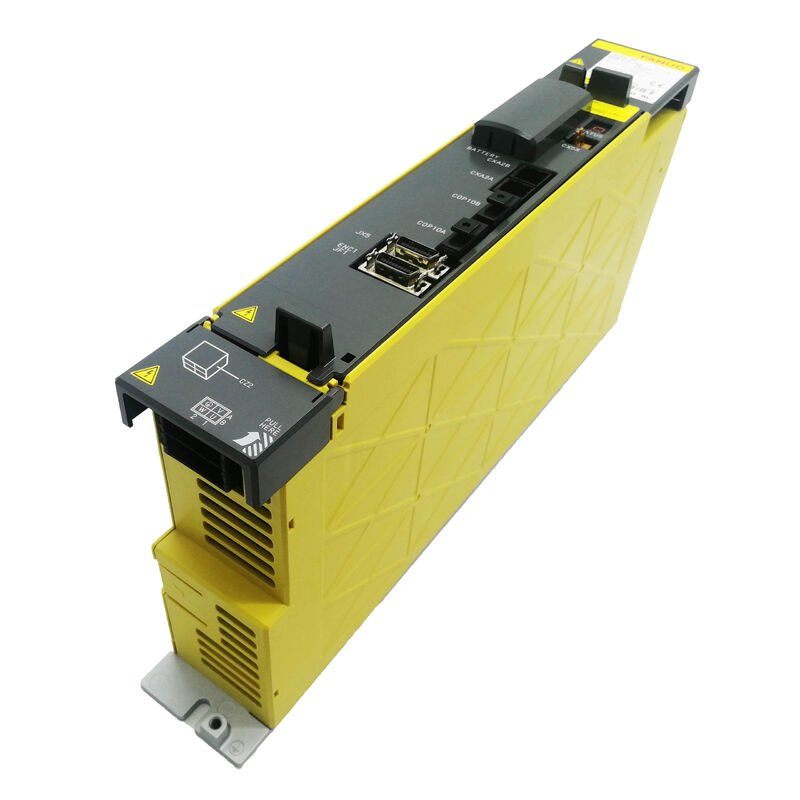
Fanuc A06B-6114-H103 | Alpha i Single-Axis Servo Amplifier Module SVM1-20i — 6.5A, 283–339V DC, FSSB, HRV3, CNC 16i / 18i / 21i / 0i-B
Overview
The Fanuc A06B-6114-H103 is the SVM1-20i — the single-axis, smallest-current member of Fanuc's alpha i (ai) servo amplifier module family.
As the successor to the first-generation A06B-6096-H102 (SVM1-20), it reflects Fanuc's move to the i-generation servo architecture that arrived with the 16i/18i-B and 21i-B controls in the early 2000s and has since become the backbone of Fanuc CNC systems worldwide.
On machine tools built by the world's major builders — machining centres, turning centres, five-axis machines, and transfer lines — the A06B-6114-H103 is the go-to module wherever a single light-to-medium duty axis needs to be driven within the alpha i servo system's shared power rail.
The module is a 60mm wide servo amplifier that slots into the alpha i servo system rack alongside other SVM and aiSP spindle modules, all drawing DC power from the common aiPS power supply.
The narrow 60mm profile is the physical marker of the SVM1-20i's position at the low end of the current range — wider modules (80mm, 90mm) carry the higher-current SVM1-40i and SVM1-80i designations. In a typical machining centre configuration, an X or Y axis driven by an αiS 4/5000 or smaller motor will be served by the A06B-6114-H103, while the Z-axis or pallet axis — requiring more torque — takes an SVM1-40i or higher.
Communication between the CNC and the A06B-6114-H103 runs exclusively through FSSB — Fanuc Serial Servo Bus — a proprietary fibre-optic serial link that transmits position commands and receives feedback between the CNC's servo card and each amplifier module in the system.
Each SVM1-20i occupies one FSSB axis slot; the CNC's servo card identifies the amplifier and its attached motor during system initialization via the FSSB protocol's handshaking sequence.
This means the CNC's servo parameters must correctly match the motor type attached to the A06B-6114-H103 — an incorrect motor number in parameter No. 2020 produces an axis mismatch alarm at power-up.
The HRV3 servo control algorithm running inside the A06B-6114-H103 is a significant improvement over the HRV2 algorithm in the first-generation SVM1-20. HRV3 uses a higher speed calculation cycle (62.5µs velocity loop cycle), producing better velocity regulation under dynamic cutting loads and more precise position control during acceleration and deceleration phases.
For CNC applications involving high-feed rate contouring, complex five-axis surface paths, or aggressive spindle-synchronised operations, HRV3's tighter loop computation makes a real difference in surface finish and positional accuracy.
Key Specifications
| Parameter |
Value |
| Model |
SVM1-20i |
| Rated Output Current |
6.5A (single L axis) |
| Transistor Rating |
20A IPM |
| DC Link Input Voltage |
283–339V DC |
| Rated Input Power |
2.5kW |
| Max Output Voltage |
240V AC |
| Control Interface |
FSSB (optical fibre) |
| Servo Algorithm |
HRV3 |
| Width |
60mm |
| Wiring Board |
A16B-2203-0691 |
| Control PCB |
A16B-2101-004x |
| Replaces |
A06B-6096-H102 |
| CNC Compatibility |
15i-B, 16i/18i B/C, 21i B/C, 0i-B/C/D |
Alpha i System Architecture — Where the SVM1-20i Fits
Understanding the A06B-6114-H103's role requires understanding how the alpha i servo system is built. The system is modular: one or more aiPS power supply modules (A06B-6110 series) rectify the incoming three-phase AC and produce the shared DC bus voltage (283–339V DC) that all the servo and spindle modules in the rack draw from.
The SVM modules — SVM1, SVM2, SVM3 — are the inverter stages that convert this DC bus voltage into the variable-frequency, variable-voltage AC that drives the servo motors. Each SVM contains IPM transistor modules, gate drive circuits, and the servo control card, all enclosed in Fanuc's 60mm to 90mm modular housings.
The A06B-6114-H103 sits at the narrow end of this range. Its single 20A IPM transistor module produces a continuous rated output of 6.5A — sufficient for alpha i motors in the 200W to approximately 500W continuous torque range, depending on the motor's current-to-torque conversion.
Motors outside this current range require a higher-rated SVM.
The module's 2.5kW input rating from the DC bus also defines the maximum power the aiPS power supply must be sized to supply for this axis plus all others in the system, which is why aiPS selection for a multi-axis machine requires summing the power requirements of all installed SVM and aiSP modules.
FSSB: Why the Fibre Link Matters
The fibre optic FSSB link between the CNC's servo card and the A06B-6114-H103 is not merely a convenience — it is a fundamental part of why the alpha i system achieves the servo loop performance it does.
Electrical noise immunity is perfect on a fibre link: motor switching transients, power supply ripple, and EMI from adjacent equipment have no effect on the serial data stream.
The link carries position commands, current commands, feedback data, and system alarms between the CNC and each amplifier at a high update rate that would be impossible over conventional copper signal wiring without substantial shielding and layout discipline.
For the machine installer, FSSB also simplifies wiring considerably. Instead of the wire-heavy connections that earlier analogue servo architectures required between the CNC and each axis amplifier, FSSB daisy-chains the amplifiers together with a single fibre run from the CNC's servo card output to the first module's COP10A/COP10B connector pair, then from module to module down the chain.
The CNC assigns axis numbers to modules based on their position in the chain and their response to the initialisation query — a clean architecture that supports rapid system commissioning and straightforward fault isolation.
HRV3 Control — Velocity Loop and Axis Performance
The HRV3 designation on the A06B-6114-H103's control card refers to High Response Vector control, version 3.
The key improvement in HRV3 over HRV2 is the velocity loop update cycle: HRV3 runs its velocity calculation at a 62.5µs cycle, compared to HRV2's 125µs.
Halving the calculation cycle means the velocity loop detects and corrects speed deviations twice as frequently, producing a servo that responds to load disturbances — such as cutter engagement forces, axis reversal friction, and machine structural compliance — with noticeably better speed stability.
The practical result is improved surface finish on profiled cuts where velocity regulation during direction changes directly affects the workpiece surface.
HRV3 also enables higher servo gains before stability becomes a concern, which allows tighter following error on fast contouring paths and better axis synchronisation in interpolated multi-axis moves.
For machine builders specifying servo systems for their more demanding machines, the HRV3 capability of the A06B-6114-H103 is an important parameter that distinguishes it from first-generation FSSB modules.
Replacement Context — Upgrading from A06B-6096-H102
The A06B-6114-H103 is the designated i-generation replacement for the A06B-6096-H102 (SVM1-20, HRV2, first FSSB generation). The two modules serve the same physical motor range and connect through the same FSSB fibre topology, but they are not drop-in interchangeable without CNC configuration consideration.
The H103 requires a power supply from the A06B-6110 series aiPS units; the H102 draws from the older A06B-6087/6088/6089 series power supplies.
Machines originally built with the H102 on the older power system cannot replace only the SVM without also addressing the power supply compatibility — a full drive system review is necessary before specifying the upgrade.
For machines already running on the A06B-6110 series aiPS power supplies with H102 SVM modules installed, the H103 is a direct functional replacement.
Servo parameters should be verified after replacement to confirm the motor type number and gain settings match the installed motor.
Internal Boards and Serviceable Components
The A06B-6114-H103 contains two main boards: the A16B-2203-0691 wiring board handles the power section interface and I/O connections, while the A16B-2101-004x FSSB control card manages the servo algorithm computation and fibre communication. Neither board is sold as a separate spare — Fanuc and authorised service providers treat the module as the service unit.
However, several components within the module are separately available and replaceable by qualified service engineers: the 20A IPM transistor module, the internal cooling fan, the battery pack (for encoder backup), and the DC bus fuses.
These component-level repairs extend the service life of the A06B-6114-H103 substantially for units that have suffered isolated component failures rather than widespread board damage.
FAQ
Q1: What is the difference between the A06B-6114-H103 and the A06B-6114-H104 (SVM1-40i)?
The H103 (SVM1-20i) carries a single 20A IPM and is rated at 6.5A continuous output. The H104 (SVM1-40i) carries a single 40A IPM and is rated at 12.5A continuous output.
The H104 is physically wider (80mm vs 60mm for the H103) and powers larger alpha i motors — the αiS 8/3000, αiF 4/5000, and similar — that draw more than the H103's 6.5A continuous.
Both modules connect via FSSB and use HRV3. Motor models outside the H103's current range simply require the H104 or a higher-rated module; no configuration can extend the H103's 6.5A output rating.
Q2: What happens if the wrong motor type number is loaded in CNC parameter No. 2020 for the A06B-6114-H103 axis?
A mismatched motor type number causes the SV5136 alarm (improper servo motor) at power-up, and the axis cannot be enabled.
In some configurations, an SV0401 (axis not ready) or SV5061 (servo error overflow) may also appear.
The motor type number must correspond to both the physical motor connected and the amplifier's current rating — if the type number specifies a motor requiring more current than the H103's 6.5A rated output, the CNC will detect the mismatch.
Correct the parameter to the motor type number corresponding to the installed motor from Fanuc's servo motor and amplifier parameter list, then cycle power to clear the alarm.
Q3: Can the A06B-6114-H103 drive a beta i series (βiS) motor, and if so, which models?
Yes. The H103 is compatible with a defined set of beta i series motors that fall within its 6.5A current rating: βiS 0.4/5000, βiS 0.5/6000, βiS 1/6000, βiS 2/4000, βiS 4/4000, βiS 8/3000, and βiS 12/2000.
Beta i motors used in FSSB configurations require the alpha i amplifier series (not the separate beta i SVU amplifier units) and connect via the same encoder feedback and motor power interfaces as alpha i motors.
The CNC parameter No. 2020 motor type number for beta i motors differs from the alpha i entries — confirm the correct beta i motor type number from the applicable Fanuc servo motor parameter list.
Q4: The A06B-6114-H103 shows alarm code "6" or "b" on its LED display — what does this indicate?
Alarm 6 on the SVM1-20i LED display indicates inverter overheat. Alarm "b" indicates an L and M axis over-current condition (note: the SVM1-20i has only one axis, so "b" appearing on a single-axis module typically indicates the IPM over-current detection circuit has activated on the single L axis output).
For alarm 6 (overheat): check the module's internal cooling fan for operation, verify the cabinet ambient temperature, and confirm adequate air flow through the drive rack.
For alarm "b": check for motor winding shorts, short circuit in the motor power cable, or a failed IPM transistor inside the module.
A persistent "b" alarm with the motor disconnected points to an IPM failure requiring module service.
Q5: Is it possible to use the A06B-6114-H103 in a system that still has first-generation A06B-6087 or A06B-6089 power supply modules?
No, this is a critical compatibility restriction. The A06B-6114-H103 (SVM1-20i, i-generation) is designed specifically for the A06B-6110 series aiPS power supply modules.
It cannot be powered from the older A06B-6087, A06B-6088, or A06B-6089 series power supplies used with the first-generation A06B-6079 and A06B-6096 SVM modules.
The DC bus voltage, control power supply voltages, and bus communication protocols between the power supply and the SVM modules differ between the two generations. Mixing them in a single drive system is not supported and will cause the system to fail to initialise or damage components.
A full drive system upgrade — replacing both the power supply and all SVM modules together — is required when transitioning from first to i-generation servo hardware.



 Your message must be between 20-3,000 characters!