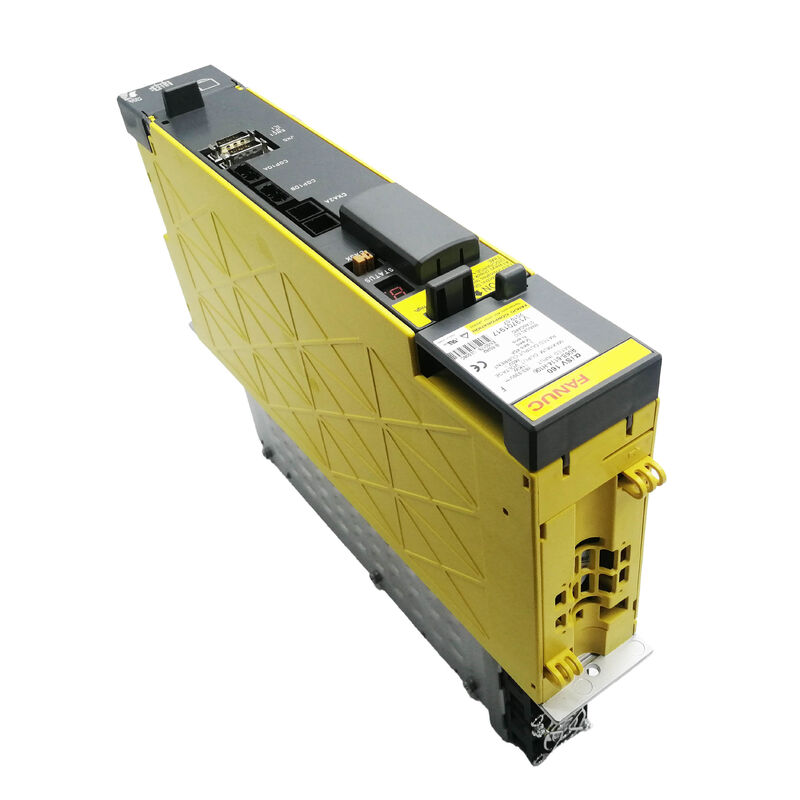
FANUC A06B-6114-H106 — SVM1-160i: The Current Ceiling of the 60mm Alpha i Module
There's a line in FANUC's alpha i SVM range where the physical size jumps. Modules rated at 80i, 160i, and below all share the same 60mm cabinet footprint — they look identical from the front of a drive cabinet. Step up to the 360i (H109) and the width nearly triples, to 150mm, with three internal IGBT transistors to match. The H106 sits right at that boundary: at 45A rated output and a single 160A IGBT module, it is the highest-current drive in the alpha i series that still occupies the standard 60mm slot.
That matters for cabinet design and for replacement planning. A machine built with a 60mm module layout can accommodate the H106 without any cabinet modification. Upgrading further to the 360-class would require physical rearrangement of the drive stack. For applications driving large alpha i servo motors in the 22- to 40-class current range — the kind of motors used on heavy rotary axes, large milling heads, and high-torque primary axes on mid-to-large machining centers — the SVM1-160i delivers what those loads need while staying within the standard physical envelope.
Sande Electric holds stock of the A06B-6114-H106 in both new and inspected-used conditions, with worldwide dispatch within 0–3 working days.
The Dual Fan: What Separates the 160i From the 80i at a Glance
When comparing an A06B-6114-H105 (SVM1-80i, 19A) to an A06B-6114-H106 (SVM1-160i, 45A) sitting side by side in a cabinet, the physical width is identical — 60mm each. The front panel indicator LED is in the same position. The FSSB fiber optic connectors are the same type. But look at the heatsink on the back: the SVM1-80i carries a single external fan on the heatsink; the SVM1-160i carries two.
That second fan is the thermal signature of the 160-class. A single 160A IGBT module running at 45A continuous output generates substantially more heat than the 100A transistor in the smaller module. FANUC's engineers kept the footprint at 60mm by managing the increased thermal load with the additional external fan rather than expanding the cabinet width. The tradeoff is that two fans means two potential failure points for thermal management. On a machine where the SVM1-160i drives a primary high-duty axis, keeping a spare fan assembly — or at minimum monitoring the heatsink fan status through the CNC's maintenance screen — is more important than it would be on a lighter-duty module.
An alarm code "F" on the front LED indicates the external cooling fan has stopped. On the H106, this alarm can indicate failure of either external fan without specifying which one. A quick physical check of both fans on the heatsink is warranted before assuming the module itself has failed.
Motor Compatibility and Where This Drive Is Used
The SVM1-160i is designed around the mid-to-large alpha i servo motor range. Verified compatible motors include the α22/4000iS, α30/3000i, α30/4000iS, α40/3000i, and α40/4000iS. These are motors that appear on the primary linear axes of mid-size vertical machining centers and horizontal boring mills — axes carrying significant workpiece or fixture weight where the motor needs sustained high torque at low speed as well as fast acceleration for rapid traverse.
For perspective within the 6114 single-axis module ladder: the H105 (SVM1-80i at 19A) handles motors in the α4 to α8 class — lighter-duty secondary or auxiliary axes. The H106 at 45A steps up to the α22 through α40 class — the primary milling and positioning axes on machines of meaningful working volume. The next step up from the H106 within single-axis modules is the H109 (SVM1-360i at 115A), which is reserved for the largest alpha i motors in the α50 and αC50 class, and requires the substantially wider 150mm chassis.
The 45A continuous rating also means the H106 supports alpha i motors running at higher acceleration profiles without triggering over-current faults during rapid moves, provided the aiPS power supply feeding the DC bus has been correctly sized for the total connected load.
Architecture: Still SVM, Still Needs the aiPS Bus
Like all modules in the 6114 alpha i series, the A06B-6114-H106 is an SVM — Servo Module. It does not contain its own AC-to-DC power supply. It draws DC bus power from a shared aiPS (Alpha i Power Supply) module, typically from the A06B-6110 or A06B-6111 series, which rectifies the incoming three-phase AC and maintains the common DC link for all SVM and spindle amplifier modules on that bus.
This is the defining structural difference from the older 6090 SVUC series (such as the A06B-6090-H244 covered elsewhere in this catalog) and from the 6093 beta SVU family, both of which contain their own built-in power supplies. The SVM bus architecture centralizes power conversion and regeneration handling in the aiPS, while the servo modules focus exclusively on motor control. For a replacement of an existing H106 in a machine that already has a functioning aiPS, this is transparent — the replacement module connects to the same DC bus connectors as the original.
Technical Specifications
| Parameter |
Detail |
| Part Number |
A06B-6114-H106 |
| Also Known As |
A06B6114H106 |
| FANUC Designation |
SVM1-160i (Alpha i Servo Module) |
| Series |
FANUC 6114 Alpha i |
| Unit Type |
SVM (requires shared aiPS power supply) |
| Axis Count |
Single-axis (L-axis) |
| Rated DC Input |
283–339V DC, 11 kW |
| Rated Output Current |
45A (L-axis) |
| Max Output Voltage |
240V AC |
| IGBT Configuration |
One 160A transistor module |
| Control Interface |
FSSB (Fiber Optic Serial Servo Bus) |
| Wiring Board |
A16B-2203-0662 |
| FSSB Control Card |
A16B-2100-074x or A16B-2101-004x |
| Physical Width |
60mm |
| Cooling |
Internal fan + dual external heatsink fans |
| Compatible Power Supply |
A06B-6110 series aiPS |
| Compatible Motors |
α22/4000iS, α30/3000i, α30/4000iS, α40/3000i, α40/4000iS |
| Compatible CNC |
FANUC Series 15iB, 16i/18i B/C, 21iB/C; 0i-C/D |
| Software Variant |
#N (available; confirm if required) |
| Operating Temperature |
0°C to 55°C |
| Humidity |
10%–90% RH (non-condensing) |
| Dimensions |
80 × 325 × 242 mm |
| Weight |
4.4 kg |
| Manufacturer |
FANUC, Japan |
| Certification |
CE, RoHS |
| Condition Available |
New / Used (inspected) |
| MOQ |
1 piece |
| Daily Supply Capacity |
Up to 100 pcs |
| Dispatch |
0–3 working days from confirmed payment |
| Packaging |
Original packing |
The HRV Servo Control Advantage
The A06B-6114-H106, as part of the alpha i servo module generation, supports FANUC's HRV (High Response Vector) current loop control. HRV2 and HRV3 modes, when enabled through CNC parameter settings, operate the current control loop at significantly higher sampling rates than earlier servo generations. The practical result is tighter velocity control at low speeds, smoother surface finish on contoured cuts, and reduced following error on axes that change direction frequently.
For machines doing precision boring, jig grinding, or fine surface milling where the α30 or α40 motor is driving a primary axis through tight contouring moves, the HRV servo control in the 6114 generation provides measurably better performance than what the older 6096 or 6090 series amplifiers could deliver on the same motors. If a machine was previously running an older alpha series amplifier and has been upgraded to 6114, re-tuning the HRV mode after the upgrade can recover surface quality that may have degraded in the original amplifier's later service life.
Alarm Code Reference
| LED Code |
Alarm |
Description |
| 1 |
FAL |
Internal fan stopped |
| 2 |
LV5V |
Low control power voltage |
| 5 |
LVDC |
Low DC link voltage |
| 6 or b |
— |
Inverter overheat (6) / L-axis over-current (b) |
| F |
— |
External cooling fan stopped |
| P |
— |
FSSB communication error |
| 8 |
HCL |
L-axis over-current |
| 8. (dot) |
IPML |
L-axis IPM alarm |
| L |
— |
FSSB disconnect at COP10A |
| U |
— |
FSSB disconnect at COP10B |
The distinction between alarm 8 (HCL, over-current detected by external sensor) and alarm 8. (IPML, IPM module self-protection) guides the troubleshooting path: HCL points toward motor wiring or motor condition checks; IPML points toward the IGBT module itself and its thermal environment.
Condition Options
New-old-stock units are genuine FANUC product in original packaging, suitable for machines where reliability margin and remaining service life are priorities. These carry a 12-month warehouse warranty.
Used inspected units are tested for L-axis output function, FSSB communication integrity, and operational status. They carry a 3-month warranty and suit planned or budget-constrained replacements where the machine's duty cycle is moderate. Confirm condition availability before ordering, as 6114-series stock levels on specific models fluctuate with supply from decommissioned machines.
Ordering, Payment & Shipping
Worldwide dispatch via DHL and FedEx within 0–3 working days of confirmed payment. Combined shipping available on multi-item orders.
Payment options:
- Bank Transfer (T/T) — all order values
- PayPal — orders up to USD $500
- Western Union — all order values
Import duties and local taxes are the buyer's responsibility at destination.
Warranty & Returns
| Condition |
Warranty Period |
| New / Unused |
12 months |
| Used / Inspected |
3 months |
Returns accepted for units arriving damaged, incomplete, not as described, or confirmed non-functional within 4 days of receipt. Unit must be returned in original condition with warranty label intact. Return shipping is at the buyer's expense. No returns for incorrect orders or change of mind.
Frequently Asked Questions
Q1: The SVM1-160i (H106) and SVM1-80i (H105) look the same width in the cabinet. How can I confirm which model is actually installed on my machine?
A: Both modules are 60mm wide with the same general front-panel layout, so visual inspection from the front alone doesn't distinguish them reliably. The definitive confirmation is the part number label on the side of the module — the full FANUC part number including the H105 or H106 designation is printed there. If the label is worn or damaged, check the FANUC CNC's servo maintenance screen: the CNC reads the amplifier's identity through the FSSB link and displays the connected module designation on startup. The physical tell is the heatsink: the H105 (SVM1-80i) has a single external fan on the heatsink; the H106 (SVM1-160i) has two. If you see a pair of fans on the back of the heatsink, it's the 160i. Motor nameplate data also confirms this — α22 and larger motors require the H106 or a higher-class module; α8 and smaller motors point to the H105.
Q2: My machine shows alarm "F" (external cooling fan stopped) on the H106. Does that always mean the module needs replacement?
A: Not necessarily — alarm F on the SVM1-160i indicates that one or both of the dual external heatsink fans has stopped or fallen below the minimum speed threshold, but this does not by itself indicate an internal module failure. The external fans on the heatsink are field-serviceable components. If the module is otherwise functioning and the alarm appeared without a concurrent IPM or over-current alarm, inspect both external fans physically: dust accumulation and bearing wear are the most common causes of fan failure on drives that have been in service for several years. Replacing the failed fan often clears the alarm without replacing the module. However, if the machine continued to run with fan failure for an extended period and the heatsink temperature rose significantly, inspect the IGBT module condition carefully — sustained overheating can degrade the transistor even if no IPM alarm was triggered. Contact us about fan replacement parts or full module exchange depending on your findings.
Q3: Can the A06B-6114-H106 be used to drive an α40/4000iS motor on a machine that previously used an A06B-6117-H304 (alpha i 200V three-axis module) for the same axis?
A: Yes, the A06B-6114-H106 is compatible with the α40/4000iS motor and can drive it as a single-axis replacement in a restructured drive cabinet. The key considerations in this substitution are: first, the H106 is an SVM module and requires a DC bus from an aiPS power supply, which the 6117 three-axis module also uses — so if the aiPS is already present and sized for the load, the electrical architecture is compatible. Second, the motor code parameter in the CNC (parameter 2020 for the relevant axis) must correctly identify the α40/4000iS so that current limits, HRV mode settings, and protection thresholds are properly configured for that motor. Third, the FSSB axis assignment may need adjustment if the axis formerly occupied a position in the three-axis module's L/M/N sequence, since the H106 presents as a single-axis module on the FSSB chain. Review the CNC's FSSB configuration screen after installation to verify the axis mapping is correct.
Q4: Is there a meaningful performance difference between the H106 and the older 6096 or 6117 series amplifiers when driving the same alpha i motor?
A: Yes, for precision contouring and surface finish applications the difference is real and measurable. The 6114 alpha i series introduces HRV2 and HRV3 current loop control, operating at higher sampling rates than the 6096 and 6117 series. At high feed rates on curved tool paths, the tighter current loop of the 6114 reduces velocity fluctuation and following error compared to the earlier amplifier generations. For roughing cuts and coarse operations the difference is minimal, but for fine contour finishing, precision boring, or any axis where surface quality directly reflects servo performance, the 6114 generation amplifier provides a meaningful upgrade even when driving the same motor that was previously connected to an older series module. If you are replacing a 6117 or 6096 module with a 6114, re-initializing servo parameters after installation and tuning the HRV mode with the CNC's servo tuning function will capture the full performance benefit of the newer amplifier.
Q5: What aiPS power supply is needed to support the A06B-6114-H106, and how is the total bus load calculated?
A: The A06B-6114-H106 draws from the DC bus with a rated input of 11 kW at the 283–339V DC link voltage. The aiPS module must be selected with a continuous power rating sufficient to cover the sum of all SVM and spindle amplifier modules sharing the same bus. For example, if a drive cabinet has one H106 (11 kW) plus two smaller SVM modules and a spindle module, the total rated input power of all connected modules determines the minimum aiPS rating required. FANUC's A06B-6110 series covers a range of power ratings — common choices include the H045 (5.5 kW), H055 (11 kW), H075 (15 kW), and larger variants up to 37 kW. The H106 on its own, at 11 kW rated input, can be fed by a single A06B-6110-H055 aiPS if it is the only module on the bus. In practice, most machines with an H106 are multi-axis installations, so the aiPS is selected for the combined bus load with appropriate headroom. If you are uncertain whether an existing aiPS in your cabinet is adequate for an expanded drive configuration, contact us with the full list of modules being powered and we can advise on sizing.
Contact for availability and pricing: Ms. Amy — sales01@sande-elec.com | Skype: sandesales01 | Tel: +86 18620505228


 Your message must be between 20-3,000 characters!