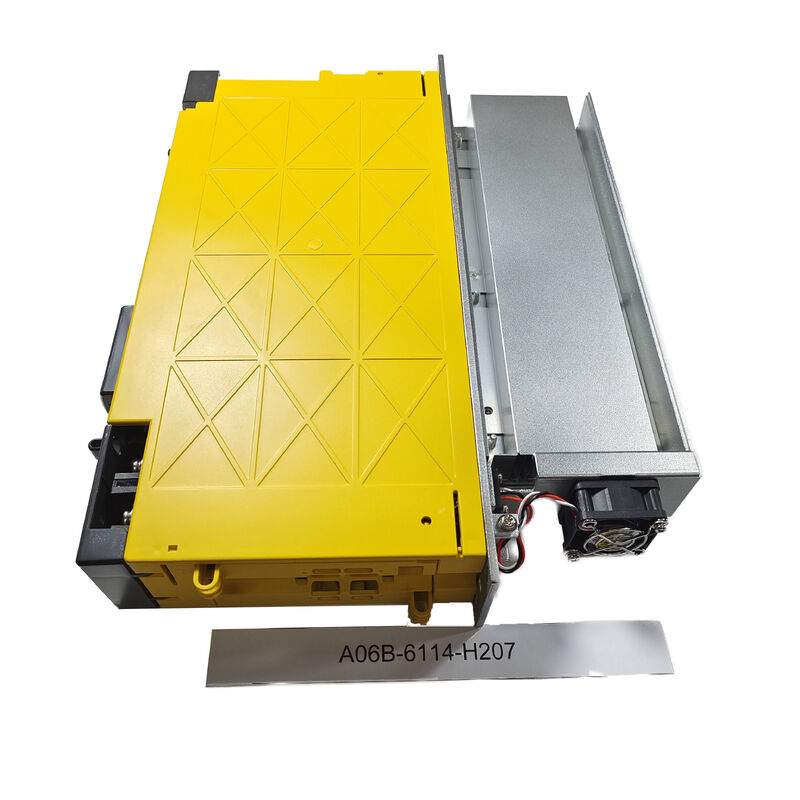
FANUC A06B-6114-H207 | Alpha i SVM2-40/40i Dual-Axis Servo Module — 13A / 13A / 200–240V / FSSB / i-Series
Symmetric Dual Axis — 40/40 Current Class
The A06B-6114-H207 is the SVM2-40/40i — FANUC's Alpha i dual-axis servo module with equal 13 Arms / 40 A peak rated output on both the L and M channels. The 40/40 class designation means both axes are at identical current capacity, not a mixed pairing where one channel is larger. This is the specification for machine tools where two servo axes share a single module at equal load — matched feed axes, symmetric twin-drive configurations, or any layout where the machine builder chose to balance the drive architecture across both channels.
Within the A06B-6114 family, the H207 sits alongside mixed-class dual-axis variants (such as 20/40 and 40/80 configurations). The H207 is not interchangeable with those — different current class on one channel changes which motors can be driven and how the CNC's axis parameter set is configured. When replacing an H207, confirm the installed module's full part number. A module that appears identical in the cabinet may be a different variant with asymmetric channel ratings.
Key Specifications
| Parameter |
Value |
| Part Number |
A06B-6114-H207 |
| Designation |
SVM2-40/40i |
| L-Axis Current |
13 Arms / 40 A peak |
| M-Axis Current |
13 Arms / 40 A peak |
| Main Input |
3-phase 200–240V AC |
| Interface |
FSSB |
| CNC |
i-Series Model B |
| Frame |
60mm, external fin |
| Outline/Panel |
Drawing 2, Cut-out 2 |
Physical Fit — 60mm Frame, External Fin, Panel Cut-out 2
The module occupies a 60mm slot in the Alpha i drive cabinet and uses an external heatsink fin at the rear, classified as Outline Drawing 2 / Panel Cut-out 2 / Maintenance Area 1 in FANUC's physical specification tables. This classification defines the cabinet panel penetration dimensions, the required cooling air space behind the heatsink, and the maintenance access clearance. A replacement module must match these physical specifications — modules from different outline classes will not fit the original cabinet cutout and heatsink arrangement correctly.
FAQ
Q1: What is the A06B-6114-H207 in FANUC's Alpha i lineup?
A 2-axis servo amplifier module — one body driving two servo axes simultaneously. FANUC identifies it as αi SV 40/40 (start-up manual) and SVM2-40/40i (descriptions manual). Both channels are rated at 13 Arms / 40 A peak. It is not a single-axis module and not a 3-axis unit — axis count is one of the core compatibility checks before ordering.
Q2: What current class is this module?
Both the L and M channels are rated at 13 Arms continuous, 40 A peak. This places the H207 in the 40/40 symmetric class — distinct from nearby 20/40 and 40/80 asymmetric variants that look similar in a cabinet but have different per-channel current ratings.
Q3: What CNC interface does this module use?
FSSB (Fiber-optic Serial Servo Bus) via the COP10A/COP10B connectors. This is the standard servo communication interface for i-Series CNCs (Model B). The module is not compatible with older parallel PWM interface architectures (6090 or 6079 series).
Q4: What should be verified before ordering an H207 replacement?
Confirm the exact part number from the installed module's label. Verify the machine uses the i-Series CNC with FSSB. Check the cabinet layout matches the 60mm external-fin frame class (Outline 2, Panel Cut-out 2). Also inspect the FSSB fibre cable connectors and the DC bus connections from the aiPS power supply module before powering up after installation.
Q5: Does replacing the H207 require CNC parameter changes?
For a like-for-like SVM2-40/40i replacement, no CNC axis parameter changes are typically required — motor type parameters and servo gains are stored in the CNC's SRAM and are not affected by the amplifier swap. After installation, verify the FSSB axis assignment matches the module's L and M channel positions in the drive cabinet.


 Your message must be between 20-3,000 characters!