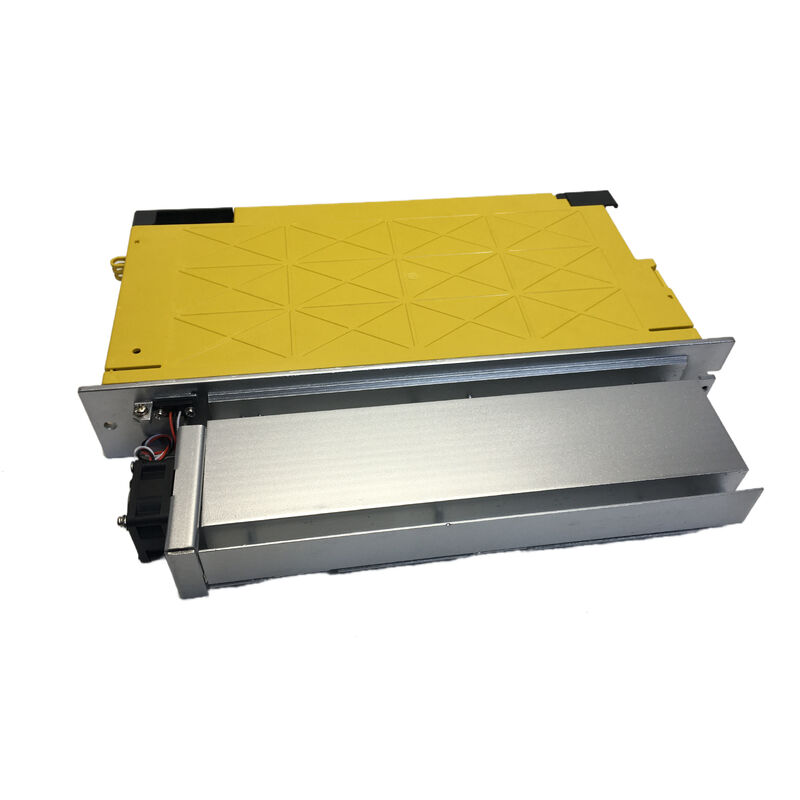
FANUC A06B-6114-H304 AC Servo Amplifier Unit
Alpha i Series | SVM3-20/20/40i | Three-Axis | FSSB Interface | 9.5 kW
Three Axes, One Module, Zero Compromise
Running three servo axes from a single drive module is an elegant solution — fewer cabinet slots, fewer power connections, fewer potential points of failure in the inter-module wiring. The FANUC A06B-6114-H304 is the largest three-axis Alpha i series servo amplifier module, the SVM3-20/20/40i, and it's the variant of choice when two smaller axes and one higher-current axis need to share a single compact housing within a FANUC drive stack.
This module belongs to the A06B-6114 generation of Alpha i amplifiers — the post-2004 i-series that replaced the first-generation FSSB Alpha modules — and connects to FANUC CNC controllers via FSSB (Fanuc Servo Serial Bus) fiber optic communication. It's been found in service across machining centers, turning centers, EDM machines, and robotic systems built around the FANUC 0i, 16i, 18i, 21i, 30i, 31i, and 32i control families.
Technical Specifications
| Parameter |
Value |
| Part Number |
A06B-6114-H304 |
| Module Description |
SVM3-20/20/40i — 3-Axis Alpha i Servo Module |
| Number of Axes |
3 (L, M, N) |
| Interface |
FSSB (Fiber Optic Servo Serial Bus) |
| Rated Input Voltage |
283 – 339 VAC |
| Power Rating |
9.5 kW |
| Max Output Voltage |
240 VAC |
| Rated Output Current — L Axis |
6.5 A |
| Rated Output Current — M Axis |
6.5 A |
| Rated Output Current — N Axis |
13 A |
| Current Rating Designation |
20/20/40i |
| Internal PCB — Wiring Board |
A16B-2203-0680 |
| Internal PCB — Control Card |
A16B-2101-004x |
| Transistor Modules |
Two 20A + one 50A |
| Housing Width |
60 mm |
| Cooling |
Internal fan + external heatsink |
The 20/20/40 Current Architecture — Practical Meaning
The "20/20/40" designation in the module name tells the complete load story. Two axes share identical 20A transistor modules — each delivering a 6.5A continuous rated output — while the third axis carries a 50A transistor module and a 13A rated output. This asymmetric arrangement is deliberate. On a typical three-axis machining center, the two smaller channels handle lighter feed axes (typically X and Y) while the larger N axis drives a heavier axis like Z, which must overcome gravity and tool weight under the full cutting load.
Machine builders and CNC retrofitters routinely specify the H304 over the smaller SVM3-20/20/20i (A06B-6114-H303) precisely when one axis in a three-axis group consistently operates under higher torque demand. Getting the current channel assignment right — connecting the higher-load axis to the N channel — is one of the first commissioning steps that determines whether the module runs within its thermal envelope over a shift.
FSSB: Why Fiber Optic Communication Changes the Drive Cabinet
FANUC's Fiber Optic Servo Serial Bus isn't simply a different connector — it's a fundamentally different approach to the signal path between CNC controller and drive module.
Traditional servo interface wiring carries high-speed digital position and velocity commands over copper signal cables running alongside high-current motor power cables. That physical proximity creates opportunities for noise coupling, which shows up as following errors, encoder alarms, and intermittent axis faults that are notoriously difficult to trace and fix.
FSSB replaces the copper signal path with optical fiber. Light is immune to electromagnetic interference — the drive cabinet can carry kilowatts of switched motor current through adjacent cable runs without any risk of that noise reaching the control signals. The result is a servo system that runs cleanly in electrically hostile environments: next to spindle drives, near welding equipment, in the same cabinet as frequency inverters.
The fiber optic connection also supports FANUC's high-resolution velocity control (HRV) — the firmware-level feature that increases the speed loop sampling rate and tightens velocity control bandwidth. HRV becomes available once the FSSB link is established at the correct communication cycle.
Compatible CNC Controllers
The A06B-6114-H304 is documented in FANUC's FSSB servo amplifier configuration tables for use with the following CNC series:
- FANUC Series 0i (all variants including 0i-MB, 0i-MD, 0i-MF)
- FANUC Series 15i
- FANUC Series 16i / 160i
- FANUC Series 18i / 180i
- FANUC Series 21i / 210i
- FANUC Series 30i / 300i / 300is
- FANUC Series 31i / 310i / 310is
- FANUC Series 32i / 320i / 320is
- FANUC Robot controllers (R-30iA and compatible generations)
The module also supports FANUC Beta series servo motors on the L and M axis channels, per the Beta series servo motor description manual (B-65232EN). For Alpha i series motors on all three channels — including αi4/4000 through αi8/3000i — the H304 is the standard match.
Inside the Module: What's Serviceable
The A06B-6114-H304 is a single housing containing two distinct board assemblies plus the power section. The wiring board (A16B-2203-0680) handles the power interface; the FSSB control card (A16B-2101-004x) manages the fiber optic communication and axis control logic. Neither PCB is available as a separate spare — they are integral to the module.
What is available separately and serviceable without a full module swap:
- Individual IGBT transistor modules (the 20A and 50A units)
- Internal cooling fan
- Battery pack (for absolute encoder position retention)
- Axis fuses
For most field failures — a single transistor module blown by a motor fault, a degraded cooling fan — component-level repair is both possible and cost-effective. Full board failures typically push the economics toward exchange or full module refurbishment.
A Note on the #N Suffix Variant
The A06B-6114-H304#N is the same module with a slightly different suffix indicating a configuration detail (typically related to the feedback connector type or battery backup configuration for the encoder). For ordering and compatibility purposes, the base H304 and the H304#N are functionally equivalent across the supported CNC control families.
Frequently Asked Questions
Q1: What is the difference between the A06B-6114-H304 and the A06B-6117-H304?
Both are three-axis Alpha i SVM3-20/20/40i modules with identical current ratings and the same FSSB interface. The distinction is the control PCB generation: the A06B-6114 series uses a standard Alpha i control card, while the A06B-6117 series is fitted with an HRV (High Resolution Velocity control) capable control card (A20B-2101-004x). The HRV card supports tighter velocity loop bandwidth for applications requiring very smooth low-speed motion. For most standard CNC machining applications, the H304 and H317 perform identically — HRV becomes meaningful primarily in high-precision contouring and grinding applications.
Q2: Can the A06B-6114-H304 be used with older FANUC Alpha (non-i) series CNC controls?
No. The A06B-6114 series uses FSSB fiber optic communication, which requires an FSSB-capable CNC controller. Older Alpha series CNC controls using Type A or Type B copper interface cannot communicate with FSSB modules. If the machine runs an older FANUC control, the correct amplifier generation is the A06B-6079 (Type A interface) or A06B-6080 (Type B interface) series, not the 6114.
Q3: All three axes need to be connected — can unused axis channels be left unconnected?
It depends on the machine configuration. If only two axes are required from a three-axis module, FANUC's parameter settings must correctly reflect which axes are active. Leaving a channel completely disconnected without appropriate parameter configuration can generate axis alarms at power-up. In practice, the module is typically used in machines that genuinely require three axes from a single module; using a two-axis module for a two-axis requirement is the cleaner solution if the third channel is never needed.
Q4: What typically causes this module to fail, and is repair worthwhile?
The most common failure modes are transistor module damage (caused by motor short circuits, overcurrent events, or motor winding faults) and cooling fan failure leading to thermal damage. Transistor failures are component-level repairs that cost significantly less than module replacement. Fan failures, if caught early, are straightforward replacements that prevent the thermal damage that makes a module irreparable. Battery-related encoder alarm faults are maintenance items, not failures — the backup battery should be replaced on a schedule rather than reactively.
Q5: The module is listed as discontinued — how difficult is sourcing?
FANUC has officially discontinued the A06B-6114 series, but the installed base is large enough that a healthy aftermarket continues to supply both new-old-stock and certified refurbished units. Exchange programs — where a faulty unit is sent in and a tested refurbished unit is returned — are the most common procurement route and typically carry 12-month warranties. Lead times from reputable CNC parts specialists are generally short for this model due to sustained demand.


 Your message must be between 20-3,000 characters!