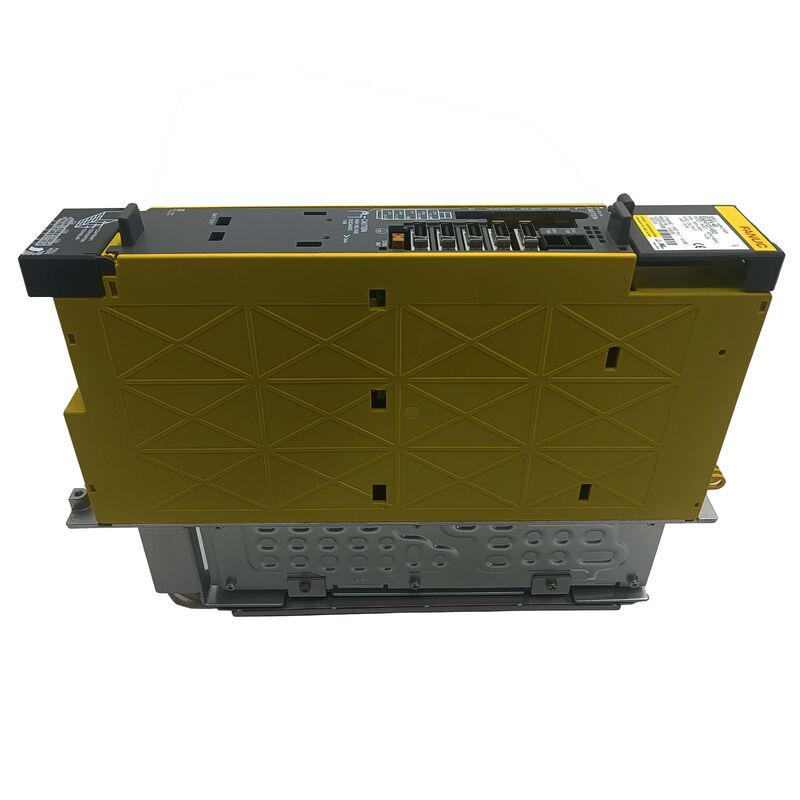
FANUC A06B-6132-H003 | Beta i biSV-40 Single-Axis Servo Amplifier — I/O Link Interface / Built-In PSU / 13.6A
Why I/O Link Instead of FSSB
Most FANUC servo amplifiers — both Alpha and Beta series — communicate with the CNC over FSSB (FANUC Serial Servo Bus). The A06B-6132-H003 is different. It connects to the CNC via the I/O Link interface, routed through the PMM (Power Motion Manager) or a compatible I/O Link master.
This distinction matters in practice. FSSB requires high-speed fibre-optic cabling routed from the amplifier back to the CNC's servo module. I/O Link uses the same wiring infrastructure as the machine's I/O network — far less demanding in terms of cable routing and distance. This is why the biSV-40 was designed specifically for auxiliary and remote servo axes: pallet changers, tool magazine drives, door actuators, and rotary tables that are physically remote from the main drive cabinet. Placing this amplifier close to the mechanism it drives eliminates the need to route high-speed servo bus cabling across the machine.
The I/O Link architecture also means the A06B-6132-H003 can interface with compatible PLCs and robot controllers that support I/O Link master functionality — not just FANUC CNC systems.
Critical Installation Points
Parameters must be loaded. Unlike some drives, the biSV-40 requires servo parameters to be loaded from the CNC controller before it operates. A replacement unit supplied blank will not run straight from the box. Have the machine's parameter backup ready before starting the swap.
Node addressing is mandatory. Each biSV-40 on the I/O Link network requires a unique node address. Set the replacement unit's address to match what the CNC configuration expects — incorrect addressing produces communication errors between the drive and the CNC.
Motor matching is critical. The H003 is rated at 13.6A. This is a low-output variant — pairing it with a motor whose rated current exceeds this limit causes overcurrent faults or premature drive failure. Verify the motor's rated current before ordering.
H003 Within the 6132 Family
| Variant |
Current |
Notes |
| H002 |
Lower than H003 |
Smallest motors only |
| H003 |
13.6 A |
Mid-low power (this unit) |
| H004 |
Higher than H003 |
Larger auxiliary motors |
These are not interchangeable. Always match the original part number exactly.
Key Specifications
| Parameter |
Value |
| Part Number |
A06B-6132-H003 |
| Model |
BSVM1-40i / biSV-40 |
| Interface |
I/O Link (via PMM) |
| Rated Current |
13.6 A |
| Input |
200–240V AC |
| Power Supply |
Built-in |
| Axis |
Single |
| Certification |
CE |
FAQ
Q1: Why does this drive use I/O Link rather than FSSB like the other servo axes?
By design. The biSV-40 was built for auxiliary and remote axes where locating the drive near the mechanism is mechanically convenient. I/O Link uses the machine's existing I/O wiring infrastructure, which has far less demanding cable routing requirements than FSSB. This makes it practical for pallet changers, tool magazines, and rotary tables positioned away from the main drive cabinet.
Q2: Do I need to back up parameters before replacing a failed A06B-6132-H003?
Yes. Servo parameters — axis tuning values, motor type settings, I/O Link node address — are stored in the CNC controller, not in the amplifier. A confirmed backup before the swap prevents any risk of data loss and speeds up re-commissioning. Run the controller's parameter backup function before starting the replacement.
Q3: What should be checked before replacing the amplifier when it shows an I/O Link alarm?
Check the I/O Link cable connections at both the amplifier and the master, and verify the motor is not short-circuited or mechanically seized — both of which can trigger the same drive alarms as an amplifier fault. Read the alarm code from the amplifier's display and look it up in FANUC's alarm reference before ordering a replacement. The fault may be in the motor or cable, not the drive.
Q4: Can the A06B-6132-H003 connect to non-FANUC automation systems?
In principle yes — I/O Link is supported by some non-FANUC PLCs and robot controllers. In practice, the vast majority of biSV-40 units are used in FANUC CNC environments. Verify I/O Link protocol compatibility with the specific non-FANUC system's documentation before committing.
Q5: H003 was the variant in our machine but it is listed as discontinued. Is it still available?
The Beta i 6132 series remains active in the aftermarket because large numbers of machines with auxiliary biSV-40 axes are still running. Both new surplus and inspected used units circulate through specialist FANUC parts channels. Confirm the H003 specifically — H002 and H004 are not direct substitutes.


 Your message must be between 20-3,000 characters!