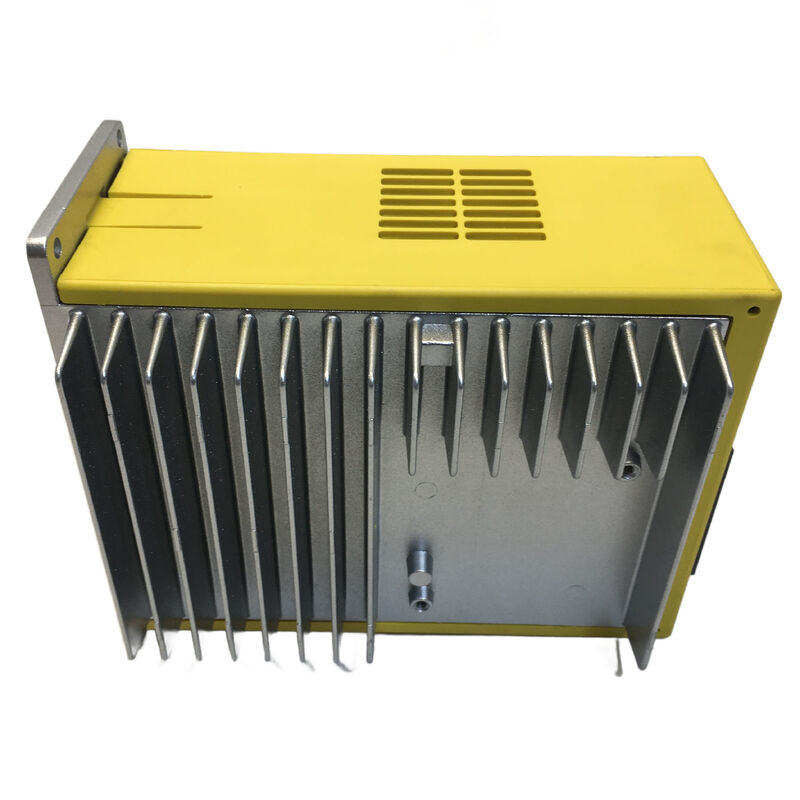
FANUC A06B-6093-H172 AC Servo Amplifier Unit — Product Description
One Part Number, Two OCR Traps — And Why That Matters When You're Searching
Most FANUC drive part numbers that cause search confusion do so because of a single character substitution: the numeral zero rendered as the letter O. The A06B-6093-H172 is different. It carries two distinct OCR misread problems in a single part number.
The first is familiar — "A06B" becomes "AO6B" and "6093" becomes "6O93" when a scanner or low-resolution camera reads the zero digits as the letter O. Every product listing URL on this site reflects that convention because search engines encounter both strings in real-world queries.
The second is specific to this model's suffix, and it's less commonly discussed. The "H172" suffix begins with the digit one — a character that, in FANUC's label typeface and in many printed documentation fonts, is nearly indistinguishable from the uppercase letter I. The result is "HI72" rather than "H172," which is exactly the variant string appearing in this page's URL: AO6B-6O93-HI72. If you searched using that string and landed here, the unit you're looking for is confirmed: it's the A06B-6093-H172, with an all-numeric suffix beginning with the digit 1, not the letter I.
This dual-confusion pattern is worth understanding before you verify your part against documentation, purchase orders, or machine labels. Both substitution types can appear in the same paperwork — sometimes in different places on the same label — and each one can independently send a procurement search in the wrong direction.
The A06B-6093-H172 is a single-axis AC servo amplifier manufactured by FANUC Corporation in Japan, CE certified, and available in new and tested refurbished condition. MOQ: 1 piece.
Entering the A06B-6093 Family: A Different Generation Than the 6096
Buyers who have sourced FANUC 6096-series components before will notice immediately that the A06B-6093 is a different product family. The two series share FANUC's general design philosophy for this era of CNC equipment, but they are not the same generation and are not interchangeable in any meaningful sense.
The A06B-6093 series is a compact servo amplifier family that FANUC developed for its CNC controller systems of the same period. In terms of scale and physical footprint, the 6093 series units are notably more compact than the 6096-series modules — they were designed to fit into tighter cabinet configurations, particularly in smaller machine tools where drive cabinet space was constrained by the machine's overall dimensions. The interface between the 6093-series amplifier and the CNC controller follows the analog servo command protocol common to FANUC systems of this era, where the controller outputs an analog velocity command signal and the servo amplifier closes the current loop independently.
| Comparison Point |
A06B-6093 Series |
A06B-6096 Series |
| Physical form factor |
Compact single/dual-axis units |
Larger multi-axis modules |
| Interface type |
Analog velocity command |
Analog velocity command |
| Compatible controllers |
FANUC Series 0, 3, 6, 10, 11, 12 |
FANUC Series 0, 6, 10, 11, 12 |
| Cabinet integration |
Tighter-fit, compact installations |
Larger drive cabinet assemblies |
| Cross-series compatibility |
No — not interchangeable with 6096 |
No — not interchangeable with 6093 |
The critical takeaway from this comparison: a machine fitted with A06B-6093-series drives requires A06B-6093 replacements. The 6096 series, despite overlapping controller compatibility, uses different physical mounting, different connector configurations, and different internal drive architecture. They cannot substitute for each other.
H172 Suffix Decoded
The suffix structure for A06B-6093 series amplifiers follows FANUC's established convention, with the digits after H carrying axis count and current tier information.
"1" — The leading digit confirms this is a single-axis unit. One servo axis is controlled per physical module. Unlike the dual-axis and three-axis modules in the 6096 series, this module drives exactly one servo motor from one set of output power terminals. A machine with three axes controlled by 6093-series drives would use three separate single-axis modules rather than one multi-axis module.
"72" — The trailing digits identify the current output tier for this specific variant. The "72" tier places this module within a defined current range in the 6093 family. Motors connected to this amplifier were specified and matched to this current tier by the machine builder; verifying that the replacement module matches this suffix exactly is necessary before installation.
Regarding the "I vs 1" ambiguity in documentation: wherever you encounter "HI72" in printed materials, service records, purchase orders, or online search results, treat it as equivalent to "H172." The character is the digit 1 in every case — the letter I never appears in FANUC servo amplifier suffix codes. When placing an order or creating a purchase order, always use A06B-6093-H172 with the digit 1.
Specifications
| Parameter |
Detail |
| Part Number |
A06B-6093-H172 |
| Also Referenced As |
A06B6093H172 / AO6B-6O93-HI72 (OCR variant — "I" = digit 1, "O" = digit 0) |
| Drive Series |
FANUC A06B-6093 Series Compact AC Servo Amplifier |
| Axis Configuration |
Single-axis unit |
| Current Rating Tier |
H172 (tier 72) |
| Manufacturer |
FANUC Corporation |
| Country of Origin |
Japan |
| Certification |
CE |
| Compatible Controller Families |
FANUC Series 0, 3, 6, 10, 11, 12 (analog velocity command interface) |
| Condition Available |
New (Original) / Tested Refurbished |
| Minimum Order Quantity |
1 piece |
| Supply Capacity |
Up to 100 pcs/day |
The Machines That Use 6093-Series Single-Axis Drives
The compact form factor and single-axis architecture of the A06B-6093-H172 point toward a specific category of machine tool. Understanding this context helps maintenance teams confirm they have identified the right component before investing time and shipping cost in a replacement.
Compact vertical machining centers and knee mills. Smaller machining centers from the late 1980s and early 1990s — particularly machines where cabinet depth was constrained by the machine column profile — frequently used compact single-axis drive modules rather than multi-axis module stacks. Each axis got its own drive, housed in a compact cabinet behind or beside the machine column.
Small CNC turning centers. Two-axis CNC lathes with limited cabinet space often used 6093-series drives for the X and Z axes, with each axis independently managed by a separate single-axis module. When one axis develops a servo alarm, the other axis continues normally, which is itself a diagnostic indicator confirming the single-axis architecture.
Dedicated special-purpose CNC machines. Drilling units, tapping centers, and single-purpose automated stations from this era sometimes drove one or two axes through 6093-series amplifiers, particularly in configurations where the machine tool builder selected drives for compactness over the modular integration of the larger 6096-series format.
In all these configurations, an H172 failure manifests as a complete loss of function on the single axis it controls. The alarm code on the CNC display — whether it's a velocity deviation alarm, a current alarm, or a drive-not-ready signal — will reference that specific axis, and the H172 module is the first hardware component to investigate once encoder cables and motor leads have been confirmed healthy.
Sourcing Reality for the 6093 Series
The A06B-6093 series occupies a particular position in the secondary market. These are genuinely old components — machines fitted with 6093-series drives have been in service for well over three decades in most cases. Unlike the 6096-series units, which became available in larger quantities as facilities upgraded from Series 0 and Series 10/11/12 controllers during the 2000s and 2010s, the 6093 series entered the secondary market somewhat earlier and in smaller overall quantities.
This means availability is more variable and less predictable than for some other FANUC legacy series. Specific current tier variants like the H172 are not always in stock simultaneously, and when they do appear, they come primarily from machine decommissions and retooling projects rather than from large-scale surplus inventory releases. For facilities running multiple machines with 6093-series drives, the case for maintaining confirmed shelf spares is stronger than it is for more commonly traded variants — the window between "part is available" and "part has been purchased by someone else" can be short.
When evaluating a refurbished H172 for spare or immediate use, ask specifically whether the unit has been tested under a simulated load rather than just powered up in a bench configuration. A module that initializes correctly without a motor connected can still have output stage issues that only appear under actual axis loading conditions.
Condition, Warranty, and Returns
New / original units — Uninstalled factory stock. Covered by a 12-month warranty. For machines in active production where servo reliability directly affects throughput, new stock eliminates the uncertainty associated with the component's prior operating history.
Tested refurbished units — Recovered from decommissioned machines, cleaned, and verified under functional testing. Covered by a 3-month warranty. Given the age of machines using this series, a well-tested refurbished unit from appropriate equipment can represent a practical and cost-effective maintenance solution.
Report physical damage, description discrepancies, or incomplete shipments on the day of arrival or the following business day. Units found non-functional within 4 days of receipt qualify for return. Warranty does not extend to damage caused by incorrect installation, motor-side fault energy absorbed by the drive, or parameter changes made after delivery. Returns are not accepted for wrong-item purchases or change-of-mind situations — always confirm the part number from the physical label on the failed unit before ordering.
Shipping and Payment
Dispatch: 2 to 4 working days from confirmed payment, Guangzhou warehouse.
Carriers: DHL and FedEx for worldwide delivery. Local pickup at the Guangzhou warehouse is available by advance arrangement.
Combined orders: Multiple components — additional single-axis drive modules, controller boards, or cables — can be shipped together in one consignment. Contact the team to arrange combined shipping before payment.
Payment: T/T bank transfer for all order values. PayPal and Western Union accepted for orders up to USD $500.
Import duties: All destination-country customs duties, taxes, and import fees are the buyer's responsibility. Buyers in regions with limited DHL/FedEx coverage should confirm logistics options before placing an order.
Frequently Asked Questions
Q1: The part number on my machine's drive label shows "H1 72" with a space — is this the same as A06B-6093-H172, or a different variant?
A space between "H1" and "72" in a printed or handwritten record almost certainly represents the same A06B-6093-H172 — label printing artifacts, document formatting, and manual transcription sometimes introduce spacing that isn't part of the actual part number. The authoritative source is the label on the physical drive module itself, which will show the complete suffix without intentional spacing. If the label on the failed unit shows "H172" as a continuous string, that is the number to order. If there is genuine ambiguity in the label text — for instance, if the label is partially obscured or damaged — cross-referencing the FANUC controller's servo parameter data, which encodes the drive type in its parameter set, can help confirm which variant was originally installed.
Q2: My machine has four controlled axes and currently uses four separate A06B-6093 single-axis modules. Is it possible to replace all four with a smaller number of multi-axis modules to reduce cabinet complexity?
Technically, FANUC has offered multi-axis module formats in various series, but substituting modules of a completely different form factor and internal architecture than what the machine was built with is a substantial modification rather than a maintenance replacement. It would require changes to wiring, mounting hardware, parameter data, and potentially feedback signal routing — the kind of project that requires FANUC application engineering involvement and machine retesting, not a cabinet swap during scheduled downtime. For machines that are productively running and where the goal is simply to replace a failed drive, sourcing the matching single-axis H172 is the correct path. The multi-axis consolidation question is worth exploring if the machine is due for a broader refurbishment, but it's a separate project.
Q3: We found "AO6B-6O93-HI72" in a supplier's catalog. Is this actually the same part as A06B-6093-H172, or could it be a different unit?
It is the same unit. The string "AO6B-6O93-HI72" contains three OCR-derived character substitutions from the actual part number A06B-6093-H172: the first "O" in "AO6B" is the digit 0, the second "O" in "6O93" is also the digit 0, and the "I" in "HI72" is the digit 1. All three substitutions are consistent OCR artifacts from FANUC's label typeface. Suppliers who list inventory under both the correct numeric form and the OCR-derived form are simply making the part findable through both search paths — it refers to one physical product. When creating your own purchase documentation, use A06B-6093-H172 with all-numeric characters.
Q4: Our machine was originally commissioned with FANUC Series 6 controllers. The drives are A06B-6093-H172 units. If we upgrade the controller to a more modern FANUC system, can we retain the existing 6093-series drives?
Generally, no — not without significant interfacing modifications. The A06B-6093 series operates on an analog velocity command interface, where the CNC controller outputs an analog signal (typically ±10V) and the drive interprets that as a speed reference. Modern FANUC CNC systems — even from the Series 16/18/21 generation onward — primarily used FSSB (FANUC Serial Servo Bus) for servo communication, a digital serial interface that is fundamentally incompatible with the analog command architecture of the 6093-series drives. A controller upgrade on a machine with 6093-series drives almost always requires concurrent drive replacement to a compatible digital-interface drive series. Attempting to retain the 6093-series hardware while upgrading the CNC controller would require analog interface adapter hardware that is both technically complex and costly — in most cases, a clean drive and controller upgrade is more practical than trying to bridge the interface gap.
Q5: What is the typical failure signature of an A06B-6093-H172 as it approaches end of life, and is there any early warning behavior we can monitor?
Aging 6093-series drives rarely fail without some preceding behavioral changes, though the warning signs can be subtle enough to be attributed to other causes initially. The most common early indicators include axis positioning repeatability gradually degrading — the axis returns to a commanded position within tolerance most of the time, but occasional outlier errors begin appearing in quality inspection data. A second early warning is increased servo alarm frequency during thermal load cycles: the drive runs without fault during the cool part of a shift, then generates velocity deviation or overcurrent alarms during peak production periods when the cabinet temperature is elevated, then clears on its own after a rest period. This thermal pattern is characteristic of power stage components that are marginal under load but recover when cool. A third indicator is increased audible noise from the axis motor during deceleration, which can reflect irregular current delivery from the drive's output stage rather than a mechanical bearing issue. If any of these patterns are present and worsening over weeks or months, beginning the sourcing process before a hard failure occurs is strongly advisable — the H172 is not a part that benefits from a reactive break-fix approach when the early warning signs are already visible.
Compact drive. Correct series. Confirmed part number.


 Your message must be between 20-3,000 characters!