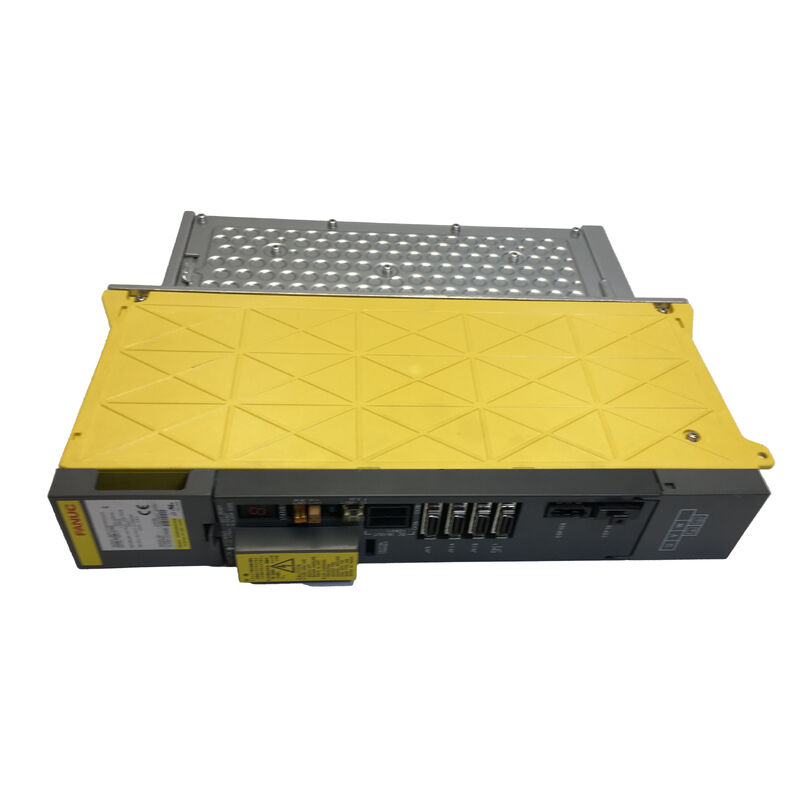
FANUC A06B-6096-H202 AC Servo Amplifier Unit — Product Description
The Drive Sizing Question That Gets Overlooked During Repairs
There's a tendency in emergency maintenance situations to think of all FANUC servo amplifier modules within the same series as interchangeable — as long as the generation is right and the axis count matches, any variant should work. That assumption costs time and money when it doesn't hold.
The A06B-6096-H202 is a dual-axis servo amplifier in FANUC's A06B-6096 series, rated at the "02" current tier. It was designed for machines where the two controlled axes each drive smaller-frame servo motors operating at moderate load profiles — not the heaviest axes in FANUC's 6096-era lineup, but well-suited to the application range the machine builder specified when the equipment was assembled. Replacing it with a higher-current dual-axis variant like the H207 may seem like an acceptable workaround when the H202 is unavailable, but the parameter data in the controller is configured to the H202's specific current tier, and running outside that specification without adjustment creates its own set of problems.
The right part for the H202 slot is the H202. If this is the module number on your failed unit, this page is where the sourcing process begins.
Manufactured in Japan. CE certified. Available in new and tested refurbished condition. MOQ: 1 piece.
The "02" Current Tier: Where It Appears Across the 6096 Family
One of the more useful — and occasionally confusing — aspects of the A06B-6096 naming system is that the current tier suffix appears across both dual-axis and three-axis variants. The "02" tier in particular shows up in two separate modules that serve fundamentally different axis configurations in the same equipment generation.
| Part Number |
Axis Config |
Current Tier |
Typical Application |
| A06B-6096-H202 |
Dual-axis |
02 |
Small two-axis machines; light-load supplementary axis pairs |
| A06B-6096-H207 |
Dual-axis |
07 |
Higher-demand dual-axis configurations; mid-range motor pairings |
| A06B-6096-H302 |
Three-axis |
02 |
Three primary axes on standard 3-axis CNC; same current tier as H202 |
The H202 and H302 share the same "02" current tier, which means the motor current ratings they were designed to work with are in the same range — but one drives two axes and the other drives three. In a machine that uses both an H302 and an H202 together, it's not uncommon for the motors on the H302's three axes and the motors on the H202's two axes to be of similar frame sizes, because the current tier matched them all to the same general power class.
What this means in practice: if you have a machine with both an H302 and an H202, and a servo fault alarm appears on one of the H202's axes, it's worth noting that the motor connected to that axis may be in the same power range as those on the H302 — potentially pointing to a shared upstream supply issue or a cable fault before concluding that the H202 module itself has failed.
Decoding the H202 Suffix
"2" — The leading digit confirms this is a dual-axis module. Two independent servo axes are controlled by a single physical unit, sharing a common power section but maintaining individual drive channels for each axis.
"02" — The trailing digits designate the current output tier for this module. The "02" tier is the lower end of the current range in the dual-axis 6096 family, making the H202 the natural match for machines built around smaller-frame FANUC AC servo motors where high continuous current output was not required by the machine's axis design.
As with all 6096-series listings, the URL for this page contains "AO6B-6O96-H2O2" — a known OCR rendering artifact where numeric zero characters in FANUC's label typeface are read as the letter O. The correct part number for ordering, cross-referencing, and documentation purposes is always A06B-6096-H202, with all-numeric characters. Both string forms refer to the same physical unit.
Specifications
| Parameter |
Detail |
| Part Number |
A06B-6096-H202 |
| Also Referenced As |
A06B6096H202 / AO6B-6O96-H2O2 (OCR variant) |
| Drive Series |
FANUC A06B-6096 Series AC Servo Amplifier |
| Axis Configuration |
Dual-axis module |
| Current Rating Tier |
H202 (tier 02 — lower current range of dual-axis group) |
| Manufacturer |
FANUC Corporation |
| Country of Origin |
Japan |
| Certification |
CE |
| Compatible Controller Families |
FANUC Series 0, 6, 10, 11, 12 (analog servo interface) |
| Condition Available |
New (Original) / Tested Refurbished |
| Minimum Order Quantity |
1 piece |
| Supply Capacity |
Up to 100 pcs/day |
What Kind of Machine Uses an H202?
The A06B-6096-H202's current tier points toward machines whose axis loading requirements fall in the lighter half of the 6096 series' operating range. Several categories of equipment fit this profile.
Compact two-axis CNC lathes. A basic two-axis turning center — X-axis for cross-slide, Z-axis for carriage — paired with smaller-frame servo motors is one of the most straightforward H202 configurations. In these machines, the H202 may be the only servo amplifier in the cabinet, controlling both axes from a single module. Any servo alarm on either the X or Z axis in such a machine focuses attention immediately on the H202 and the components connected to it.
Supplementary light-axis pairs in larger machines. In more complex machining centers or special-purpose equipment, the heavier primary axes might be handled by a higher-current module or a different module type entirely, while a pair of lighter supplementary axes — a rotary table and a tailstock, for instance, or a part transfer mechanism with two controlled axes — is assigned to an H202. In these cases, the H202 represents the lower-demand portion of the axis group, and its failure leaves those supplementary functions inoperative while the primary axes continue normally.
Wire EDM table axis pairs. Wire EDM machines from the 6096-series era often controlled the X/Y table axes through a dual-axis module at a modest current tier, since wire EDM axis loading is characterized more by precision and low-speed smoothness than high current demand. The H202's current tier is consistent with this application profile.
In each case, the consistent thread is that the motors on the H202's two axes were engineered for operation within the "02" current tier from the machine builder's original specification — and matching that specification during replacement is what ensures stable, correctly-tuned axis behavior after the swap.
A Note on Sourcing Low-Current-Tier Modules
There's a reasonable-sounding logic that sometimes leads maintenance teams astray: if a low-current module is unavailable, why not use a higher-current variant from the same family? The axis count matches, the generation matches, and the surplus market often has more high-current modules available.
The practical answer is that it depends entirely on what changes are made alongside the substitution. A different current tier means the servo parameters stored in the CNC controller — including the current loop gain settings, maximum current limits, and related tuning values — are calibrated to the original module's specifications. Installing an H207 in an H202 slot without making corresponding parameter adjustments will produce an axis that may behave erratically under load, generate nuisance alarms, or tune poorly. Making those adjustments requires access to the original machine documentation and familiarity with FANUC's servo parameter structure for this controller generation.
When the H202 is available through the secondary market, the simpler and more reliable path is to source the correct variant and keep the controller parameters unchanged. That's the straightforward maintenance approach, and it's the reason the H202 maintains consistent demand even though higher-current variants from the same series sometimes appear in greater quantities.
Condition, Warranty, and Returns
New / original units carry a 12-month warranty and represent the cleanest option from a long-term reliability standpoint. Stock is drawn from original FANUC production; these units have not been installed or subjected to operational wear.
Tested refurbished units carry a 3-month warranty and are recovered from machines that have been decommissioned, upgraded, or parted out. Units are functionally tested before listing. For facilities managing tight maintenance budgets, or where the H202 is needed as a standby spare rather than for immediate critical production, tested refurbished stock provides a working component at a lower acquisition cost.
Return conditions: report physical damage, description mismatches, or incomplete delivery on the same day or the following business day after arrival. Units that prove non-functional within 4 days of receipt are eligible for return. Warranty does not cover damage resulting from incorrect installation, motor-side faults passed back into the drive, or controller parameter errors applied after delivery. Returns are not accepted for incorrect purchases or change of mind — verify the part number on the physical label before ordering.
Shipping and Payment
Dispatch: 2 to 4 working days from confirmed payment, Guangzhou warehouse.
Carriers: DHL and FedEx for international shipments. Local warehouse collection available in Guangzhou with advance notice.
Combined orders: Multiple components can be shipped together. Practical when sourcing the H202 alongside other 6096-series modules, controller boards, or servo cables for the same machine overhaul.
Payment: T/T bank transfer for all order values. PayPal and Western Union for orders up to USD $500.
Import costs: All destination-country duties, taxes, and customs fees are the buyer's responsibility. Buyers in regions with carrier service limitations are encouraged to contact the team before placing an order.
Frequently Asked Questions
Q1: My machine uses an H202 and an H302 in the same drive cabinet. Both share the "02" current tier — does this mean they are interchangeable if one fails?
They share the same current tier designation, but they are not interchangeable — and the reason is the axis count difference, not the current rating. The H302 controls three axes; the H202 controls two. The CNC controller assigns specific axis numbers to specific drive module slots, and those assignments are reflected throughout the servo parameter data. Installing an H202 in a slot that expects an H302 would leave one axis with no drive connection at all, regardless of how the current tiers compare. Conversely, the H302 cannot fit the H202 slot because the controller is not configured to receive a three-axis module in a position it expects a dual-axis unit. When one module fails, the replacement must match both axis count and current tier — there is no cross-substitution path between H202 and H302.
Q2: How does the H202's "02" current tier compare to the H207's "07" tier in practical terms? If I can only source an H207, what would need to change?
The "07" tier in the H207 represents a higher current output range than the "02" tier in the H202. Installing an H207 in an H202 slot is physically possible in the sense that the module will mount and connect, but without corresponding changes to the servo parameters in the CNC controller, the current loop will be configured for a different drive specification than what is actually installed. This can produce axis behavior ranging from sluggish response to overcurrent alarms to poorly damped oscillation, depending on which parameters are most affected. Making the substitution work correctly requires adjusting the relevant servo tuning parameters to values appropriate for the H207 at the actual motor load — which in turn requires access to the machine's original commissioning data or willingness to retune the axis from scratch. For a like-for-like maintenance swap, sourcing the correct H202 is the straightforward option. The H207 substitution is a modification, not a replacement.
Q3: We have a machine that has been in storage for about three years following a facility relocation. The H202 appears intact with no visible damage. What should we check before restarting the machine?
Dormant storage is one of the more challenging conditions for 6096-series drives. The primary concern is the electrolytic capacitors in the DC bus section — capacitors that sit uncharged for extended periods undergo a form of dielectric degradation, and bringing full DC bus voltage up immediately after a long dormancy can cause the capacitors to draw excessive charging current, potentially causing internal damage. The standard mitigation is to perform a gradual voltage reformation: bring the supply voltage up incrementally using a variable autotransformer over a period of time, rather than switching full line voltage directly. For a drive that has been stored for three years, this process is worth taking seriously. Additionally, inspect all connector contacts for oxidation, check the cooling fan for bearing resistance (particularly if the storage environment had temperature cycling), and verify that no moisture has entered the module housing. A drive that passes these checks and runs cleanly through a few axis traversal cycles at low feedrate has likely reactivated successfully.
Q4: The failed H202 on our machine shows no obvious burn marks or component damage. Can we assume it's a soft fault that might be cleared without replacement?
External appearance is not a reliable indicator of internal health for servo drives of this generation. The most common failure modes in 6096-series hardware — capacitor degradation, IGBT gate driver circuit deterioration, and power transistor junction damage — produce no visible signs on the module's exterior. A drive that looks physically intact may have an output stage that is unable to sustain load current, or a protection circuit that trips immediately under axis motion even though it powers up without error. Before concluding that the H202 has failed, it's worth checking whether the fault clears after the controller is fully powered down and restarted with the axes at their reference position, and whether the alarm code on the CNC display points to a drive-internal fault versus an encoder or cable fault. If the alarm persists across multiple restarts and the encoder/cable path has been ruled out, the drive module is the most probable cause regardless of its external condition.
Q5: We're considering purchasing two H202 units — one for immediate installation and one as a shelf spare. Is there anything specific to look for in a spare that will sit in storage for potentially one to two years?
For planned shelf spares, the condition of the electrolytic capacitors at the time of procurement matters more than it does for an immediately-installed unit. When requesting a refurbished unit for spare stock, it's worth asking whether the unit has been tested under actual load conditions rather than just powered up and initialized — a load test reveals capacitor and IGBT health in a way that a no-load power-up does not. New original stock, if available, is the more conservative choice for long-term shelf spares because the capacitors will have spent less total time in service before storage. Once you have the spare unit on the shelf, storing it in a temperature-stable, low-humidity environment away from direct sunlight and vibration will help preserve its condition. Some facilities also perform a periodic power-up of shelf spares every twelve months or so, running the capacitors through a charge cycle to maintain their dielectric layer — a practice that extends the reliable shelf life of older-generation drive hardware noticeably.
The right tier. The right axes. The right generation.


 Your message must be between 20-3,000 characters!