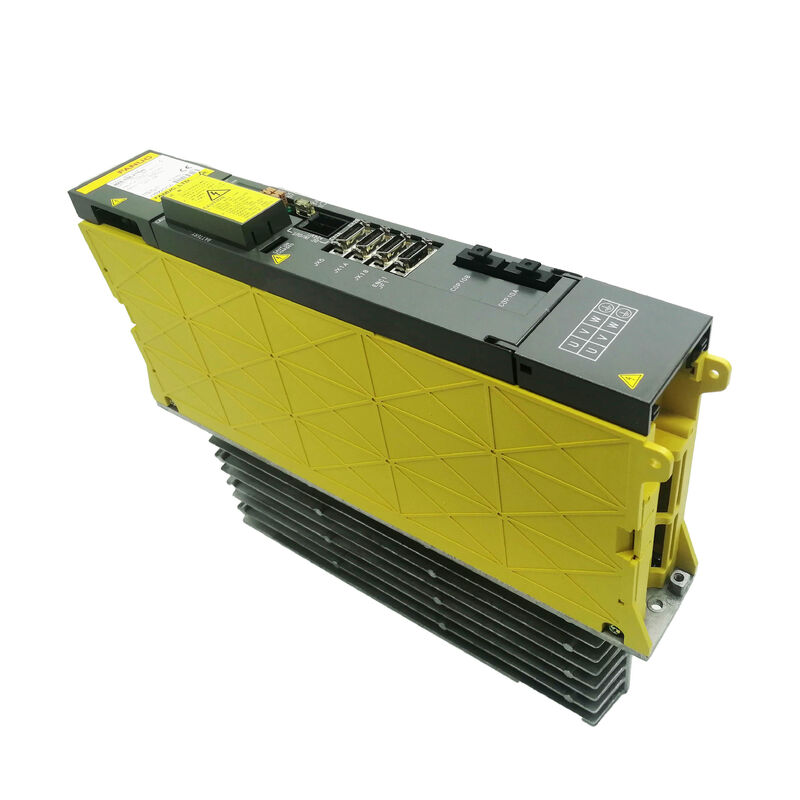
FANUC A06B-6096-H207 AC Servo Amplifier Unit — Product Description
When the Axis Count Doesn't Divide Evenly Into Three
Most people picture a basic CNC machine as a three-axis system — X, Y, Z. But a meaningful share of the older FANUC-controlled equipment running in factories today was built with four, five, or more controlled axes from the start: a fourth axis for a rotary table, a fifth for a tilting head, an additional axis for automated tool changing, or a second synchronized spindle on a turning center. In these configurations, the drive cabinet doesn't contain a single three-axis module and call it done — it contains a combination of module types sized and arranged to cover the full axis count.
The A06B-6096-H207 is precisely the module that fills the gaps in those configurations. As a dual-axis unit in FANUC's A06B-6096 series, it pairs with three-axis modules like the H302 to build out cabinets for machines with four, five, or six controlled axes — or it stands alone in two-axis machines where the full axis group fits neatly within one dual-axis unit. It serves a different role than the H302, even though it comes from the same product family.
Manufactured in Japan, CE certified, available in new and tested refurbished condition. If A06B-6096-H207 is the number on your machine's failed module label or in your maintenance documentation, this page addresses your specific sourcing situation.
H207 vs H302 — Two Modules From the Same Family, Two Different Jobs
Both the A06B-6096-H207 and the A06B-6096-H302 belong to FANUC's A06B-6096 series, which means they share the same generation, the same controller compatibility, and the same general drive architecture. What separates them is the axis count encoded in their suffix and the current rating tier that follows.
| Variant |
Axis Configuration |
Current Tier |
Typical Role in Cabinet |
| A06B-6096-H207 |
Dual-axis (2 axes) |
Tier 07 |
Fills fourth/fifth axis slots; sole module in 2-axis machines |
| A06B-6096-H302 |
Three-axis (3 axes) |
Tier 02 |
Covers three primary axes in standard 3-axis CNC |
A machine with four controlled axes might run a single H302 for the primary X/Y/Z group and a single H207 for the fourth axis — using both modules together to cover the full system. In that configuration, the two modules have different part numbers but operate side by side in the same cabinet, connected to the same controller. When the H207 fails in such a setup, the three primary axes keep running (if the H302 is healthy), while the fourth axis drops out — a pattern that is itself a useful diagnostic indicator pointing directly to the H207 module.
A machine with only two controlled axes — a straightforward two-axis lathe, for instance, or a specialized boring machine — may use the H207 alone, without any H302 in the cabinet at all.
In both cases, the correct replacement is the H207, not the H302. The axis counts are different, the current tiers are different, and the parameter configurations in the CNC controller are matched to the specific module variant in each slot.
Understanding the H207 Suffix
In the A06B-6096 series naming scheme, the suffix after H carries two pieces of information:
"2" — The leading digit confirms this is a dual-axis module, capable of independently driving two servo axes from a single physical unit with a shared power section.
"07" — The trailing digits identify the current output rating tier for this variant. This is distinct from the "02" tier in the H302, and it reflects a different set of motor compatibility requirements. The H207's current tier is matched to the specific motors connected to its two axes; using an H207 in a slot that was specified for a different current tier requires parameter changes and compatibility verification, not just a physical swap.
One consistent issue in sourcing FANUC 6096-series parts: the URL for this product listing contains "AO6B-6O96-H2O7" — where numeric zeros appear as the letter O due to optical character recognition of FANUC's label fonts. The actual part number is always A06B-6096-H207 with all-numeric characters after the letter A. When searching, cross-referencing documentation, or confirming with a supplier, treat both string forms as representing the same unit.
Specifications
| Parameter |
Detail |
| Part Number |
A06B-6096-H207 |
| Also Referenced As |
A06B6096H207 / AO6B-6O96-H2O7 (OCR variant) |
| Drive Series |
FANUC A06B-6096 Series AC Servo Amplifier |
| Axis Configuration |
Dual-axis module |
| Current Rating Tier |
H207 (tier 07) |
| Manufacturer |
FANUC Corporation |
| Country of Origin |
Japan |
| Certification |
CE |
| Compatible Controller Families |
FANUC Series 0, 6, 10, 11, 12 (analog servo interface) |
| Condition Available |
New (Original) / Tested Refurbished |
| Minimum Order Quantity |
1 piece |
| Supply Capacity |
Up to 100 pcs/day |
Where the H207 Gets Used: A Closer Look at Real Machine Configurations
The machines that specifically require an H207 fall into two broad categories, and understanding which one applies to your situation helps set realistic expectations for the sourcing process.
Multi-axis machines with mixed module configurations. A four-axis turning center with X, Z, C (spindle positioning) and a sub-spindle axis might use an H302 for the three primary axes and an H207 for the fourth. Five-axis machining centers with a rotary/tilt head configuration sometimes distribute the axis assignments across two or three modules of different types. In these mixed cabinets, the H207 is almost always the module handling the supplementary axes — the ones that extend the machine beyond a basic three-axis operation. When these axes stop working and the primary axes continue normally, the H207 is the immediate focus.
Standalone two-axis machines. On a dedicated two-axis CNC lathe, a profile grinding machine, or a two-axis boring unit, the H207 may be the only servo amplifier in the cabinet. In this configuration, any servo alarm on either axis points to the single H207 module as the primary suspect (after ruling out motor and cable causes).
In both cases, the H207 is not a secondary or lesser component — it is the drive that the affected axes depend on entirely, and its failure stops those axes just as completely as a three-axis module failure stops a three-axis machine.
The Age Factor: What to Expect From 6096-Series Components Today
The A06B-6096 series was produced to serve FANUC controller families that were in active deployment during the 1980s and into the 1990s. Machines built around this hardware have now been in service for anywhere from twenty-five to forty years. The ones still running production today represent a specific category: mechanically sound equipment, well-maintained, often in facilities where the capital cost of replacement is not justified by the machine's continuing productivity.
The components in these machines — drives, power supplies, servo motors — have been operating under those conditions for decades. Some are in excellent condition because the machine ran moderate duty cycles in a controlled environment. Others show accumulation of wear: electrolytics that have drifted from spec, IGBTs with reduced switching efficiency, connectors that have cycled through hundreds of thermal expansions and contractions. A tested refurbished unit from a decommissioned machine of similar vintage may actually offer better remaining service life than a unit that has been operating continuously at the edge of its thermal limits for twenty years.
This generational reality also shapes the secondary market. A06B-6096-H207 units become available primarily when equipment is decommissioned, upgraded with newer controllers, or parted out after a total machine failure. Supply is not constant or predictable — availability depends on what has recently entered the secondary market, and specific variants can be abundant one month and scarce the next. For facilities that know they are running H207-equipped machines, checking current stock and securing a confirmed spare is a more reliable strategy than assuming the part will be available when urgently needed.
Condition and Warranty
New / original units — Uninstalled factory stock in appropriate packaging. Covered by a 12-month warranty. These represent the highest reliability baseline and are the correct choice for machines in demanding production environments.
Tested refurbished units — Recovered from decommissioned or retooled machines, cleaned, and functionally tested under load before listing. Covered by a 3-month warranty. For planned spare stock programs, lower-utilization machines, or situations where the budget for a new unit is not available, tested refurbished units provide a verified working component at reduced cost.
All warranty returns must include the original label intact. Report damage, incomplete delivery, or description mismatches on arrival day or the following business day. Units found non-functional within 4 days of receipt qualify for return. Warranty does not extend to damage caused by incorrect installation, motor-side faults, or parameter errors applied after delivery. Returns are not accepted for wrong-item purchases or change of mind — always verify the part number against your machine's physical label before ordering.
Ordering and Shipping
Dispatch: 2 to 4 working days from payment confirmation, Guangzhou warehouse.
Carriers: DHL and FedEx for international delivery. Local warehouse pickup available in Guangzhou with advance arrangement.
Combined shipping: Available when ordering multiple components together. Useful when sourcing both an H207 and other drive or controller components for the same machine rebuild.
Payment: T/T bank transfer (all values). PayPal and Western Union accepted for orders up to USD $500.
Customs: All destination-country import duties, taxes, and customs brokerage fees are the buyer's responsibility. Buyers in regions with DHL/FedEx service limitations should contact the sales team before placing an order to discuss available logistics alternatives.
Frequently Asked Questions
Q1: My machine has both an A06B-6096-H302 and an A06B-6096-H207 in the same drive cabinet. The fourth axis has stopped working but the other three axes are fine. Does this confirm the H207 has failed?
The symptom pattern you describe — loss of one axis group while the other remains operational — is consistent with an H207 module fault, and it's one of the cleaner diagnostic indicators you'll encounter with this type of cabinet configuration. However, before concluding the module has failed, it's worth checking two things: first, whether the alarm code displayed on the CNC controller is a servo drive fault or an encoder/feedback fault, since the latter can originate in the cable or motor rather than the drive; and second, whether the DC bus voltage reading on the H207 is within normal range (the controller's servo status display often shows this). If the alarm code is a drive-internal fault or the H207 is not initializing on power-up, the module is almost certainly the cause. If it's an encoder feedback error, inspect the encoder cable on the affected axis before ordering a replacement module.
Q2: Can an A06B-6096-H207 be used as a substitute for an A06B-6096-H302 if the H302 is unavailable?
No — not as a direct drop-in substitute. The H302 controls three axes and the H207 controls two, so using an H207 in a three-axis slot would leave one axis without a drive connection entirely. Beyond the axis count mismatch, the current tiers are different (02 vs 07), meaning the parameter data for each slot is configured to its specific module. Even in scenarios where only two of the three H302 axes are actively used, substituting an H207 would require axis reassignment, parameter reconfiguration, and likely wiring changes — it becomes a modification project rather than a maintenance replacement. The correct approach when an H302 is unavailable is to source the H302 from alternative channels, not to substitute an H207.
Q3: How does the current tier "07" in the H207 compare to the tier "02" in the H302? Is a higher tier number always a higher current rating?
Within the A06B-6096 series, the numeric part of the suffix after the axis count digit does reflect different current rating tiers, but the relationship between tier number and actual current output is not a simple linear scale — the tier numbers are FANUC's internal categorization codes rather than direct current values. What matters for sourcing is that the H207's "07" tier and the H302's "02" tier are different specifications, and each is matched to specific motor combinations in the machines where they were installed. The only reliable way to confirm which tier your machine requires for a given slot is to reference the original machine documentation, the nameplate on the failed module, or the servo parameter data in the CNC controller. Using a different tier without verifying motor compatibility and updating the relevant servo parameters creates the risk of incorrect current regulation, which can manifest as axis positioning errors, oscillation, or thermal alarms.
Q4: We're sourcing parts for a machine that has been idle for several years after the previous maintenance team left. We found what appears to be an H207 in a storage box with no label. Is there any way to identify it confidently before installing it?
An unlabeled module in storage creates a real identification challenge, but there are approaches that can help narrow it down. If you have access to the machine's original drive cabinet and a working H207 or H302 is still installed in it, a side-by-side physical comparison — module dimensions, connector positions, board layout, and any visible component markings on the PCB — can help determine whether the mystery module is from the same series and the same axis-count variant. FANUC's 6096-series two-axis and three-axis modules have visibly different connector configurations reflecting their different axis counts, so the physical form factor should confirm or rule out the H207 identification. Additionally, if the circuit board inside the module carries any visible part numbers on its surface — FANUC servo boards often do — these can be cross-referenced to confirm the module type. If none of these methods yield a confident identification, using the mystery module in production is not advisable regardless of its apparent condition.
Q5: What is the most common root cause of failure in A06B-6096 series drives at this stage of their service life, and does it affect how we should evaluate a refurbished unit?
At the age these drives have reached, the most common failure modes fall into two categories. The first is electrolytic capacitor degradation in the DC bus and power supply sections — capacitors have a finite operational lifespan, and units that have been in continuous service since the 1990s may have capacitors whose capacitance has drifted well below specification even if the drive hasn't produced a hard fault. This can cause intermittent behavior, reduced regenerative braking performance, and eventually catastrophic failure. The second common failure mode is IGBT gate driver circuit deterioration, which can cause one axis to produce erratic torque output or nuisance overcurrent alarms before a complete failure occurs. When evaluating a refurbished unit, ask whether the testing process included load-cycle testing under current rather than just a power-up check — a drive can power up and initialize correctly while still having marginal capacitor or IGBT performance that only becomes apparent under actual axis loading. A reputable refurbishment process includes functional testing at representative operating conditions, not just a visual inspection and power-on confirmation. Units that have been tested this way provide considerably more confidence than those that have only been checked for cosmetic condition and basic initialization.
Right module. Right axes. Right generation.


 Your message must be between 20-3,000 characters!