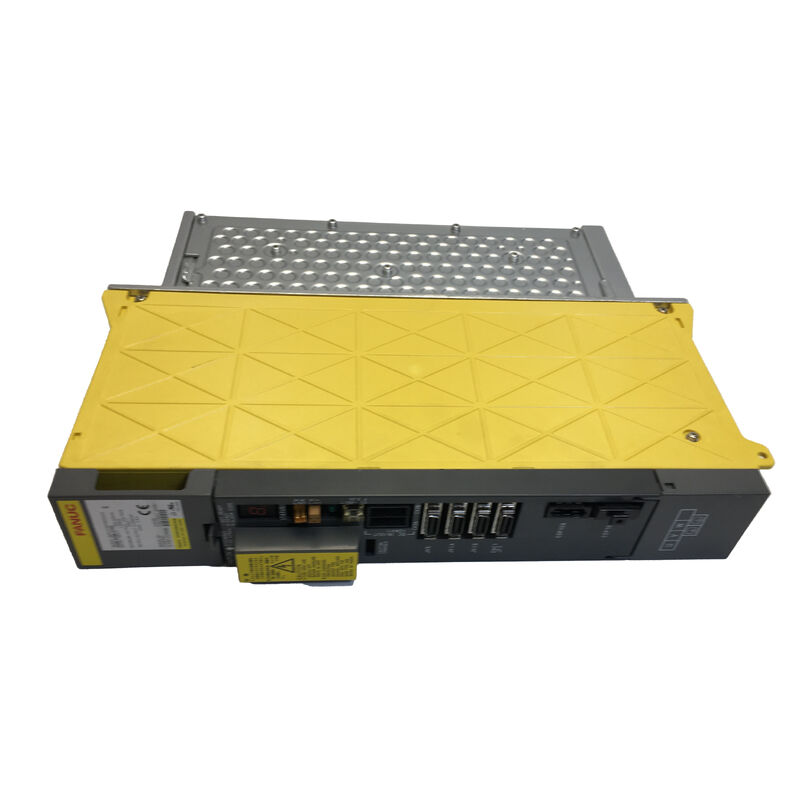
FANUC A06B-6096-H302 AC Servo Amplifier Unit — Product Description
One Module, Three Axes — and Why That Changes the Sourcing Equation
Every drive cabinet tells a story about how a machine was designed. In the cabinets built around FANUC's A06B-6096 Series amplifiers, that story often unfolds across fewer slots than you'd expect. Where later generations typically place dual-axis modules side by side to serve a three-axis machine, the A06B-6096-H302 handles all three axes in a single unit — a design philosophy that compresses the drive footprint, consolidates the power bus connections, and reflects the engineering priorities of the era when these machines were built.
That architectural choice has a practical consequence today: when the drive fails, there isn't a per-axis module to isolate and swap. The entire three-axis amplifier unit is the replaceable component. Getting the machine back into production means sourcing the correct A06B-6096-H302 — not an approximation, not a newer-generation substitute — and having it on hand before the downtime clock gets expensive.
This unit is manufactured in Japan, CE certified, and available in both new and tested refurbished condition. The 6096 series is a generation older than the more widely-known 6102 α Series, which means sourcing requires knowing exactly what you're looking for and confirming availability early.
The A06B-6096 Series: Placing This Drive in FANUC's History
FANUC's servo drive lineup evolved through several distinct generations, each with its own controller compatibility, communication interface, and physical architecture. The A06B-6096 series occupies a specific point in that timeline — predating the A06B-6102 α Series that became widely deployed through the late 1990s and 2000s, and used with FANUC controllers from the Series 0, Series 6, Series 10, Series 11, and Series 12 families, among others.
This is not a minor distinction. Machines built around A06B-6096 Series drives use a different servo interface architecture than those running A06B-6102 or A06B-6114 components. The controller communicates with the drive differently, the parameter structure is generation-specific, and the physical connectors and wiring harnesses are designed for 6096-series modules. A buyer who arrives at this page looking for a newer-generation substitute will need to reconsider: upgrading from A06B-6096 to A06B-6102 is not a module swap — it requires controller hardware changes, rewiring, and a full parameter reconfiguration. For a machine that simply needs its drive replaced and returned to original specification, the A06B-6096-H302 is the correct part.
Understanding this generational context is also important for setting realistic sourcing expectations. The A06B-6096 series is not in current production, and global availability depends entirely on what remains in distributor stock and what has been recovered from decommissioned machines. This makes early sourcing — before a machine failure creates urgency — the most practical approach for facilities that rely on equipment using these drives.
Decoding H302: Three Axes, One Current Tier
FANUC's part number suffix structure in the 6096 series encodes axis count and current rating, much as it does in later drive generations. For the H302:
The "3" identifies this as a three-axis module — one physical unit driving three servo axes simultaneously from a shared power section, with independent current regulation per axis. This is what distinguishes the H302 from two-axis variants in the same family. In a standard three-axis CNC machining center or lathe with three controlled axes, the H302 handles the complete drive function within a single cabinet slot.
The "02" specifies the current output tier for this variant. As with all FANUC servo amplifiers, the rated current must be matched to the motors on all three axes. In a three-axis module, this means the current tier is a system-level specification — all three motors connected to this unit must have current requirements compatible with the H302's output characteristics. If a machine originally equipped with H302 has had any motors upgraded or replaced with different models since commissioning, it is worth verifying that the new motors remain compatible with the original amplifier specification.
Specifications
| Parameter |
Detail |
| Part Number |
A06B-6096-H302 |
| Also Referenced As |
A06B6096H302 / AO6B-6O96-H3O2 (OCR variant) |
| Drive Series |
FANUC A06B-6096 Series AC Servo Amplifier |
| Axis Configuration |
Three-axis module |
| Current Rating Tier |
H302 — specified per original machine documentation |
| Manufacturer |
FANUC Corporation |
| Country of Origin |
Japan |
| Certification |
CE |
| Compatible Controller Families |
FANUC Series 0, 6, 10, 11, 12 and related generations |
| Condition Available |
New (Original) / Tested Refurbished |
| Minimum Order Quantity |
1 piece |
| Supply Capacity |
Up to 100 pcs/day |
Three Axes in One Module: The Maintenance Implications
The single-module three-axis architecture of the H302 creates a specific diagnostic and repair dynamic that differs from multi-module cabinet configurations. With dual-axis modules spread across several slots, a fault on one axis can often be isolated by observing which module is showing an alarm status — and only that module needs to be replaced. With a three-axis module, the physical unit serving all three axes is also the first replacement candidate whenever any one of those axes throws a servo alarm.
This doesn't mean the H302 should be assumed faulty whenever a servo alarm appears. Servo alarms on any axis can originate in the drive, the motor, the feedback cable, or the wiring between them. The diagnostic approach should still follow the standard sequence: identify the alarm code, check motor insulation and winding resistance on the affected axis, inspect the encoder feedback cable for continuity and shielding integrity, and if possible, run the other two axes to see whether the problem is isolated to one axis or affects the entire module. A fault that appears consistently on one specific axis regardless of operating conditions, while the other two axes function normally, is more likely motor or cable-related than a module failure. Conversely, if alarms appear on multiple axes or the module fails to initialize at all on power-up, the drive itself becomes the primary suspect.
When a replacement H302 is installed, all three axes need to be verified — not just the one that showed the original alarm. A three-axis module that has been running with one degraded axis may have accumulated thermal stress on the shared power section, and a thorough functional check across all axes during the commissioning of the replacement is worthwhile.
Sourcing Realities for A06B-6096 Series Drives
The A06B-6096 family occupies a narrower availability window than later-generation FANUC servo drives. New-in-box factory stock for specific 6096 variants becomes harder to locate as years pass, and the secondary market depends on decommissioned machines and rebuild projects releasing quality-tested units back into circulation. The H302 in particular — as a three-axis module used in complete-axis-group configurations — appears less frequently in circulation than single-axis or dual-axis variants simply because three-axis machine configurations it serves represent a narrower slice of the installed base.
For facilities running equipment equipped with A06B-6096-H302 drives, the practical implication is straightforward: proactive spare parts planning pays higher dividends here than with more common drive variants. A confirmed spare on the shelf costs far less than an emergency procurement situation when production is down and a machine with no quick-source replacement is sitting idle.
Availability should be verified directly with the sales team before finalizing any sourcing plan. Stock status for specific 6096 variants changes as units are sold, recovered, and tested — a listing being present is not a guarantee of immediate in-stock availability, and a direct inquiry before committing to a timeline is the responsible approach.
Condition, Warranty, and Returns
New / original condition units carry a 12-month warranty and are appropriate for machines in regular production where performance reliability and warranty coverage have the highest value.
Tested refurbished units are recovered from decommissioned or upgraded machines, cleaned and functionally verified before listing, and covered by a 3-month warranty. For planned spare stock programs or cost-sensitive repair situations, refurbished units represent a practical option — particularly for a drive series where new stock is not always readily available.
Warranty conditions: units arriving damaged, incomplete, or not matching the description should be reported on the day of delivery or the following business day, with photographic documentation. Units found non-functional within 4 days of receipt under normal operating conditions qualify for return. Warranty is void for damage caused by incorrect installation, motor-side fault propagation, or physical handling after delivery. The original warranty label must remain intact on any returned unit. Returns are not accepted for wrong-item purchases or change of mind — always verify the part number against your machine's documentation before placing an order.
Ordering Information
Dispatch: 2 to 4 working days after payment confirmation from our Guangzhou warehouse.
Shipping: DHL and FedEx for international orders. Local warehouse pickup in Guangzhou can be arranged. Combined shipping is available when ordering multiple components in a single transaction.
Payment: T/T bank transfer for all order values. PayPal and Western Union for transactions up to USD $500.
All import duties, taxes, and destination-country customs fees are the buyer's responsibility. Buyers in regions with DHL/FedEx service restrictions should contact the sales team before ordering to confirm logistics options for their location.
Frequently Asked Questions
Q1: What controllers is the A06B-6096-H302 compatible with, and how does it differ from A06B-6102 Series drives?
The A06B-6096 Series is designed for use with older FANUC controller generations including the Series 0, Series 6, Series 10, Series 11, and Series 12, which use an analog servo interface. The A06B-6102 Series, by contrast, belongs to a later generation — the FANUC α Series — and while it also uses analog servo interface, it represents a distinct product generation with different internal architecture, parameter structures, and physical connector layouts. The two series are not interchangeable as direct drop-in replacements. Machines built around A06B-6096 drives will typically require the same series for a like-for-like replacement. Upgrading from 6096 to 6102 requires controller hardware and wiring changes beyond a module swap, and is a retrofit project rather than a maintenance repair.
Q2: My machine has a servo alarm on only one of the three axes controlled by the H302. Does this mean the entire module needs to be replaced?
Not necessarily. Servo alarms appearing on a single axis are frequently caused by motor insulation breakdown, encoder signal degradation due to cable damage or connector oxidation, or mechanical issues at the axis drive train rather than drive module failure. Before concluding the H302 is at fault, inspect the motor windings for insulation resistance on the affected axis, check the encoder feedback cable for continuity and shielding continuity, and look for any alarm pattern correlation with specific operating conditions (load, temperature, or speed). If the alarm clears when the axis is driven in a different direction or under reduced load, that is a strong indicator of a motor or mechanical issue rather than a drive fault. If the alarm persists regardless of operating condition and does not appear on the other two axes despite similar loading, the module itself becomes a more likely culprit — but the diagnostic steps above should be completed before committing to a replacement order.
Q3: Is the OCR variant "AO6B-6O96-H3O2" in the listing URL a different part number from A06B-6096-H302?
No — they refer to the same unit. This is a well-known optical character recognition artifact with FANUC part numbers. The numeral "0" (zero) and the letter "O" are visually nearly identical in FANUC's labeling fonts, so scanned or manually typed part numbers frequently appear with letter substitutions. "AO6B-6O96-H3O2" is simply "A06B-6096-H302" with zeros misread as letter O throughout. The physical nameplate label on original FANUC hardware uses numeric characters throughout; digital listings that have been OCR-processed or manually transcribed from photographs introduce these rendering errors. When searching for this part or cross-referencing records, treat both string forms as equivalent. The authoritative reference is always the physical label on the actual hardware.
Q4: We have two machines running A06B-6096-H302 drives. Should we stock a spare unit before one fails, or wait until a failure occurs?
Given that A06B-6096 Series parts are not in current production and secondary market availability depends on what has been recovered from decommissioned machines, proactive stocking is the more defensible approach for facilities running multiple machines on this drive. The cost differential between a planned spare acquired when stock is available versus an emergency procurement when a machine is down is significant — not just in unit price, but in expedited freight, production downtime, and potentially idle labor while sourcing is underway. For two machines on the same drive variant, a single confirmed spare on the shelf covers both and represents a relatively modest insurance cost against that scenario. The sooner a stock check is done and a spare secured, the more likely a suitable unit is available at a reasonable price and lead time.
Q5: After installing a replacement A06B-6096-H302, what verification steps should be completed before returning the machine to full production?
A structured run-in and verification process after drive replacement reduces the risk of discovering issues under production pressure. After power-up and confirmation that the drive initializes without alarm, each of the three controlled axes should be exercised individually through their full travel range at reduced feed rate — checking for smooth motion, absence of servo alarms, and normal position feedback readings on the CNC screen. Following single-axis checks, execute coordinated multi-axis moves representative of the machine's normal operating cycles to verify there are no interaction issues between axes. Check that all axis positions return accurately to reference after homing. Monitor the cabinet temperature during this run-in, as a new or refurbished drive may run slightly warmer than expected during initial operation — this is normal and should stabilize. Only after completing this structured verification and observing stable operation across multiple test cycles is the machine ready to return to production machining. This process typically takes thirty to sixty minutes and is time well spent before committing the machine to a production batch.
Correct generation. Three-axis confirmed. Japan-origin stock.


 Your message must be between 20-3,000 characters!