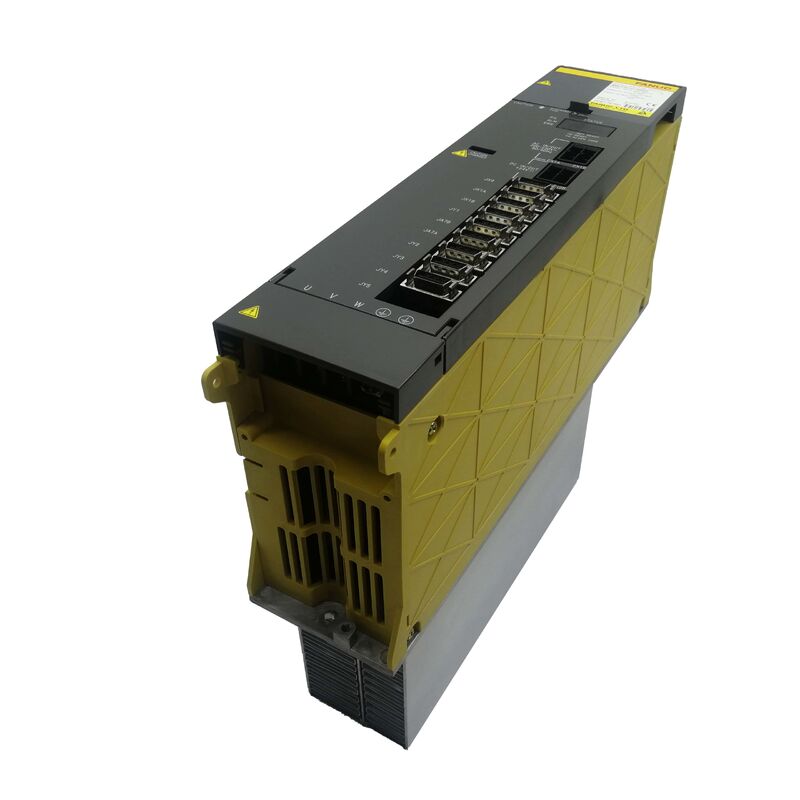
FANUC A06B-6102-H211 AC Servo Amplifier Unit — Product Description
The Axis That Doesn't Need Brute Force Still Needs the Right Drive
In CNC machine tool design, not all axes are created equal. The axes that move the workpiece or carry the spindle head under heavy cutting loads place very different demands on their drives compared to the axes responsible for precise, light-load positioning — a rotary table that indexes in small increments, an auxiliary axis that controls a tool changer arm, or the fine-feed axis on a grinding machine where smooth low-speed motion matters more than peak current capacity.
The FANUC A06B-6102-H211 is built for exactly this end of the spectrum. It sits at the lower current rating tier within the α Series dual-axis amplifier family — the H211 — paired with the servo motors that power lighter axes where current draw stays well within moderate limits during normal operation. Fitting an oversized amplifier to these axes doesn't improve performance; it can actually compromise fine positioning stability by introducing resolution mismatch in the current feedback loop. The right variant for the right axis is what allows the whole machine to run as its designer intended.
This unit is manufactured in Japan, CE certified, and available in both new and tested refurbished condition. If A06B-6102-H211 is the number documented for your failed drive slot, this page covers everything you need to make a confident sourcing decision.
Reading the Drive Cabinet: H211, H215, and H230 Side by Side
Machines running FANUC α Series drives often have more than one A06B-6102 module in the cabinet, and they are frequently different variants — because different axis groupings carry different load profiles. Understanding how these three common variants relate to each other helps clarify why the part number must be matched precisely to its slot, not substituted freely.
| Variant |
Axis Config |
Current Tier |
Typical Application |
| A06B-6102-H211 |
Dual-axis |
Lower |
Light-load axes: rotary/auxiliary axes, wire EDM, small lathes |
| A06B-6102-H215 |
Dual-axis |
Mid |
Standard X/Y table axes on mid-size machining centers |
| A06B-6102-H230 |
Dual-axis |
Higher |
Heavy-load axes: large Z-axis, high-torque feed axes |
All three share the same physical form factor, the same analog servo interface to the FANUC controller, and the same drive bus connector layout. That is precisely what makes accidental substitution a risk — they look interchangeable on a shelf or in a listing, but the CNC's servo parameter data is configured to the specific current tier of each slot. Drop an H230 into an H211 slot without updating the amplifier parameters, and the current regulation loop will behave incorrectly, potentially causing axis oscillation or instability at low speeds — the exact operating range where these lighter axes spend most of their working time.
What H211 Tells You About This Unit
In FANUC's α Series part number convention, the suffix after the H encodes the drive's axis configuration and current output tier in a consistent pattern. For the A06B-6102-H211:
The leading "2" confirms this is a dual-axis module — one physical unit driving two servo axes simultaneously. This is standard for the A06B-6102 family: a shared power section with independent per-axis current regulation, allowing two axes to be controlled from a single drive slot in the cabinet.
The trailing "11" places this variant at the lower end of the current rating scale within the α Series dual-axis lineup. It is the tier matched to servo motors with lower continuous current requirements — motors commonly used on the lighter, more precision-oriented axes in a CNC system.
One practical note for buyers: the URL on this page contains the string "AO6B-6IO2-H2II" — this is a common OCR and font rendering artifact where the numeral zero (0) is misread as the letter O, and the numeral one (1) is misread as the letter I. The actual part number is unambiguously A06B-6102-H211 with all numeric characters. When cross-referencing machine documentation, always verify against the physical nameplate label and treat optical character confusion in digital listings as a known hazard with FANUC part numbers.
Specifications
| Parameter |
Detail |
| Part Number |
A06B-6102-H211 |
| Also Referenced As |
A06B6102H211 / AO6B-6IO2-H2II (OCR variant) |
| Drive Series |
FANUC α Series AC Servo Amplifier |
| Axis Configuration |
Dual-axis module |
| Current Rating Tier |
H211 — lower output tier within α Series dual-axis range |
| Manufacturer |
FANUC Corporation |
| Country of Origin |
Japan |
| Certification |
CE |
| Compatible Controller Families |
FANUC Series 0, 16, 18, 21 (analog servo interface variants) |
| Interface Type |
Analog servo interface |
| Condition Available |
New (Original) / Tested Refurbished |
| Minimum Order Quantity |
1 piece |
| Supply Capacity |
Up to 100 pcs/day |
Where the H211 Fits in Real Machine Configurations
The lower current tier of the H211 makes it well suited to the following scenarios, all of which are common in the field:
Small-format CNC lathes and turning centers with compact servo motors on their cross-slide and carriage axes. These machines don't require the current headroom of a large machining center, and their servo motors are matched accordingly. A drive cabinet in this configuration may use H211 modules throughout, rather than the mixed H211/H230 arrangement seen in heavier three-axis machines.
Wire EDM machines, where axis movement is slow, highly precise, and involves minimal mechanical load against the workpiece. The current demands on the servo axes in this type of machine are consistently low, and a lower-tier amplifier is the correct specification for that operating environment.
Rotary and indexing axes on machining centers where the primary work axes (X, Y, Z) may use higher-current modules, but an auxiliary fourth or fifth axis controlling a rotary table or indexing head operates under much lighter loads. In this mixed configuration, H211 modules for the lighter axes and H215 or H230 for the primary axes in the same cabinet is a common arrangement.
Older milling machines with compact servo motors, where the original machine builder selected smaller motors specifically matched to the cutting envelope and axis travel of the design. These machines often have a full cabinet of lower-current drive modules.
Condition and Warranty
New / original units are uninstalled factory stock in appropriate packaging, covered by a 12-month warranty. These are the right choice when the machine is in continuous production and reliability expectations are highest.
Tested refurbished units come from decommissioned or upgraded machines, have been functionally verified under operating conditions, and carry a 3-month warranty. They are a practical option for planned spare stock, lower-utilization machines, or budget-sensitive repairs where a confirmed working unit is the goal.
All warranty claims require the original label to remain intact. Units that arrive damaged, incomplete, or not matching the description should be reported on the day of arrival or the next business day, with photographs where possible. Non-functional units within 4 days of receipt under normal operating conditions qualify for return or replacement. Warranty does not cover damage from incorrect installation, motor-side fault propagation, or parameter configuration errors applied after delivery.
Ordering and Logistics
Dispatch: 2 to 4 working days after payment confirmation, from our Guangzhou warehouse.
Shipping: DHL and FedEx for international delivery. Local Guangzhou warehouse pickup is available and can be arranged directly. Combined shipping applies when multiple parts are ordered together — a useful option when sourcing several drive components for a single machine repair or a spare parts program covering multiple machines.
Payment: T/T bank transfer for all order values. PayPal and Western Union for orders up to USD $500.
Customs: All import duties, taxes, and destination-country fees are the buyer's responsibility. Buyers in regions where standard DHL/FedEx service is restricted or unavailable should contact the sales team before placing an order so that alternative logistics arrangements can be discussed. Do not assume service availability for all destinations without checking first.
Frequently Asked Questions
Q1: I can't source the H211 quickly and the machine is down. Can I temporarily substitute an H215 to get production running while I wait for the correct part?
Physically, an H215 will fit the same slot as an H211 — the form factor is identical. However, making it function correctly requires updating the servo amplifier parameter in the CNC to match the H215's current rating characteristics. Without that parameter change, the current regulation loop for both axes on that module will be operating against the wrong reference data, which can cause fine-positioning errors, low-speed instability, or unexpected alarm states. The parameter update itself is not technically difficult for someone familiar with FANUC servo parameter configuration, but it must be done and then verified with axis test moves before trusting the machine for production. The key risk is that the temporary fix may alter the machine's servo tuning in ways that affect part quality subtly — always revert to the correct H211 variant and restore original parameters as soon as the correct part is available.
Q2: Why does the product listing show "AO6B-6IO2-H2II" — is this a different part number?
No, it's the same part number rendered through optical character recognition (OCR). FANUC uses a font in some of their labeling where the numeral "0" (zero) and the letter "O" are visually similar, as are the numeral "1" (one) and the letter "I". When part number labels are scanned or typed from photographs, these characters frequently get transposed in digital records. The correct part number is always A06B-6102-H211 — all numeric after the initial letter A. When searching for this part or cross-referencing machine documentation, treat "AO6B-6IO2-H2II" and "A06B6102H211" as the same unit. Physical nameplates on FANUC equipment are the authoritative reference; digital transcriptions should be verified against the actual hardware label.
Q3: Our machine has been in storage for approximately two years before being recommissioned. The drive was not failed — it was simply stored with the machine. Do we need to do anything before powering the drive up?
Extended storage introduces two potential concerns for servo amplifiers of this generation. First, the electrolytic capacitors in the DC bus section gradually lose their charge capacity when not powered over a long period — a process called capacitor degradation. For storage periods of two years or more, a controlled power-up sequence is advisable: bring the drive up gradually using a variable transformer (variac) at reduced voltage over a period of thirty to sixty minutes, allowing the capacitors to reform under gentle conditions before applying full voltage. Second, any connectors or contact surfaces that have been exposed to humidity during storage should be inspected for oxidation before connecting. Internally, the drive itself should be inspected for evidence of condensation damage. If the storage environment was climate-controlled and the unit was stored in original packaging, the risk is lower — but the capacitor conditioning step is a sensible precaution regardless of storage conditions.
Q4: We manage maintenance for multiple small CNC machines and several have been flagged for potential drive issues. Is there a way to test drive health without removing and shipping the modules?
In-situ assessment of α Series servo amplifier health has some practical limits, but there are useful diagnostic approaches that don't require module removal. The CNC controller's servo diagnostic screen can display current feedback data, velocity error, and position error in real time — unusual patterns in these values during normal axis motion can indicate drive-related degradation before a full fault occurs. The amplifier's status LEDs also provide fault history information on many α Series modules: a pattern of recurring transient alarms that clear on power cycle, or alarms that correlate with specific load conditions, often points to a drive with marginal thermal performance or weakening IGBT switching. Physical inspection of the drive cooling fans is worthwhile — failed or sluggish fans are a leading cause of accelerating drive deterioration. If a specific axis has been generating intermittent servo alarms for several months without a clear motor or cable cause, the drive module for that axis is a reasonable next focus for investigation.
Q5: We're purchasing several parts across multiple orders over the coming months as a planned maintenance program. Is there a preferred way to structure these purchases to get the best outcome on pricing and shipping?
For a structured maintenance program covering multiple machines over an extended timeline, the most effective approach is to submit a consolidated requirements list upfront — all anticipated part numbers, estimated quantities, and rough timing — even if individual orders will be placed in stages. This allows the sales team to check global availability across all required variants at once, flag any that have limited stock or longer sourcing lead times, and set expectations about which items need to be prioritized in earlier orders. It also creates the basis for discussing combined shipping arrangements on batches of parts, which reduces per-unit freight cost compared to individual shipments. Maintenance managers who plan their α Series spare parts procurement quarterly rather than reactively typically face fewer emergency sourcing situations and lower total parts costs — the secondary market for these drives rewards buyers who aren't operating under production-down pressure.
Correct tier. Correct axis. Confirmed Japan-origin stock.


 Your message must be between 20-3,000 characters!