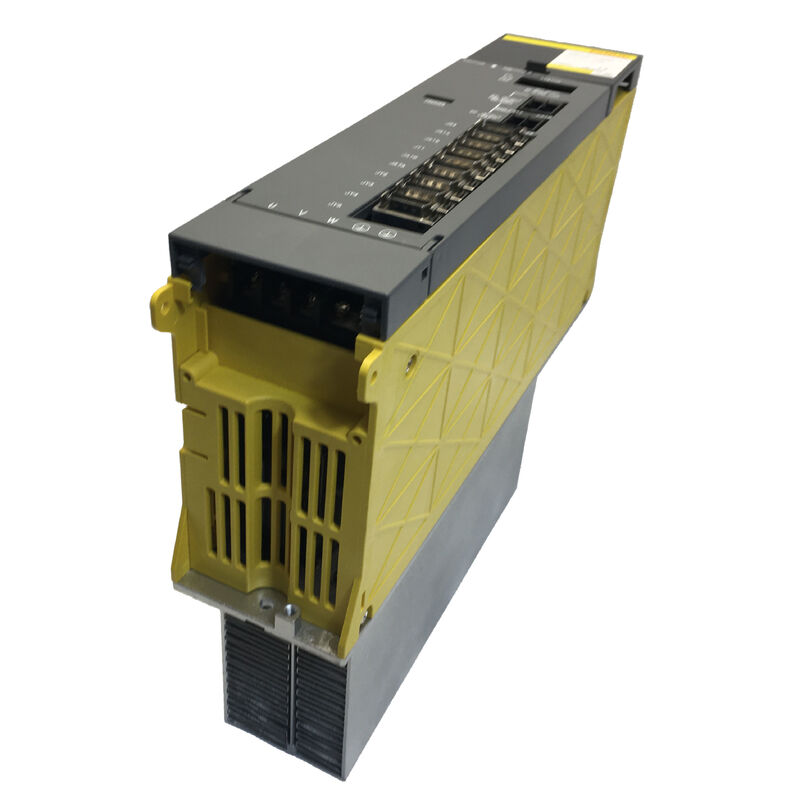
FANUC A06B-6102-H230 AC Servo Amplifier Unit — Product Description
Three Axes, Two Drive Slots, One Critical Difference
Walk up to a FANUC-controlled machining center from the late 1990s or early 2000s and open the drive cabinet. In many configurations, you'll find the X and Y axes served by one dual-axis servo amplifier module, and the Z axis — the vertical spindle quill that carries the full weight of the cutting tool — handled separately, often by a module with a meaningfully higher current rating. The mechanics of vertical travel, gravity compensation, and the torque demands of rapid Z-axis moves simply require more from the drive.
That is the environment the A06B-6102-H230 was designed for. It belongs to FANUC's α Series servo amplifier family, and within that family the H230 is a dual-axis module rated at a higher continuous output current tier than the H215. For the axes where the loads are heavier and the current demands are greater, this is the variant the system specifies — and fitting the wrong one is a reliable way to generate thermal overload alarms until someone traces the problem back to the drive cabinet.
This unit is manufactured in Japan, CE certified, and available in new and refurbished condition. If H230 is the number on your machine's documentation or on the label of the module that failed, read on.
H230 and H215 — Same Series, Different Jobs
Because these two part numbers differ only in their suffix, they are worth addressing directly. Both the A06B-6102-H215 and the A06B-6102-H230 are dual-axis modules from the FANUC α Series — same drive family, same communication interface, same physical form factor, same controller compatibility. What separates them is the rated output current, which the suffix encodes.
The "2" in both designations confirms the dual-axis configuration. The trailing digits — "15" versus "30" — represent different current rating tiers. The H230 sits higher in that hierarchy than the H215. In practical terms, this means the H230 is matched to servo motors with higher continuous current draw: larger axis motors, heavier loads, or applications where the motor sees sustained high-torque demand during normal operation.
Swapping an H215 in where an H230 is specified — even temporarily, even "just to get the machine running" — will typically result in the drive hitting its thermal protection threshold during heavy-load cycles. The alarm may not appear immediately on light work, which makes the mismatch easy to overlook initially and harder to diagnose when the fault does surface. The correct fix is always the correctly rated variant.
The reverse substitution, fitting an H230 where an H215 is specified, carries its own risks: parameter settings for amplifier current ratings need to match, and a mismatch here can cause unstable current regulation on lower-power axes. Neither direction of wrong-part substitution is benign.
Specifications
| Parameter |
Detail |
| Part Number |
A06B-6102-H230 |
| Also Referenced As |
A06B6102H230 / AO6B-6IO2-H23O |
| Drive Series |
FANUC α Series AC Servo Amplifier |
| Axis Configuration |
Dual-axis module |
| Current Rating Tier |
H230 — higher output tier within α Series dual-axis range |
| Manufacturer |
FANUC Corporation |
| Country of Origin |
Japan |
| Certification |
CE |
| Compatible Controller Families |
FANUC Series 0, 16, 18, 21 and related analog-interface variants |
| Condition Available |
New (Original) / Tested Refurbished |
| Minimum Order Quantity |
1 piece |
| Supply Capacity |
Up to 100 pcs/day |
Where the H230 Shows Up in Practice
In a typical three-axis vertical machining center running a FANUC Series 16 or 18 controller, the drive cabinet is organized by axis assignment and load profile. X and Y axes handle horizontal table movement — generally lower inertia, more predictable load curves. The Z axis deals with vertical positioning under gravity, often with a ballscrew that must counteract both cutting forces and the weight of the spindle head.
For machines configured this way, the Z-axis drive module frequently carries a higher current rating than the X/Y module in the same cabinet. That's where the H230 tends to appear — not because the axis count is higher, but because the motor it serves draws more current under normal operating conditions than the motors on the lighter axes.
The same logic applies in turning centers with heavy chucks, or in machines where one axis consistently runs large-diameter cutters at aggressive feed rates. The drive pairing in these cabinets is rarely arbitrary; the machine builder specified different current tiers for different axis loads, and the α Series part number encodes exactly that engineering decision.
When sourcing a replacement, the axis assignment matters as much as the part number. If the failed drive is the one serving the Z axis on a three-axis machining center, the H230 is likely the correct unit for that slot — but always verify against the machine's documentation rather than assuming from the axis label alone.
What Affects Long-Term Drive Reliability in α Series Installations
Servo amplifier life in this generation of FANUC drives is closely tied to thermal management. The internal IGBT modules and gate driver circuits generate heat proportional to the current being switched, and the cooling architecture depends on consistent airflow through the cabinet and across the drive fins. In a machine that's been running for fifteen or twenty years, the fans mounted directly on the amplifier modules are among the most overlooked maintenance items — they run continuously, they accumulate dust, and when their bearings begin to fail the airflow drops before any obvious audible warning.
A drive that runs hot for months before failing may have damaged its internal circuitry beyond what external testing can fully reveal — which is one reason why a tested refurbished unit from properly decommissioned equipment is a more reliable option than a pulled unit of uncertain history. Fan replacement on the amplifier module, combined with a thorough cabinet cleaning when installing a new drive, meaningfully extends the replacement unit's service life.
The other common failure pathway in α Series drives is the DC bus capacitors, which degrade with age even under normal operating conditions. In units that have been stored for extended periods rather than actively used, capacitor condition is worth verifying before placing the module into a critical production machine without a monitored run-in period.
Warranty, Condition, and Returns
New units are uninstalled original stock, packaged appropriately, and covered by a 12-month warranty. These are the right choice for production-critical machines where downtime costs are significant and reliability expectations are high.
Tested refurbished units carry a 3-month warranty and are suited to planned spare parts programs, lower-utilization machines, or situations where budget is the primary constraint. All refurbished units are functionally tested before listing. Units that cannot be verified to operating specification are not listed regardless of visual condition.
For warranty claims: report damage, incomplete delivery, or description mismatches on the day of arrival or the following business day, with photographic documentation. Units that prove non-functional within 4 days of receipt under normal operating conditions qualify for return. Warranty does not cover damage from incorrect installation, motor-side faults, or parameter errors introduced after delivery. Original warranty labels must remain intact on any returned unit.
Ordering Logistics
Dispatch: 2 to 4 working days after payment confirmation. Carriers: DHL and FedEx internationally; Guangzhou warehouse pickup available locally. Combined shipping is offered when multiple components are ordered together — this is worth requesting when sourcing several drive modules for a single machine.
Payment: T/T bank transfer for all order values; PayPal and Western Union for orders up to USD $500.
Cross-border buyers are responsible for all import duties, taxes, and destination-country fees. These should be factored into the total landed cost when comparing sourcing options.
Frequently Asked Questions
Q1: My machine's drive cabinet has two A06B-6102 modules — one is H215 and the other is H230. Can I use a single variant to stock both slots as spares?
Not as a direct drop-in spare for both positions without adjusting parameters. The H215 and H230 are different current rating tiers, and the CNC controller's servo parameter settings are configured to match the specific amplifier variant in each drive slot. If you install an H230 in a slot that was previously running an H215, the parameter data for that axis will need to be updated to reflect the different amplifier characteristics — or the current regulation behavior will be incorrect. Maintaining separate spares for each variant is the safest approach for a machine where both types are in use. If you want to standardize on one variant, the engineering work required to validate the change should be done deliberately and documented, not assumed.
Q2: How do I confirm which α Series dual-axis variant the Z-axis slot in my machine requires, before ordering?
The most reliable source is the machine's electrical documentation — the drive assignment diagram or parameter data sheet, which machine builders typically include in the maintenance manual. This will specify the amplifier model by axis. The second source is the failed unit's own nameplate: even if the unit is non-functional, the part number label on the module casing should be readable. If neither is accessible, the CNC controller's stored parameter data often includes servo amplifier type codes for each axis that can be read via the parameter display screen, which an experienced FANUC technician can cross-reference to the correct part number. Ordering based on the axis name alone ("the Z drive") without confirming the specific model is a common sourcing error that's easily avoided.
Q3: The machine threw a servo alarm on an axis, but the drive module appears undamaged externally. Does this mean the drive isn't the problem?
External appearance is not a reliable indicator of drive condition in α Series amplifiers. Most internal failure modes — IGBT degradation, driver circuit faults, capacitor failures — are not visible from the outside. The diagnostic approach before ordering a replacement should include: noting the exact alarm code and looking up its meaning in the controller's alarm list, checking the motor and feedback cable on that axis for continuity and insulation faults, and if possible swapping the suspect drive module to a different axis slot to see whether the alarm follows the module. If the alarm follows the module to its new slot, the drive is confirmed faulty. If the alarm stays on the original axis after the swap, the problem is likely in the motor, cable, or wiring rather than the drive itself. Taking this swap step first can save the cost of ordering a replacement for the wrong component.
Q4: We're importing this unit internationally. Are there any documentation or compliance considerations we should be aware of?
The A06B-6102-H230 carries CE certification and is manufactured in Japan by FANUC Corporation, which satisfies the documentation requirements for most industrial import destinations. For customs classification, FANUC servo amplifier units typically fall under the electronic industrial control equipment category in most tariff schedules, though the specific HS code will vary by destination country. Buyers should confirm the applicable import tariff and any required import permits with their customs broker before placing the order, as these vary significantly by region. All import duties, taxes, and brokerage fees are the buyer's responsibility. If your destination requires specific compliance documentation, contact the sales team at the time of inquiry — they can advise on what paperwork is available.
Q5: Is it possible to have the A06B-6102-H230 repaired rather than replaced?
Board-level repair of FANUC α Series servo amplifiers is technically possible and is offered by some specialist industrial electronics repair shops. The feasibility depends on the specific failure mode: blown fuses or gate resistors are straightforward repairs; IGBT module replacement is more involved but achievable with the right equipment and components; PCB-level trace damage or corrupted firmware is generally not economical to address. The practical consideration is time — repair turnaround at a specialist shop is typically measured in weeks, while a replacement unit from available stock ships in days. For machines in active production, the replacement route almost always has lower total downtime cost. Repair becomes more attractive when the unit is an obsolete variant with very limited secondary market availability, making replacement difficult to source quickly regardless of cost. For the H230, current market availability should be checked directly before committing to the repair path.
Correct variant. Correct current rating. Confirmed stock.


 Your message must be between 20-3,000 characters!