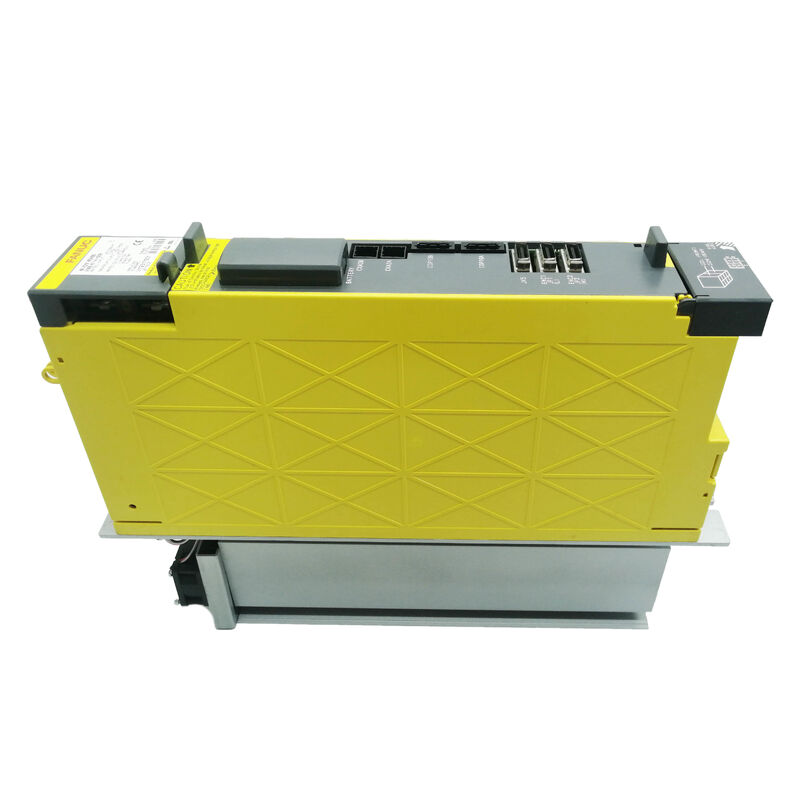
FANUC A06B-6114-H104 AC Servo Amplifier Unit — Product Description
One Axis. Full Precision. No Shortcuts.
Not every CNC axis needs to share a drive module with its neighbor. For machines where individual axis management, isolated fault diagnosis, or dedicated current capacity matters more than cabinet compactness, a single-axis amplifier is the deliberate choice — not the compromise. The A06B-6114-H104 is precisely that: a single-axis αi SV Series AC servo amplifier from FANUC, manufactured in Japan, designed to drive one servo axis with the full control authority and encoder feedback integration that FANUC's αi platform is known for.
The H104 suffix tells the full story in compact form. Within the A06B-6114 αi SV family, "H1xx" denotes single-axis configuration, and the trailing digits specify the continuous rated output current for that axis channel. This rating must match the operating requirements of the servo motor connected to it — not approximately, but exactly. FANUC's drive system is parametrized, not self-configuring, and installing a mismatched amplifier generates alarms that don't always point directly at the real cause.
The A06B-6114 Family: Where the H104 Fits
FANUC's αi SV Series covers a wide range of axis configurations and motor ratings. The A06B-6114 sub-family spans single-axis and dual-axis variants, each with different current output levels to match motors of varying sizes. The H104 is a single-axis unit, which places it alongside the H106, H115, and similar single-channel variants — each suited to different motor load profiles. Dual-axis units within the same family carry H2xx designations (H206, H208, and so on).
This matters practically because maintenance teams often search for an A06B-6114 replacement without specifying the suffix, only to find that the available stock is a dual-axis H206 rather than the single-axis H104 they need. The two are not pin-for-pin or parameter-for-parameter equivalent. If your machine's drive slot, wiring harness, and controller configuration are set up for a single-axis unit, a dual-axis replacement requires cabinet rework and parameter changes that extend a simple swap into a multi-hour engineering exercise.
Specifications
| Parameter |
Detail |
| Part Number |
A06B-6114-H104 |
| Drive Series |
FANUC αi SV (Servo Amplifier) |
| Axis Configuration |
Single-axis |
| Manufacturer |
FANUC Corporation |
| Country of Origin |
Japan |
| Certification |
CE |
| Condition Options |
New (Original) / Tested Refurbished |
| Compatible Controllers |
FANUC αi Series CNC Systems |
| Packaging |
Original or industrial protective packaging |
| MOQ |
1 piece |
Who Actually Buys This Part
Understanding the buyer profile for the A06B-6114-H104 helps set realistic expectations about the sourcing process.
Maintenance engineers are the most common buyer, working against a machine that's already down. They know their exact part number, they've already confirmed the fault is in the amplifier rather than the motor or encoder, and they need fast availability combined with confidence the unit has been properly checked before it ships.
Machine rebuilders and retrofitters source this part during planned overhauls, typically buying alongside other αi Series drive components to refurbish a complete drive cabinet. For this group, the ability to order multiple components and have them shipped together is as important as unit price.
Spare parts stockers — facilities running several FANUC-equipped machines — buy the H104 proactively to carry as a maintenance spare. The logic is straightforward: having a verified unit on the shelf converts a potential multi-day production halt into a same-shift drive swap.
All three buyer types benefit from verifying current stock availability before placing an order, since the supply of specific αi SV variants changes based on what's been sourced from decommissioned machine inventory.
Condition & Warranty
New (Original) — Factory stock, never installed, carries a 12-month warranty. The first choice for production-critical machines and any application where the amplifier will see sustained high-cycle operation from day one.
Tested Refurbished — Pulled from service equipment, evaluated under load, and verified functional before listing. Carries a 3-month warranty. A sensible option for machines at the end of their production life, low-duty applications, or buyers building out a cost-effective spare stock where a new unit's warranty premium isn't justified by the machine's schedule.
Both conditions ship in packaging designed to protect the drive during international transit. The warranty label must remain intact on any unit submitted for warranty service.
Ordering, Payment & Dispatch
Lead time: 2–4 working days from payment confirmation to dispatch.
Shipping: DHL and FedEx for international delivery. Local Guangzhou pickup available. Combined shipping on multi-item orders — request a quote for multiple components.
Payment: T/T (bank wire transfer), PayPal, Western Union. PayPal accepted on orders up to USD $500. Wire transfer for all order values.
Import duties and taxes at the destination country are the buyer's responsibility.
Returns Policy — Clear and Straightforward
Goods that arrive damaged, incomplete, or not matching the description should be reported on the delivery day or the following business day, with photos if possible. Units that prove non-functional within 4 days of receipt under normal operating conditions qualify for return or replacement. Damage caused by incorrect wiring, improper installation, or parameter errors is not covered. Returns are not accepted for change-of-mind purchases or wrong-part orders placed without prior compatibility verification. All returns must carry the original warranty label and ship back in the same condition as received.
Frequently Asked Questions
Q1: My machine uses an A06B-6114-H104. Can I swap it with an A06B-6114-H106 if the H104 is out of stock?
In short, this is not a straightforward drop-in swap. The H104 and H106 are both single-axis αi SV units within the same family, but they carry different continuous output current ratings per axis. Fitting a higher-rated unit in place of a lower-rated one may work electrically, but it requires servo parameter adjustments in the CNC to match the new amplifier's characteristics. If these parameters are not updated correctly, the axis will generate drive alarms or behave erratically. Before substituting a different suffix, consult your machine's servo parameter sheets and confirm with a FANUC-experienced technician that the parameter changes are within scope. If you're not in a position to do that safely, holding out for the correct H104 unit is the lower-risk path.
Q2: How do I know for certain that the servo amplifier is the failed component and not the motor or encoder?
Servo fault diagnosis follows a logical sequence. First, note the exact alarm code displayed by the CNC controller — FANUC alarm codes for servo faults are specific enough to indicate whether the issue is in the drive, the motor, the encoder feedback signal, or the communication between the amplifier and the controller. Second, inspect the amplifier visually for signs of burning or component damage. Third, if possible, swap the suspect amplifier with a known-good unit from another axis on the same machine — if the alarm follows the amplifier to its new slot, the amplifier is faulty; if it stays in the original slot with a different amplifier, the motor or wiring is the likely cause. Skipping this diagnostic sequence and ordering a replacement amplifier before confirming the fault source is the most common — and most expensive — mistake in CNC drive maintenance.
Q3: The H104 suffix ends in "04" — does that number directly correspond to a specific continuous output current in amps?
Within FANUC's αi SV naming convention, the numerical portion of the suffix does relate to the amplifier's rated output, but it's not a direct amp-for-amp correspondence to a round number. The suffixes reflect FANUC's internal ratings tiers rather than a literal current value in amps. The practical takeaway is that you should match the replacement amplifier by full part number, not by interpreting the suffix numerically. If you need to understand the electrical specifications in detail — for example, when evaluating whether a substitute variant is feasible — the FANUC αi Series Descriptions manual for your controller generation contains the full drive specification tables.
Q4: What is the expected service life of this amplifier, and what typically causes them to fail?
FANUC servo amplifiers are built for long service lives in industrial environments, and many αi Series units have been in continuous operation for 15 years or more without failure. When failures do occur, the most common causes are electrolytic capacitor degradation in the DC bus (which tends to appear as intermittent faults or erratic behavior before catastrophic failure), IGBT failure in the output power stage (usually caused by motor winding faults, excessive load, or power supply transients), and cooling fan failure leading to thermal shutdown. Cooling fan condition is worth checking regularly — a failed fan is inexpensive to replace and prevents the far more costly amplifier failure that follows if thermal stress builds unchecked.
Q5: Is it possible to source a factory-new A06B-6114-H104 directly from FANUC, and how does that compare to buying through a parts supplier?
FANUC sells spare parts through its authorized service network, and in regions where FANUC has an active service presence, ordering directly through the local FANUC office or distributor is an option. The trade-offs are lead time and price — FANUC's direct supply chain is reliable but can have longer lead times than the secondary market, and pricing is typically higher than sourced-from-stock refurbished units. For buyers in regions where FANUC's local service infrastructure is limited, or in situations where lead time from the official channel doesn't fit the downtime window, the secondary market for tested refurbished units offers a practical and cost-effective alternative, provided the supplier performs functional verification before shipment.
Parts confirmed in stock move fast. Verify availability before your schedule depends on it.


 Your message must be between 20-3,000 characters!