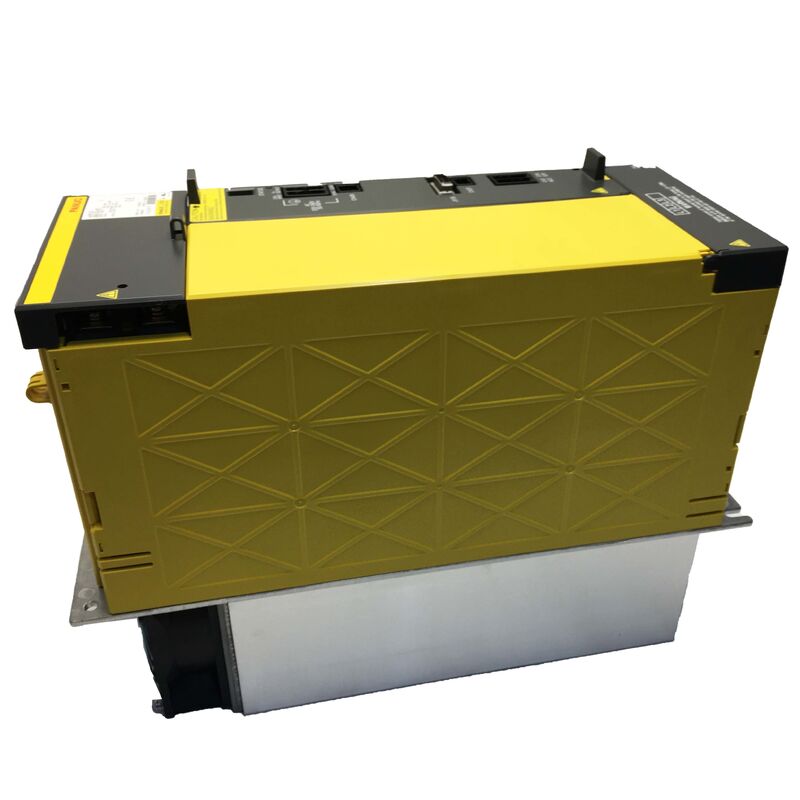
FANUC A06B-6142-H022 — αiSP 22 Type B Spindle Amplifier Module | 200V Class, 25kW
Part No.: A06B-6142-H022 (#H580) ▏Series: αi SP (Type B2 Interface) ▏Model: αiSP 22 / AiSP-22 ▏Voltage Class: 200V Input ▏Condition: New Original
Overview
The A06B-6142-H022 is a 22kW-class spindle amplifier from FANUC's first-generation αi (Alpha i) series, carrying the Type B interface designation that places it firmly in the 16i/18i/21i CNC generation of FANUC machine tools. It is a pure spindle drive module — no servo channels, no combined axis functions — engineered to control a single αi-series spindle motor with the precision and reliability that high-cycle production machining demands.
Understanding where this unit sits in the FANUC spindle amplifier lineage matters before ordering. The αi SP Type B series (A06B-6142-xxxx) is the second-generation connector variant of the original αi spindle family, succeeding the Type A (A06B-6141-xxxx). Both are first-generation αi drives targeting 16i/18i/21i controls. They are distinct from the later αiSP-B series (A06B-6220/6222-xxxx), which uses FSSB fibre-optic communication and targets 0i-D/30i/31i generation controls. Knowing the CNC control series installed in your machine determines which family applies — confusing the two is the most common sourcing error for this part number.
Like all αi-series spindle modules, the A06B-6142-H022 operates from the shared DC bus provided by a companion αiPS power supply module, drawing from the rectified and regulated DC rail rather than directly from three-phase AC mains. The complete power board and control PCB are housed within a single plug-in chassis, with each board independently field-replaceable if needed.
Technical Specifications
| Parameter |
Value |
| Part Number |
A06B-6142-H022 (#H580) |
| Series |
αi SP — First-Generation Alpha i |
| CNC Interface Type |
Type B (Type B2) |
| Voltage Class |
200V Input Series (#H580) |
| DC Bus Input Voltage |
283 – 339 V DC |
| Spindle Power Rating |
approx. 25 kW |
| Rated Output Voltage |
240 V AC, 3-phase |
| Rated Output Current |
95 A |
| Architecture |
Shared DC bus (αiPS PSM required) |
| PCB Contents |
Power board + Spindle control PCB |
| Enclosure |
IP20 |
| Compatible CNC Platforms |
FANUC Series 16i / 18i / 21i / Power Mate i |
Note: Electrical specifications reference the αiSP 22 Type A equivalent (A06B-6141-H022) which shares the same power class. Confirm from unit label before installation.
Type A vs. Type B vs. Type B2 — Understanding the Interface Difference
The number "22" in the model code refers to the spindle motor power class (22kW range). The letter code distinguishes the CNC interface version:
| Part Number |
Interface |
CNC Generation |
Notes |
| A06B-6141-H022 |
Type A |
16i / 18i / 21i (early) |
First generation αiSP 22 |
| A06B-6142-H022 |
Type B / B2 |
16i / 18i / 21i |
Updated connector layout, same power class |
| A06B-6220-H022 |
FSSB (αiSP-B) |
30i / 31i / 0i-D |
Newer B-generation series |
Type A and Type B units are not interchangeable without verifying that the CNC firmware supports the connector variant. The spindle amplifier type parameter in the CNC must match the physical unit. Fitting a Type B unit in place of a Type A may require a CNC parameter change even when the spindle motor remains the same.
Compatible Spindle Motors
The αiSP 22 amplifier targets FANUC's α-series spindle motors in the 22kW continuous power range. Representative compatible motor types include:
αiI (Integrated) series in the 22kW class:
- αiI 22/6000 — integrated spindle motor, 22kW continuous
- αiI 18/8000 — lower-speed 18kW variant within the amplifier's output headroom
αiIP (Integral, in-spindle type):
- αiIP 22/8000 — through-spindle motor rated for high-speed applications
αiIL (In-line type):
- αiIL 22/6000 — external motor driving through reduction gearing
Motor selection must always be confirmed against the FANUC motor specification sheet to ensure the continuous current demand falls within the amplifier's 95A output rating. The 22kW designation refers to the typical motor class, not a hard electrical cutoff.
The DC Bus Architecture — Why the PSM Matters
The A06B-6142-H022 does not connect directly to AC mains. It draws from a shared DC bus distributed by an αiPS (Alpha i Power Supply) module — the common rectifier and energy management hub for all servo and spindle amplifiers in the cabinet. This shared bus architecture allows regenerated braking energy from decelerating motors to flow back onto the bus and be consumed by other axes that are simultaneously accelerating, rather than being wasted as heat.
When specifying a replacement PSM for a cabinet containing this spindle module, the PSM output must be rated to cover the combined peak current demand of the spindle amplifier plus all servo axis amplifiers on the same bus. An undersized PSM is a common commissioning error that produces DC bus undervoltage alarms during simultaneous high-load acceleration events — a fault pattern that can be mistaken for spindle module failure.
Rigid Tapping and Orientation Functions
The αiSP 22 supports FANUC's full spindle function set, including:
- Spindle orientation (fixed-point stopping) — for automatic tool changers and pallet systems that require a repeatable spindle angular position
- Rigid tapping — synchronised spindle-to-Z-axis interpolation for threadcutting without a floating tap holder, available when the CNC option is enabled
- Cs contouring (C-axis interpolation) — full servo-loop control of the spindle for milling/turning compound operations, requires appropriate spindle motor encoder and CNC option
All three functions depend on the spindle motor being equipped with a suitable position feedback device (position coder or built-in encoder). The amplifier hardware supports all functions; availability on the machine depends on the CNC software options purchased at the time of original commissioning.
Part Number Cross-Reference
| Format |
Notation |
| Standard |
A06B-6142-H022 |
| With voltage class suffix |
A06B-6142-H022#H580 |
| Hyphen-free |
A06B6142H022 |
| OCR variant (6→G, 1→I) |
AO6B-6I42-HO22 |
| Common label shorthand |
αiSP 22 / AiSP-22 / AISP-22 |
| Type A equivalent (same power) |
A06B-6141-H022 — interface differs |
| Newer FSSB-generation equivalent |
A06B-6220-H022 — different CNC generation |
Shipping & Logistics
Dispatch: Stock units confirmed and dispatched within 1–2 business days. Complete with power board and spindle control PCB, packed in anti-static protection inside foam-padded rigid carton.
Carriers: DHL Express · FedEx International Priority · UPS Worldwide Express · TNT · EMS
Delivery: Express services cover 220+ countries with 24–48 hour transit. Standard international delivery 3–7 business days.
Import duties: Payable by buyer per destination country regulations. Commercial invoice and packing list included with every shipment.
FAQ
Q1: What is the practical difference between the A06B-6141-H022 (Type A) and A06B-6142-H022 (Type B) — can they replace each other? Both drive the same class of 22kW αi-series spindle motor and share the same DC bus architecture. The difference is the connector and communication interface between the spindle amplifier and the CNC control. Type A uses one connector configuration; Type B (also called B2) uses an updated layout that was introduced with later 16i/18i revisions. In many cases a Type B can substitute for a Type A unit, but it requires verifying that the CNC firmware revision in the machine supports the Type B interface and that the spindle amplifier type parameter is updated accordingly. A direct swap without parameter confirmation can leave the spindle unresponsive at power-up.
Q2: My machine uses a 16i-MB control. Is the A06B-6142-H022 the correct spindle amplifier for that platform? The Series 16i family is the primary target for the αi SP Type B series, so yes — the A06B-6142-H022 is designed for this generation. Confirm by checking the spindle amplifier type parameter on the CNC (typically accessed through the servo/spindle setting screen) and matching it to the installed or intended unit. The 16i-MB can run both Type A and Type B αiSP modules depending on the firmware version; the parameter setting tells you which is expected.
Q3: Can this amplifier be used with a FANUC 0i-D or 30i control as a direct replacement? No — the 0i-D and 30i/31i families use the newer αiSP-B series amplifiers (A06B-6220/6222-xxxx) which communicate over FSSB fibre-optic bus. The A06B-6142-H022 uses a direct digital interface that is not electrically compatible with the FSSB bus structure. If you are upgrading a machine from 16i to 30i controls, the spindle amplifier would also need to be upgraded to an αiSP-B unit — the motor itself can typically remain if it is within the current class of the new amplifier.
Q4: What spindle alarms are most commonly associated with this amplifier, and what are the first steps when an alarm appears? The most frequent field alarms on the αiSP 22 Type B include AL-01 (motor overheat), AL-07 (DC bus overvoltage during deceleration), AL-09 (DC bus undervoltage), and AL-24 (output transistor fault). For AL-07, check the DC bus voltage during spindle deceleration — this alarm often indicates the αiPS PSM's regeneration capacity is being exceeded during rapid spindle stops. Increasing the spindle deceleration time constant in the CNC parameters reduces peak regenerative energy and frequently clears this alarm without hardware replacement. For AL-09, verify the PSM mains input voltage and check for loose connections on the DC bus terminals between the PSM and this module.
Q5: The spindle module powers up without alarms but the spindle motor produces abnormal vibration during cutting. Is this an amplifier fault? Abnormal spindle vibration during cutting is more commonly a mechanical or parameter issue than an amplifier hardware fault. Start by checking the spindle motor encoder feedback — a degraded position coder signal produces speed loop instability that manifests as audible vibration or surface finish problems. Next, review the spindle current loop gain parameter (PK1SP and PK2SP in the FANUC parameter set): values drifted from the factory setting after a parameter initialisation — or incorrect values entered during a spindle amplifier swap — are a frequent cause of resonance at specific spindle speeds. If the vibration is speed-dependent (worse at certain RPMs), it points strongly to a parameter issue rather than a failed output stage.


 Your message must be between 20-3,000 characters!