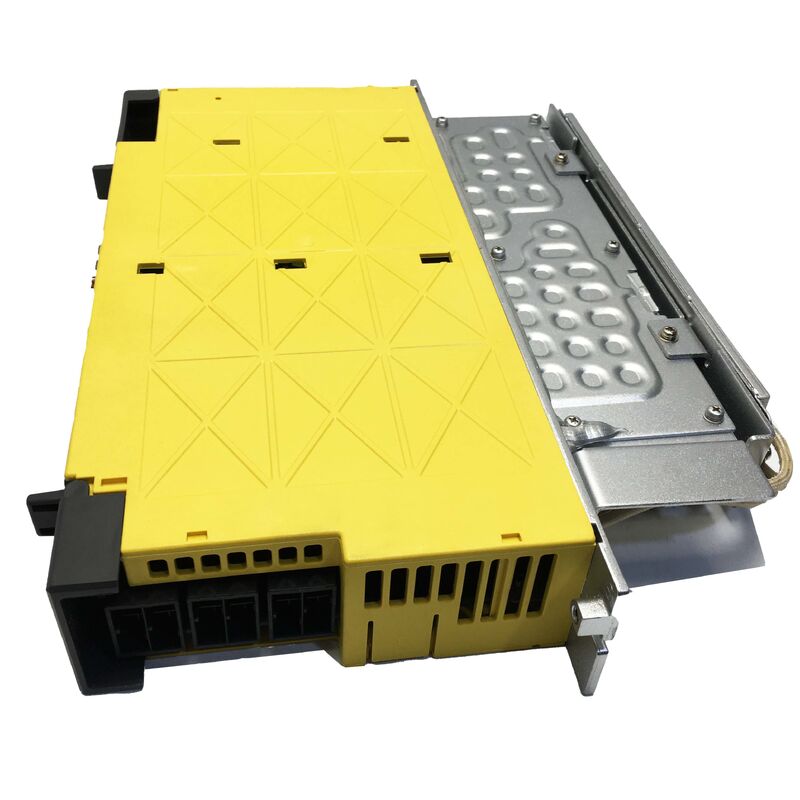
FANUC A06B-6160-H003 — βiSV40-B Single-Axis AC Servo Amplifier Unit | 200V, 40A Peak, FSSB
Part No.: A06B-6160-H003 ▏Model Designation: βiSV40-B ▏Type: Single-Axis Standalone Servo Amplifier ▏Voltage Class: 200V AC Input ▏Interface: FSSB Fibre-Optic
A Dedicated Single-Axis Drive for When Sharing Isn't an Option
Not every axis on a CNC machine fits neatly into a combined servo/spindle module. Auxiliary rotary tables, tailstocks, pallet changers, and high-load single axes often require their own dedicated drive — one sized specifically to that axis's motor rather than sharing current headroom with adjacent channels. The A06B-6160-H003 is built for exactly these situations.
Part of FANUC's βiSV-B (Beta i Servo, B-generation) family, the H003 is a compact, self-contained single-axis servo amplifier capable of delivering 40A peak output to drive a single βiS-series servo motor. It connects to the CNC via FSSB fibre-optic bus, draws from three-phase 200–240V AC mains, and incorporates a built-in regenerative resistor that handles braking energy without requiring external components. The result is a clean, self-sufficient drive unit that can be added to any 0i-D or compatible cabinet wherever an independent high-current servo axis is needed.
What separates the H003 from the combined βiSVSP units in the 6164 series is architecture: this is a pure servo amplifier with no spindle channel. It drives one motor, does it precisely, and does nothing else. For a single dedicated axis, that focus is an advantage — the full 40A peak current belongs to that axis alone, with no sharing or thermal interaction from adjacent channels.
Specifications
| Parameter |
Value |
| Part Number |
A06B-6160-H003 |
| Model Designation |
βiSV40-B |
| Number of Axes |
1 (single axis) |
| Peak Output Current |
40 A |
| Rated Output Current |
13 A |
| Output Voltage |
240 V AC |
| Input Voltage |
3-phase, 200–240 V AC (+10% / −15%), 50/60 Hz |
| Input Current |
approx. 14 A |
| Control Power |
DC 24 V |
| PWM Control Method |
Sine-wave, HRV2 / HRV3 |
| Regeneration |
Built-in regenerative resistor |
| CNC Interface |
FSSB (Fanuc Serial Servo Bus) fibre-optic |
| Cooling |
Natural convection / forced-air (installation dependent) |
| Enclosure |
IP20 |
| Compatible CNC |
FANUC Series 0i-D / 0i-MD / 0i-TD / 0i-Mate-D |
The 6160 Series Lineup — Choosing the Right Model
The A06B-6160 series covers the full βiSV-B single-axis range from compact light-duty axes to heavy-load high-inertia applications, all sharing the same FSSB interface and 200V input class. The H003 sits in the mid-upper range:
| Part Number |
Model |
Peak Output |
Continuous Output |
Typical Motor Frame |
| A06B-6160-H001 |
βiSV4-B |
10 A |
2.5 A |
βiS 0.5 / βiS 1 |
| A06B-6160-H002 |
βiSV20-B |
20 A |
6.5 A |
βiS 2 / βiS 4 / βiS 8 |
| A06B-6160-H003 |
βiSV40-B |
40 A |
13 A |
βiS 8 / βiS 12 / βiS 22 |
| A06B-6160-H004 |
βiSV80-B |
80 A |
25 A |
βiS 30 / βiS 40 |
Substituting the H002 for the H003 is a common and damaging error — the H002's 20A peak cannot handle motors sized for the H003, leading to overcurrent alarms or IGBT failure. Always match the amplifier model to the motor's current specification, not just its physical appearance.
Compatible Servo Motors
The βiSV40-B is matched to FANUC's βiS-series (Beta i Standard) servo motors within its 13A continuous / 40A peak current envelope:
Comfortably within ratings:
- βiS 8/3000, βiS 8/2000 — standard Z-axis or high-duty cycle horizontal axis motors
- βiS 12/3000 — mid-frame motor, 13A continuous sits right at the amplifier's rated output
Upper end of range:
- βiS 22/2000 — confirm duty cycle allows the continuous current demand to stay within the 13A rated limit; suitable for intermittent high-load applications with adequate idle time
All βiS-series motors in this current class use the FANUC serial pulse coder (SPC) or high-resolution absolute encoder, both fully supported by the βiSV40-B control PCB.
Three Technical Features Worth Understanding
Built-in Regenerative Resistor
Unlike the αi-B series servo amplifiers, which rely on a shared PSM (power supply module) for regeneration, the βiSV-B series incorporates its own regenerative circuit with an internal braking resistor. When the motor decelerates, the kinetic energy converts back to electrical energy and the internal resistor dissipates it as heat. This self-contained architecture means the βiSV40-B does not require a separate PSM — it connects directly to three-phase mains, which simplifies cabinet design and reduces component count for standalone axis installations.
The thermal capacity of the built-in resistor is finite. In applications with very frequent braking cycles or long deceleration distances at high motor speeds, an external regenerative resistor may need to be added. If the internal resistor overheats, the drive will trigger a regeneration alarm before the resistor sustains damage.
HRV2 and HRV3 Current Loop Modes
The βiSV40-B supports both HRV2 and HRV3 (High Response Vector) current control algorithms. HRV3 operates at a higher loop update rate, reducing the servo's position following error during acceleration-deceleration transitions and improving surface quality in contour operations. Whether HRV2 or HRV3 is active is determined by the servo parameter set in the CNC — the amplifier hardware supports both, but the CNC firmware version and servo motor encoder type must also be compatible before HRV3 is enabled.
FSSB Fibre-Optic Communication
The drive communicates with the CNC via FSSB, FANUC's serial servo bus transmitted over plastic optical fibre. The fibre-optic link provides inherent immunity to electromagnetic interference from the machine's high-current power cables — a significant practical advantage in environments with large motors, arc welding, or other EMI sources nearby. The JOG and ROP connectors on the front of the unit handle the optical send and receive paths. These connectors are push-fit and must be seated firmly; a partially connected optical cable is one of the most frequent causes of FSSB communication alarms at startup.
Part Number Cross-Reference
| Notation |
Format |
| Standard |
A06B-6160-H003 |
| Hyphen-free |
A06B6160H003 |
| OCR variant (O→0, i→1) |
AO6B-6I6O-HOO3 |
| Model designation |
βiSV40-B / Beta iSV40-B / BiSV40 |
| Lower-rated equivalent |
A06B-6160-H002 (βiSV20-B) — NOT interchangeable |
| Higher-rated equivalent |
A06B-6160-H004 (βiSV80-B) |
Shipping & Logistics
Dispatch: Stocked units are confirmed and dispatched within 1–2 business days. Each unit is shipped in anti-static packaging with foam-lined rigid carton protection.
Carriers: DHL Express · FedEx International Priority · UPS Worldwide Express · TNT · EMS
Delivery: Express options reach 220+ countries within 24–48 hours; standard international transit is 3–7 business days.
Customs: Commercial invoice and packing list provided with all shipments. Import duties and taxes are payable by the buyer in accordance with the destination country's customs regulations.
FAQ
Q1: Can the A06B-6160-H003 be used as a drop-in replacement for an A06B-6160-H002 if the H002 is unavailable? No — and this is a critically important distinction. The H002 is a βiSV20-B with a 20A peak output; the H003 is a βiSV40-B with a 40A peak. If the failed unit in your machine is an H002 paired with a βiS 4 or βiS 8 motor, substituting the H003 will work electrically, but the servo parameters (specifically the motor current limit and overload detection thresholds) must be re-initialised for the new amplifier type. Installing the H003 without updating the servo parameters can lead to incorrect current limiting, potentially damaging the motor or producing erratic axis behaviour. The reverse substitution — H002 for H003 — should never be attempted, as the H002 cannot supply the current demanded by motors matched to the H003, resulting in overcurrent alarms or IGBT failure.
Q2: Does the βiSV40-B require a separate power supply module (PSM) like the αi-B series amplifiers do? No. This is one of the key architectural differences between the βiSV-B series and the αiSV-B series. The A06B-6160-H003 connects directly to three-phase 200–240V AC mains without requiring a companion PSM. It has its own internal rectifier, DC bus capacitors, and built-in regenerative resistor. An αiSV-B module by contrast draws from a shared DC bus provided by a separate αiPS-B power supply module. For cabinet designs where a standalone axis is being added to an otherwise αi-B cabinet, the βiSV-B can be powered from its own dedicated mains feed rather than tapping into the αi DC bus.
Q3: What CNC controls are compatible with the A06B-6160-H003? The βiSV40-B uses FSSB fibre-optic communication, which restricts compatibility to FANUC controls that support this interface. Confirmed compatible platforms include the Series 0i-D (0i-MD for milling, 0i-TD for turning), 0i-Mate-D, and 0i-MF. Older FANUC controls using analogue velocity commands or the earlier I/O Link servo interface (0i-C, 16i/18i/21i generation) cannot communicate with this amplifier without a CNC upgrade.
Q4: My machine shows a servo alarm 5 (overcurrent) immediately after a cold start on the axis driven by this unit. What are the likely causes? A servo alarm 5 at cold start — before any motion command has been issued — usually indicates a fault in the amplifier output stage rather than a wiring issue, because the overcurrent is detected before current is commanded to flow. The most common cause is a short circuit in one or more of the IGBT output transistors, which can occur after a motor cable insulation fault sends a voltage spike back into the amplifier, or simply as component wear after years of thermal cycling. Before assuming IGBT failure, however, disconnect the motor power cable (U/V/W) at the amplifier output and power up again. If the alarm clears with the motor disconnected, the fault is in the motor winding insulation or the motor cable — not in the amplifier itself.
Q5: The built-in regenerative resistor on this unit is getting noticeably hot during normal operation. Is this expected, and when should it be a concern? Some heat from the regenerative resistor is completely normal during deceleration cycles — it is doing its job of dissipating braking energy. The concern threshold is when the resistor surface becomes hot enough to risk igniting adjacent wiring insulation, or when the drive begins triggering a regeneration overheat alarm (typically indicating the resistor thermal protection has tripped). This occurs when the duty cycle of braking operations exceeds the resistor's thermal capacity. If the alarm appears repeatedly, the options are to increase the deceleration time constant in the CNC program (spreading the braking energy over a longer period), reduce the maximum axis speed, or add an external regenerative resistor to share the thermal load. Restricting airflow around the unit — for example through accumulated dust on the heatsink — will also cause premature thermal trips and should be addressed through regular cleaning.


 Your message must be between 20-3,000 characters!