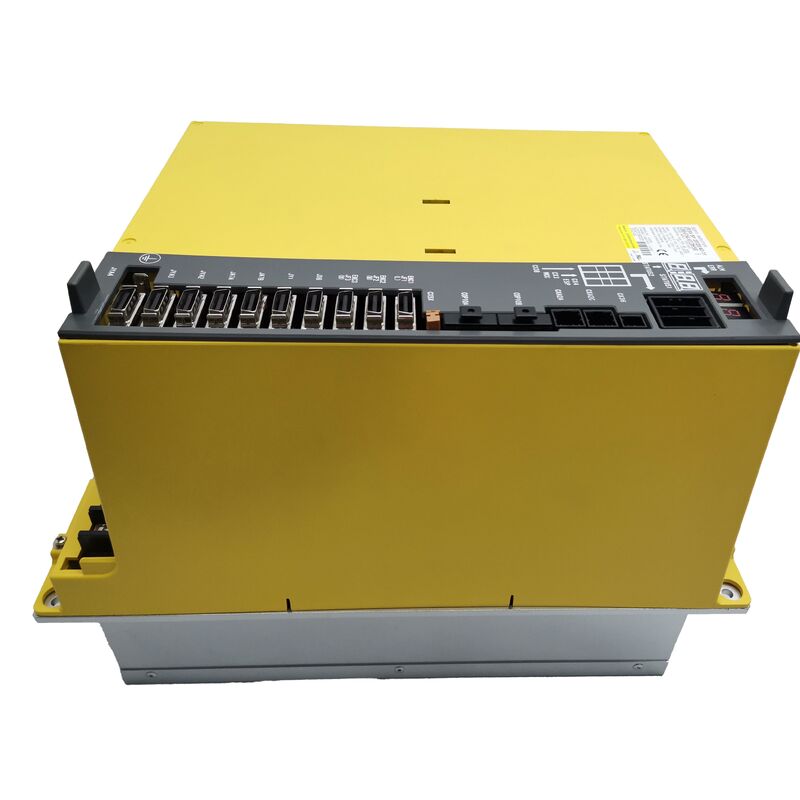
FANUC A06B-6164-H312 | βiSVSP 20/20/40-11 Combined Servo and Spindle Amplifier — 3-Axis / 11 kW Spindle / FSSB / 200V
Three Servo Axes and a Spindle in One Unit
The A06B-6164-H312 is the 11 kW spindle variant in FANUC's βiSVSP combined amplifier family — one module that drives three independent servo axes and a full spindle simultaneously. This eliminates the separate spindle amplifier and multi-axis servo module, reduces cabinet depth, and cuts the inter-unit bus wiring that would otherwise connect them.
The asymmetric servo channel sizing is intentional. The N-axis channel runs at 40 A peak / 13 A continuous — double the L and M channels at 20 A / 6.5 A each. On a typical vertical machining centre using this unit, the N-axis is assigned to the Z-axis drive: vertical travel carries a continuous gravity load from the spindle head weight that L and M horizontal axes do not see. The N channel's higher current rating handles that sustained gravity compensation load without the axis running near its thermal ceiling.
Communicating with the CNC via FSSB fibre-optic bus, the unit works with FANUC 0i-D/0i-MD and 0i-Mate-D controls. HRV2 and HRV3 current control modes are supported, providing the higher-bandwidth current loop that reduces following error during high-acceleration contouring.
Key Specifications
| Parameter |
Value |
| Part Number |
A06B-6164-H312 (#H580) |
| Model |
biSVSP 20/20/40-11 |
| L/M Continuous |
6.5 A per axis |
| N Continuous |
13 A |
| Spindle |
11 kW / 56 A rms |
| AC Input |
200–240V 3-phase, ~52A |
| Interface |
FSSB |
| HRV |
HRV2, HRV3 |
| CNC |
0i-D, 0i-MD, 0i-Mate-D |
H312 in the 6164 βiSVSP Family
All three units in this spindle-tier comparison share the 20/20/40 servo channel configuration:
| Part Number |
Servo Channels |
Spindle |
| A06B-6164-H311 |
20/20/40 (same) |
7.5 kW |
| A06B-6164-H312 |
20/20/40 |
11 kW |
| A06B-6164-H333 |
40/40/40 |
15 kW |
The H312 is matched to machines with spindle motors between 8 kW and 11 kW. The H311 would be undersized for that spindle class. The H333 has higher-rated servo channels (40/40/40) and is a different module with different wiring.
A note on conflicting market descriptions: Some distributor database entries incorrectly describe the H312 as a two-axis biSVSP 80/80-18 unit. This is a catalogue data error. FANUC's H3xx sub-series within the 6164 family are three-axis units — H311, H333, H343, H364, and H312 all share this architecture. Confirm the model designation from the label on the physical unit before cross-referencing.
FAQ
Q1: What is the difference between A06B-6164-H312 and A06B-6164-H311?
Both are three-axis servo plus spindle units with the same 20/20/40 servo channel sizing. The only difference is spindle output: H311 supports a 7.5 kW spindle; H312 supports 11 kW. If the machine's spindle motor is between 8 kW and 11 kW, H312 is the correct unit. H311 would be undersized; the next step up (H333 with 15 kW) has different servo channel ratings.
Q2: Why does the N-axis channel have higher current than L and M?
The N-axis is typically assigned to the Z-axis on a vertical machining centre — vertical travel that carries the continuous gravity load of the spindle head. L and M axes are usually horizontal with no net gravitational load. The 40 A peak / 13 A continuous N-channel rating accommodates the Z-axis's sustained gravity compensation current without thermal overload.
Q3: Some listings describe the H312 as a two-axis biSVSP 80/80-18. Which is correct?
The three-axis biSVSP 20/20/40-11 description is correct. The two-axis description is a distributor database error. FANUC's H3xx sub-series within the 6164 family are all three-axis units. Verify the model designation from the label on the physical unit — it will show biSVSP 20/20/40-11.
Q4: All axes show FSSB alarm at power-up. What should be checked first?
FSSB alarms across all axes simultaneously point to a communication issue, not individual axis faults. Check both ends of the fibre-optic cable between the CNC optical interface and this unit: physical cable damage, contamination on the push-fit optical connectors, or a partially seated connector are the most common causes. A dirty optical connector face is the single most frequent source of this symptom.
Q5: Can the spindle channel be repaired independently if it fails while servo channels remain functional?
Yes. The spindle output stage uses a discrete IGBT power module. Specialist FANUC repair facilities test all four channels independently and replace only the failed stage — significantly more cost-effective than full unit replacement. If machine downtime is the constraint, an exchange unit returns the machine to service fastest; if cost is the priority, component-level repair is the better option.


 Your message must be between 20-3,000 characters!