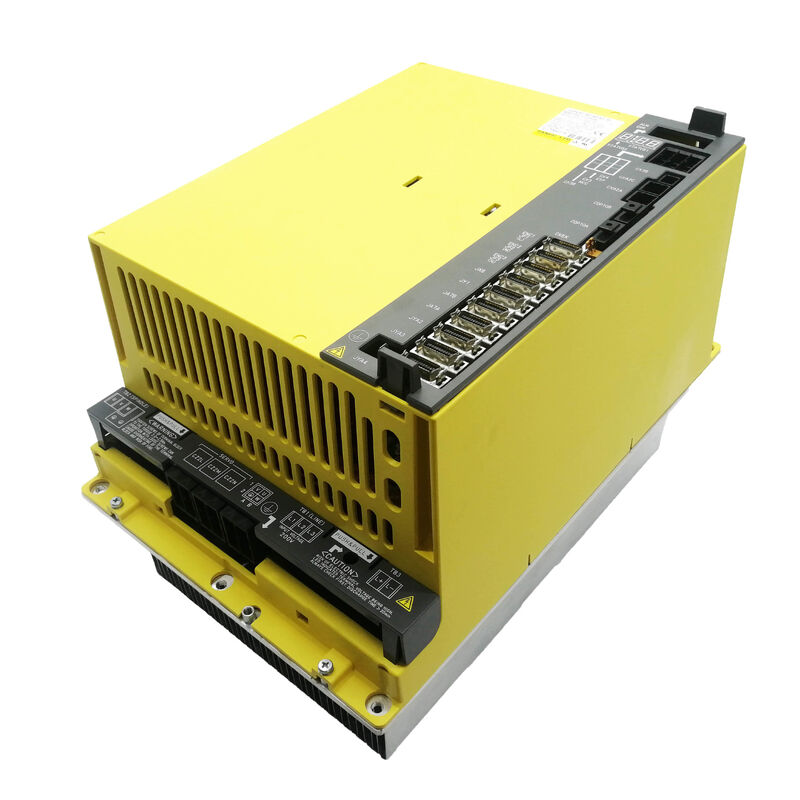
FANUC A06B-6164-H333 | βiSVSP 40/40/40-15 Combined Servo and Spindle Amplifier — 3-Axis / 15kW Spindle / FSSB / 200V
One Module for Four Drive Channels
The A06B-6164-H333 is a βiSVSP — FANUC's combined Beta i Servo and Spindle unit. Three independent servo motor channels and a full 15 kW spindle amplifier share one module. In a standard machine cabinet, this replaces what would otherwise require a separate spindle amplifier plus a multi-axis servo unit, reducing cabinet depth, cutting inter-unit cabling, and simplifying the drive topology. It is the compact, cost-optimised solution for mid-range vertical machining centres, turning centres, and compound machines that do not demand the peak power of the full Alpha i series.
Reading the model code: biSVSP 40/40/40-15 — bi = Beta i series; SVSP = Servo and Spindle integrated; 40/40/40 = three servo channels, each 40A peak (13A continuous); 15 = 15 kW spindle class. This distinguishes it from the two-axis variant (biSVSP 40/40-15, part A06B-6164-H233) and from units with mixed servo sizing.
Motor Compatibility
Servo axes (L/M/N): Designed for FANUC βiS-series servo motors — βiS 4/5000 through βiS 12/3000. The 13A per-axis continuous limit constrains motor selection. The βiS 22 frame and above exceeds this limit and requires a higher-rated servo section.
Spindle: 15 kW spindle section pairs with FANUC βi-series spindle motors — βiI 15/10000 and βiI 18/7500. Confirm against the FANUC motor specification sheet that the motor's continuous current demand falls within the amplifier's output rating.
Replacing the A06B-6134-H303#A — Not a Simple Swap
The A06B-6164-H333 is the designated replacement for the earlier A06B-6134-H303#A. Both are three-servo-axis plus 15 kW spindle combined units. The key difference is the servo communication interface: the 6134 series used a parallel I/O servo interface; the 6164 series uses FSSB fibre-optic. These protocols are not compatible.
Upgrading from 6134 to 6164 requires:
- Verifying the CNC firmware supports the 6164 series amplifier
- Installing FSSB fibre-optic cabling between the CNC and the new unit
- Updating CNC parameters for the FSSB servo topology
Key Specifications
| Parameter |
Value |
| Part Number |
A06B-6164-H333 (#H580) |
| Model Code |
biSVSP 40/40/40-15 / SVPM3-15i |
| Servo Channels |
3 (L, M, N) — 13A rated / 40A peak |
| Spindle |
15 kW |
| Input |
200V AC 3-phase |
| Interface |
FSSB fibre-optic |
| Compatible CNC |
0i-D, 0i-MD, 0i-MF, 0i-Mate-D |
| Predecessor |
A06B-6134-H303#A |
FAQ
Q1: What is the difference between A06B-6164-H333 and the A06B-6134-H303#A it replaces?
Both are three-axis servo plus 15 kW spindle combined units. The 6134 uses a parallel I/O servo interface; the 6164 uses FSSB fibre-optic. These are different communication protocols — the replacement is not a direct drop-in. The CNC firmware must support the 6164 series, FSSB fibre-optic cabling must be installed, and servo topology parameters must be updated.
Q2: Is this unit suitable for a four-axis machine?
No — the H333 provides exactly three servo channels (L, M, N) plus one spindle. For a fourth servo axis, a separate single-axis βiSV amplifier can be added downstream on the same FSSB loop. Confirm FSSB slave count against the CNC's axis configuration before adding a supplementary unit.
Q3: Can this amplifier be used with Alpha i spindle motors?
The spindle section is rated at 15 kW and is matched to FANUC β-series spindle motors. Some smaller αi spindle motors fall within the 15 kW power class, but α-series and β-series motors have different winding characteristics. Pairing them requires parameter verification and FANUC confirmation — an incorrect pairing can produce overtemperature conditions or drive faults even if nameplate power ratings appear compatible.
Q4: Multiple SV alarms appear across all three servo axes simultaneously. Does this mean all three channel IGBTs have failed?
Not necessarily. All three servo channels share a common DC bus and 24V control supply inside the module. A failure in the shared DC bus section, a common driver fault, or loss of 24V control power disables all three channels simultaneously and generates multiple SV alarms. Before assuming three independent IGBT failures, check the DC bus voltage at the PSM, inspect the 24V control supply, and look for SV021 or SV023 system-level alarms that indicate a shared-rail fault.
Q5: What spare parts should be kept on hand for this module?
The cooling fan is the highest-wear consumable — replace it preventively at regular service intervals. IGBT modules in the servo channels and spindle output stage are the most frequently replaced components in repairs. FSSB fibre-optic cables connecting this unit to the CNC are worth stocking as spares — connector contamination or physical cable damage is a common cause of communication alarms that are easily mistaken for amplifier failure.


 Your message must be between 20-3,000 characters!