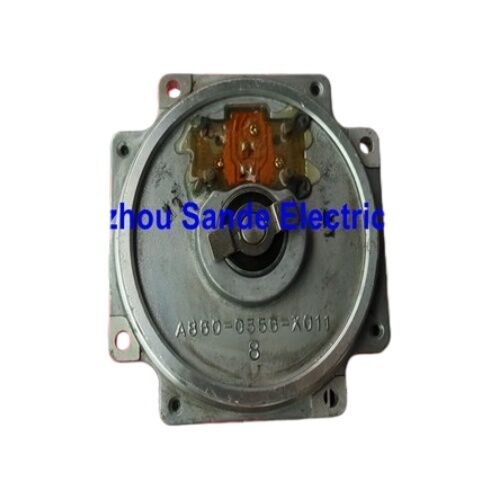
FANUC A860-0356-X011 Continuous Rotary Pulse Coder — αA64 Absolute Encoder for FANUC Alpha Series Servo Motors
The Component Behind Every Precise Axis Move
There's a small but critical piece of hardware mounted to the rear of your FANUC Alpha series servo motor that most machine operators never think about — until it fails. The A860-0356-X011 is the internal rotor and sensing element of the αA64 (AA64) pulse coder, the absolute serial encoder family that gave an entire generation of FANUC Alpha servo motors their positional intelligence.
This part number appears across multiple cross-references in the market. The complete encoder assembly is widely listed as A860-0360-T201, A860-0360-V501, or A860-0360-V511 — the A860-0356-X011 identifies the internal encoder disc/rotor component housed within that red-capped assembly. When sourcing a replacement encoder for an Alpha series motor, both the rotor element designation and the complete assembly number may appear on supplier listings, and both refer to the same functional unit you need to restore the axis.
What "AA64" Actually Means — and Why Resolution Matters
The designation AA64 breaks down as follows: A for Alpha series, A for Absolute type, 64 for 64,000 pulses per revolution. That resolution figure — 64K counts per turn — is what separates this generation of FANUC encoders from older lower-resolution units and defines the positioning precision available to the CNC control.
At 64,000 counts per revolution, the servo amplifier receives extremely fine-grained position data with every shaft rotation. On a ballscrew with a 10mm pitch, this translates to position resolution of 0.15625 micrometers per encoder count — far finer than the mechanical accuracy of most machine tools, which is exactly the point. You want the feedback system to be the most accurate element in the chain, so it never becomes the limiting factor in the machine's positioning performance.
The absolute nature of this encoder is equally significant. Unlike incremental encoders that only measure relative movement from a known starting point, an absolute encoder retains its position value even when the machine is powered down. When the machine starts up the next morning, the CNC already knows exactly where every axis is. No reference point cycle required. The servo amplifier reads the stored position immediately on power-up, and the machine is ready to run.
Technical Overview
| Attribute |
Detail |
| Part Number |
A860-0356-X011 |
| Complete Assembly Cross-Ref |
A860-0360-T201 / A860-0360-V501 / A860-0360-V511 |
| Encoder Type |
Absolute Serial Pulse Coder (αA64) |
| Resolution |
64,000 pulses per revolution (64K) |
| Feedback Type |
Serial absolute (continuous rotary) |
| Connector |
14-pin male |
| Motor Series |
FANUC Alpha series AC servo motors |
| Motor ID Suffix |
Motors with B75 suffix (A06B-0xxx-Bx75) |
| Housing |
Red plastic cap — characteristic of Alpha series |
| Country of Origin |
Japan |
| Application |
CNC machining centers, turning centers, multi-axis systems |
Where This Encoder Lives and How It Connects
The αA64 pulse coder mounts inside the distinctive red plastic end cap on the rear of FANUC Alpha series servo motors. The encoder couples to the motor shaft via a precision interconnecting coupling that transmits rotation without backlash or slip. The red cap assembly — encoder housing, coupling, and PCB together — is a self-contained unit that clips into the motor's rear bell.
The 14-pin connector carries both the power supply to the encoder and the serial data output back to the servo amplifier. In FANUC's serial pulse coder architecture, position data is transmitted as a digital serial stream rather than as raw incremental pulses. This makes the signal more noise-resistant over the cable run from motor to amplifier, and it carries richer data — absolute position, speed, and status — in a format the amplifier's DSP can work with directly.
A key practical point: the encoder cable is not part of the A860-0356-X011 / A860-0360 assembly and must be sourced separately if it is damaged. Cable faults on the 14-pin line cause servo alarms that are symptomatically identical to encoder hardware failure, so the cable is always the first thing to check before condemning the encoder itself.
The Alpha Motor Identification: Recognizing the Right Fit
FANUC Alpha series servo motors that use this encoder typically carry the alphanumeric suffix B75 in the motor order code — for example, A06B-0127-B075, A06B-0163-B075, and similar designations. The "75" in the motor code was FANUC's convention for indicating an Alpha motor fitted with the αA64 absolute pulse coder.
If you're not certain whether your motor uses this encoder, the physical marker is the red plastic cap on the motor's non-drive end. Alpha series motors with this cap use the A860-0360 family encoder. Blue or grey caps indicate different encoder generations with different internal specifications and different connector types — they are not interchangeable.
Typical Failure Patterns and What Causes Them
The αA64 encoder is an optical device — an LED illuminates a precision-etched glass disc, and photodetectors read the pattern. Several failure mechanisms are relevant to maintenance planning:
Coolant contamination. This is the most common cause of premature failure on machine tools. Coolant that finds its way past motor shaft seals or through a damaged cable entry gland reaches the encoder's optical assembly. Even a thin film on the glass disc disrupts the optical path. Unlike other electrical failures that happen abruptly, contamination-related failure often progresses gradually — intermittent servo alarms that clear and return, axis hunting at low speeds, or positioning errors that accumulate slowly before triggering a hard fault.
Battery-backed absolute position loss. The absolute position in these encoders is maintained by a backup battery when the machine is powered down. When that battery voltage drops below threshold, the encoder cannot retain position data across a power cycle. The symptom is a "pulse coder battery alarm" on power-up, followed by a request to perform a reference point return. This is a maintenance item, not a hardware failure — but if ignored and the battery fully discharges, the encoder may lose its internal calibration data and require replacement even if the optical assembly is perfectly functional.
Physical shock damage. The precision glass disc inside the encoder is not designed to absorb impacts. Dropping a motor, or a collision event that transmits shock through the motor shaft, can crack the disc. The result is an immediate, non-recoverable encoder alarm.
Aging optical components. Over many years of continuous operation, the LED source gradually dims. When its output falls below the minimum threshold required by the photodetectors, signal quality degrades. This is a long-term wear-out mechanism rather than a sudden failure, but it is the reason encoder replacement is sometimes proactive on machines logging very high operating hours.
A Continuous Rotary Encoder — What That Designation Adds
The "continuous rotary" descriptor in this product's listing reflects a specific capability distinction within the αA64 family. Some pulse coders in the FANUC range are designed for standard servo axes where the motor turns in limited arcs — a few revolutions at most in any direction. A continuous rotary pulse coder is designed for applications where the motor may rotate indefinitely in one direction: rotary tables, winding equipment, turning center C-axes, or index mechanisms that accumulate turns without limit.
In practice, the internal multi-turn counting architecture handles the extended position range. The encoder doesn't just know where within one revolution the shaft is — it also tracks how many full revolutions have been completed, across the entire expected operating range of the machine. This extended absolute position capability is what the "continuous rotary" designation flags: this encoder won't lose position reference after a certain number of turns, making it appropriate for high-rotation applications that a standard single-turn absolute encoder could not serve reliably.
Cross-Reference Summary
Buyers searching for this encoder will encounter several part numbers depending on which manual, parts catalog, or supplier listing they consult. The following all relate to the same αA64 encoder assembly family:
- A860-0356-X011 — rotor/internal element designation
- A860-0360-T201 — standard complete assembly
- A860-0360-V501 — variant with super capacitor backup (replaces battery in some configurations)
- A860-0360-V511 — variant with super capacitor, later revision
When ordering, confirm with the supplier which specific variant is compatible with your motor's backup system configuration — battery-based and capacitor-based variants serve the absolute position retention function differently and are not always interchangeable without parameter adjustments on the servo amplifier.
Frequently Asked Questions
Q1: What FANUC servo motors is the A860-0356-X011 / A860-0360-T201 encoder compatible with?
This encoder is designed for FANUC Alpha series AC servo motors — specifically those whose motor order code ends in the suffix B75, such as A06B-0127-B075 or A06B-0163-B075 and similar designations across the Alpha motor range. The physical identifier is the red plastic end cap on the motor's non-drive end. Motors from FANUC's Beta series, older S-series DC motors, or newer αi-series motors use different encoder types with different connectors and signal formats, and the A860-0360 family is not compatible with those platforms. Always verify the motor nameplate or order code before purchasing a replacement encoder.
Q2: What is the difference between A860-0360-T201, A860-0360-V501, and A860-0360-V511 — can they be used interchangeably?
All three are αA64 absolute pulse coders with 64,000 pulses per revolution and 14-pin serial output. The functional difference lies in how absolute position is retained when the machine is powered off. The T201 variant relies on an external battery in the CNC cabinet to maintain encoder position memory. The V501 and V511 variants incorporate an internal supercapacitor that stores enough charge to retain position data for a defined period without the cabinet battery. In most practical maintenance situations these variants are interchangeable, but the servo amplifier parameters and battery alarm settings may need to be checked after substitution. Confirm with your servo amplifier documentation before fitting a different variant than the original.
Q3: The machine shows a pulse coder alarm on this axis. How do I confirm the encoder is actually at fault before ordering a replacement?
Start with the encoder cable and connector, not the encoder itself. Disconnect the cable at the servo amplifier end and inspect the 14-pin connector pins for corrosion, bent contacts, or coolant residue. Run a continuity check along each conductor. Intermittent opens — particularly in the shielded conductors — are a frequent cause of pulse coder alarms and are easy to overlook without careful testing. Also check the battery backup voltage if the alarm is battery-related. If the cable and battery both check out, and substituting a known-good cable does not clear the alarm, the encoder optical assembly or PCB has most likely failed. On machines with FANUC 0i, 16i, or 30i series controls, the specific alarm number displayed will help narrow down whether the fault is an optical fault, a communication fault, or a position data fault — each points to a different failure mode within the encoder.
Q4: Can this encoder be repaired, or does it need to be replaced outright?
Component-level repair of αA64 pulse coders is technically possible but is limited to specific failure modes. Contaminated optical assemblies can sometimes be cleaned by specialists with appropriate facilities, and PCB-level repairs are feasible for certain component failures. However, if the glass encoder disc itself is cracked or chipped, or if the LED source has failed, replacement is the only practical option — the precision of the internal optical components is not maintainable in the field. The cost and time involved in professional encoder repair often makes a tested replacement unit the more practical choice, particularly when production downtime cost is factored in. If repair is attempted, the encoder must be dynamically tested at operating speed after any work — static bench testing alone does not reveal all failure modes in an optical absolute encoder.
Q5: Why does the FANUC Alpha series use a red cap on the encoder — and does color indicate anything meaningful?
The red end cap on FANUC Alpha series servo motors is a deliberate visual identifier for the encoder generation installed in that motor. It serves a practical purpose during service: a technician inspecting a row of motors can immediately see from across the cabinet which motors carry αA64 encoders (red cap) versus other generations. FANUC used different cap colors across their motor families to prevent incorrect encoder substitutions — a grey or blue cap on a FANUC motor indicates a different encoder series with different electrical specifications, different connector pinouts, and different signal formats. Swapping an encoder from a different-color-cap motor onto a red-cap motor position in the belief that they are interchangeable is a diagnostic trap that wastes time and can cause amplifier faults. Color match is a necessary but not sufficient condition for encoder compatibility — always verify the motor order code and amplifier configuration as well.
The A860-0356-X011 encoder rotor element is part of the A860-0360 αA64 absolute pulse coder assembly. Always confirm motor compatibility using the motor nameplate order code before ordering. Encoder replacement on FANUC servo axes requires reference point return procedures per the applicable FANUC servo motor and amplifier maintenance documentation.


 Your message must be between 20-3,000 characters!