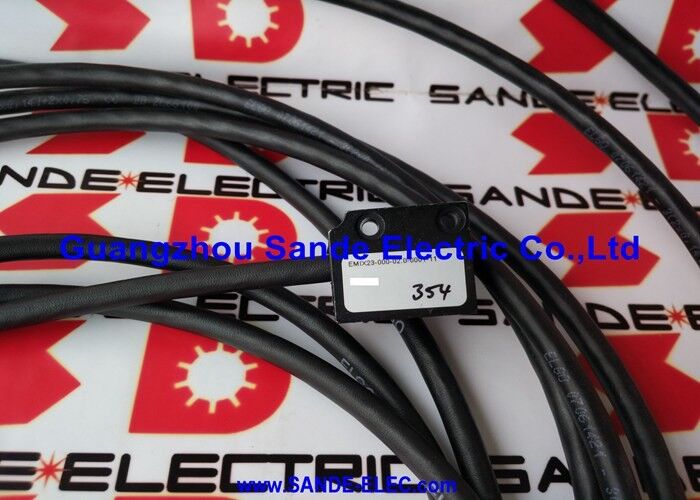
Elgo EMIX23-000-02.0-0001-11 | Magnetic Incremental Linear Encoder — 1µm Resolution, 5V TTL, 2.0m Cable, A/B/Z Quadrature Output
Overview
The Elgo EMIX23-000-02.0-0001-11 is a compact magnetic incremental linear encoder that brings 1µm resolution position measurement to applications where a glass scale would be too fragile, too bulky, or too expensive, and where a simple quadrature output at TTL logic levels is all the downstream controller needs.
Elgo's EMIX23 series integrates the sensor head and evaluation electronics in a single housing — there is no separate electronics box, no interpolation unit, and no additional amplifier required. The 2.0m pre-assembled cable exits directly from the sensor head and terminates in open wires for connection to the receiving system's digital input card.
The measuring principle is magnetic: the sensor head scans the north and south pole alternations on the Elgo MB20-20 magnetic tape (2mm pole pitch), producing a sinusoidal signal that the integrated electronics interpolate into quadrature square wave output.
At the 0.001mm resolution setting with 4-edge triggering, the 2mm pole pitch of the tape is divided electronically into 500 increments per pole pitch — a level of interpolation that delivers 1µm position granularity from a contact-free magnetic sensing mechanism with no moving parts in the sensor.
The -11 suffix in the part number specifies 5V DC supply voltage and TTL output levels.
TTL outputs (0V logic low, 5V logic high) are directly compatible with the digital input circuits of most PLCs, motion controllers, position indicators, and CNC interfaces without requiring level conversion.
The differential output pairs (A/A′, B/B′, Z/Z′) allow the signal to be connected to differential receiver inputs for the best noise immunity in installations where the cable runs through an electrically noisy environment.
The 2.0m cable length is Tosoku's standard; longer cables up to 30m are available as order variants, identified by the cable length field in the part number. For most machine installations where the sensor head is mounted on a moving carriage and the cable terminates at a nearby control cabinet, 2.0m is sufficient.
For larger machine travel ranges where the carriage-to-cabinet distance exceeds 2m, ordering the appropriate longer cable variant at specification time is the correct approach — extending the cable after the fact by splicing may degrade signal quality at the 5V TTL levels used by this variant.
Key Specifications
| Parameter |
Value |
| Resolution |
0.001mm (1µm) at 4-edge triggering |
| Supply Voltage |
5V DC |
| Output Level |
TTL differential (A/A′, B/B′, Z/Z′) |
| Signal Cable |
2.0m pre-assembled |
| Sensor-to-Tape Gap |
0.1 – 0.8mm |
| Magnetic Tape |
MB20-20 (2mm pole pitch) |
| Output Channels |
A, A′, B, B′, Z, Z′ |
| Measuring Length |
Unlimited (tape-constrained) |
| RoHS |
Yes |
| Origin |
Germany |
Magnetic Linear Encoding — Why and When
Magnetic linear encoders occupy a distinct niche in the position measurement landscape.
They are more tolerant of contamination than optical encoders (no glass scale to scratch or shatter), mechanically simpler to install (adhesive tape rather than precision ground ways), and capable of spanning long measurement distances economically.
The EMIX23 extends these advantages with full µm-range resolution that was previously only achievable with optical glass scales.
The principal application segments are precision woodworking machinery, sheet metal fabrication equipment, sawing and cutting machines, and general industrial automation where 1µm resolution is required but the environmental exposure — sawdust, metal chips, coolant, vibration — makes optical sensing impractical.
The EMIX23's magnetic immunity to non-magnetic contaminants means it continues to produce reliable position data in environments that would quickly degrade an optical scale system.
Reference Pulse and Installation Notes
The Z/Z′ differential output provides one reference pulse per pass across the tape's reference mark — this is the point the controller uses to establish an absolute reference position within the incremental measurement range.
Elgo's optional R suffix (not included in this variant's part number) enables a freely definable reference pulse position; the standard -000 version without the R option uses the tape's fixed reference mark.
Mounting the sensor head requires maintaining the 0.1 to 0.8mm gap between the sensor face and the tape surface throughout the measurement range. Elgo specifies mounting tolerances for the EMIX23 that must be observed during installation to guarantee the specified resolution.
A gap outside this range produces degraded signal amplitude or signal loss. The sensor head should be aligned parallel to the tape surface to prevent gap variation as the carriage travels.
FAQ
Q1: Can the EMIX23-000-02.0-0001-11 achieve its 1µm resolution across the full cable length of 2.0m without signal degradation?
Yes. The 5V TTL differential output is designed to maintain signal integrity across the 2.0m cable.
The differential line topology (complementary signal pairs A/A′, B/B′, Z/Z′) cancels common-mode noise induced on the cable, which is the primary source of signal degradation in encoder cables running through machine cabinets.
Ensure the receiving inputs are differential receivers (RS-422 compatible) to take full advantage of the differential topology. Connecting differential outputs to single-ended inputs is possible but sacrifices the noise rejection benefit.
Q2: What magnetic tape must be used with the EMIX23-000-02.0-0001-11?
The EMIX23 at 0.001mm (1µm) resolution requires Elgo's MB20-20 magnetic tape with EPS (single-pole magnetisation) for ≤1µm resolution.
At resolutions coarser than 1µm (e.g., 0.005mm), the standard MB20-20 tape without the EPS designation is acceptable.
The EPS tape has finer-tolerance pole boundaries that are necessary for the interpolation electronics to achieve accurate 1µm resolution.
Using standard tape with the 1µm-configured EMIX23 will produce output, but the accuracy specification cannot be guaranteed.
Q3: How is the EMIX23's reference pulse used in a practical installation?
The Z pulse fires once per pass over the tape's reference marker.
In a machine application, the controller uses the first Z pulse detected after power-up or after a defined search motion to establish the axis' absolute zero reference — after this reference pass, the controller knows its position within the machine's coordinate system and can enter closed-loop position control.
The Z pulse position is a fixed physical location on the tape, so the reference pass always establishes the same datum position each time.
If the machine's travel carries the axis through the Z marker position during normal production, the controller simply notes the Z pulse and continues — it does not affect ongoing position counting.
Q4: Is the EMIX23-000-02.0-0001-11 suitable for high-speed motion applications, and what is the maximum traverse speed?
The maximum traverse speed at 1µm resolution with 5V TTL output is determined by the maximum output frequency the electronics can generate.
At 1µm resolution, 1m/s traverse speed requires 1,000,000 count edges per second.
The EMIX23 electronics at this resolution are rated for speeds that accommodate typical industrial machine tool and automation traverse velocities — confirm against Elgo's specification sheet for the maximum specified traverse speed at the ordered resolution to verify suitability for the specific application's rapid traverse speed.
Q5: What is the recommended sensor-to-tape gap setting during installation, and how is it verified?
The target installation gap is between 0.1mm and 0.8mm, with 0.5mm as a practical midpoint that provides tolerance against mechanical variation during machine operation.
Elgo offers an optional LED distance monitoring function (suffix E in the part number) that signals when the gap is within the acceptable range during installation — this option is not included in the -02.0-0001-11 standard variant but is available in the corresponding E-suffixed part.
Without the LED monitoring option, the gap is set using feeler gauges during installation.
After installation, the quality of the A/B output signal can be observed on an oscilloscope to confirm clean square wave transitions, which serve as a practical confirmation that the gap is within the operational range.


 Your message must be between 20-3,000 characters!