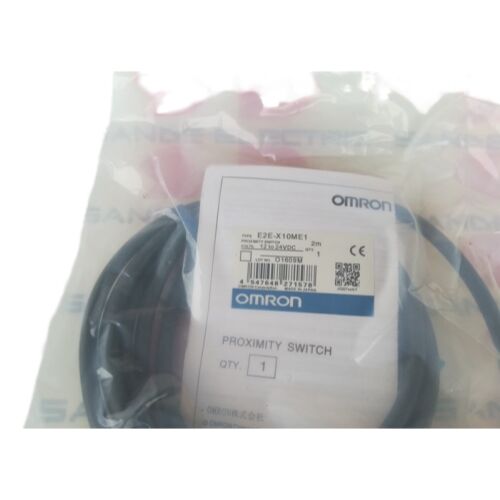
Omron E2E-X10ME1 | Inductive Proximity Sensor — M18 Unshielded, 10mm NPN NO, 12–24VDC, 200mA, 200Hz, IP67, −40°C to +85°C, 2m Oil-Resistant Cable
Overview
The Omron E2E-X10ME1 is an M18 unshielded inductive proximity sensor with 10mm sensing distance, 3-wire NPN normally open output, and a 200mA switching capacity — the highest output current in the standard E2E 3-wire range.
The ME suffix identifies Omron's extended-capability variant: where the standard E2E M18 unshielded model (E2E-X14MD1) is rated at 100mA switching capacity, the ME1 variant doubles this to 200mA, extending direct load driving capability to higher-current devices.
The operating temperature range of −40°C to +85°C is the specification that most distinguishes the E2E-X10ME1 from standard E2E variants.
Where most E2E proximity sensors are rated −25°C to +70°C, the ME1 model's extended temperature floor is suitable for outdoor installations in cold climates, unheated storage facilities, refrigeration environments, and machine tools in northern latitudes where morning startup temperatures fall well below −25°C. The +85°C upper limit accommodates installation near heat sources — casting and forging equipment, heat treatment lines, and machines with no enclosure cooling — where ambient temperatures routinely exceed 70°C.
Being unshielded, the E2E-X10ME1 extends its electromagnetic field in all directions from the sensing face, achieving the 10mm sensing distance from an M18 body that an internally shielded sensor of the same size cannot match.
This comes with the installation requirement to mount the sensor protruding from its bracket rather than flush with surrounding metal — a requirement that is straightforward to meet with standard M18 sensor mounting hardware and is consistently worth the additional mounting complexity in exchange for 10mm sensing range from the compact M18 body.
Key Specifications
| Parameter |
Value |
| Sensing Distance |
10 mm (±10%) |
| Setting Distance |
0–8 mm |
| Standard Target |
Iron 30 × 30 × 1 mm |
| Housing |
M18 × 1mm, unshielded, nickel-plated brass |
| Output |
NPN, NO, 3-wire |
| Supply Voltage |
12–24V DC |
| Operating Range |
10–40V DC |
| Switching Capacity |
0–200 mA |
| Current Consumption |
13 mA max |
| Response Frequency |
200 Hz |
| Cable |
2m oil-resistant PVC |
| IP Rating |
IP67 |
| Operating Temperature |
−40°C to +85°C |
| Standards |
EN60947-1, EN60947-5-2, CE |
200mA Switching Capacity — Direct Solenoid and Relay Driving
The 200mA switching capacity of the E2E-X10ME1 is the specification that makes it viable for direct load driving in circuits where a standard 100mA sensor would require an intermediate relay or transistor driver.
Common 24V DC industrial loads within the 200mA range include small solenoid valves (typically 50–150mA at 24V), relay coils (10–80mA), pilot lights and tower lights (20–50mA), and counter/display inputs.
With 200mA available, the sensor connects directly to the load without additional hardware, simplifying the circuit and eliminating the cost and failure point of an intermediate switching device.
The 200mA rating does not mean the sensor can drive motor loads or heavy inductive coils indefinitely. For inductive loads — solenoids and relay coils — the inrush current at switch-on is higher than the steady-state current, and the inductive kick at switch-off creates a voltage spike.
Omron's surge suppressor protection in the E2E-X10ME1 handles normal inductive switching transients, but for loads with high inductance, a flyback diode across the load is good practice to limit the turn-off spike.
−40°C to +85°C — Extended Temperature for Demanding Environments
Omron rates the E2E-X10ME1 over a 125°C span from −40°C to +85°C, which is wider than the standard E2E's 95°C span. This extended rating matters in two directions.
At the cold end, −40°C is the threshold for reliable starting of electronics in outdoor Canadian winters, Arctic industrial installations, and walk-in cold storage facilities — if a sensor is specified at −25°C and the environment drops to −35°C on a winter night, the standard sensor may fail to operate on morning startup.
At the hot end, +85°C covers the ambient conditions in close proximity to heat treatment furnaces, forge presses, casting machines, and industrial ovens where machine position sensing is needed.
For the sensing distance performance specifically, Omron specifies that temperature variation shifts the switching point by ±10% over the −25°C to +70°C range referenced at 23°C. This means at the extreme temperatures the E2E-X10ME1 operates within, the sensing distance variation is a factor in installation gap design — the 8mm setting distance (80% of nominal 10mm) provides adequate margin for the thermal variation.
FAQ
Q1: How does the E2E-X10ME1 NPN output wire to a standard PLC?
Three-wire NPN connection: brown wire to +12–24V DC supply, blue wire to supply common (0V), black output wire to PLC NPN digital input terminal.
When a ferrous target enters the 10mm sensing field, the NPN output transistor conducts — the black wire pulls the PLC input terminal toward 0V, and the PLC registers a logic 1 input (for NPN-input cards configured for sinking logic). When no target is present, the output is open — the input reads logic 0.
Q2: What is the metal-free zone requirement for the M18 unshielded E2E-X10ME1?
Omron specifies the required metal-free zone for unshielded M18 sensors in the E2E installation guide — the sensing face must protrude from the mounting bracket with no metallic material within the sensing face's lateral field projection zone.
The bracket bore should match the M18 thread, and the surrounding metal surface must be set back behind the sensor tip by at least the body diameter (18mm) on each side. Failure to maintain this zone reduces effective sensing distance as the surrounding metal absorbs the unshielded lateral field.
Q3: The operating voltage range is 10–40V, but the power supply voltage is 12–24V — what is the difference?
The power supply voltage (12–24V) is the recommended nominal operating range for stable, specified performance.
The operating voltage range (10–40V) is the absolute range over which the sensor operates without damage, covering supply rail sags (below 12V) and excursions above 24V (such as unloaded supplies or transients).
Operating above 24V or below 12V continuously is outside Omron's performance specification for switching accuracy but within the survival limit. Always design to the 12–24V nominal range for reliable, characterised performance.
Q4: Can the E2E-X10ME1 detect aluminium targets at the full 10mm range?
Aluminium has a correction factor of approximately 0.3–0.4× for M18 unshielded sensors, producing an effective sensing distance of approximately 3–4mm for a target of standard plate dimensions (30 × 30mm).
For the E2E-X10ME1 at aluminium targets, the installation gap should be within 3mm — well inside the 8mm setting distance — to ensure reliable detection. For aluminium targets, always verify the actual switching distance with the specific alloy and geometry in the installation conditions before fixing the sensor position.
Q5: The current consumption is 13mA and switching capacity is 200mA — can the supply current capacity cover both?
Yes, these are separate current values. The 13mA is the sensor's own internal current draw from the supply (always present when powered).
The 200mA is the maximum current that can flow through the output transistor when the output is active (target detected).
The supply must provide 13mA for the sensor plus up to 200mA for the load current — up to 213mA total per sensor from the 24V DC supply. In practice, most loads draw well under 200mA, and the total supply current demand is closer to 50–100mA per sensor depending on the connected load.



 Your message must be between 20-3,000 characters!