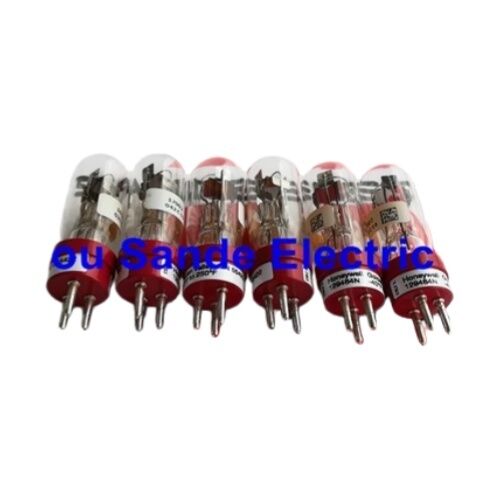
Honeywell 129464N | UV Sensing Tube — Replacement for C7035 & C7061 Flame Detectors, −40°F to +250°F
Overview
The Honeywell 129464N is the UV sensing tube used inside the C7035 MiniPeeper and C7061 UV flame detectors — the glass-envelope UV-sensitive tube that detects the ultraviolet radiation emitted by gas, oil, and other hydrocarbon flames and signals the presence or absence of flame to the connected burner control unit.
When the sensing tube in an installed C7035 or C7061 flame detector reaches end of life, the 129464N is the Honeywell-original replacement that restores the detector to its specified UV sensitivity without replacing the entire detector assembly.
The 129464N is distinguished from the related 129464M by its temperature rating: the 129464N is rated down to −40°F, extending use to outdoor installations and unheated equipment rooms in cold climates where the 129464M's 0°F lower limit would be insufficient.
Both tubes serve the same C7035 detector; the 129464N is additionally qualified for the C7061, which covers continuous-operation industrial burner applications in furnaces, dryers, and thermal processing plants.
UV flame detection is the sensing technology suited to gas and oil flames that emit UV radiation in the 185–260nm wavelength range.
The sensing tube responds to UV photons — converting their impact into an electrical signal that the detector's electronics interpret as flame presence.
Sunlight, incandescent lamps, and most artificial light sources that might cause spurious signals on visible-spectrum photocells do not emit at UV wavelengths in the critical range, making UV sensing inherently selective for combustion flames in well-designed installations.
Key Specifications
| Parameter |
Value |
| Part Number |
129464N (full: 129464N/U) |
| Compatible Detectors |
Honeywell C7035, C7061 |
| Operating Temperature |
−40°F to +250°F (−40°C to +121°C) |
| Sensing Principle |
Ultraviolet (UV) photon detection |
| Application |
Industrial and commercial burner flame supervision |
| Related Part |
129464M (0°F to +250°F, C7035 only) |
The C7035 and C7061 Platform — Where the 129464N Is Used
C7035 MiniPeeper: The C7035 is Honeywell's compact analogue UV flame sensor for intermittent-operation burner applications — gas and oil burners in commercial heating, industrial process equipment, and light industrial combustion systems that cycle on and off during normal operation.
The detector must see the burner ignite reliably at each cycle start.
The C7035 is used with Honeywell 7800-series and equivalent burner control units, providing the UV-sensing element that signals the control unit whether combustion has been established.
C7061 UV Flame Detector: The C7061 extends UV flame supervision to continuous-operation industrial burners — the large gas, oil, and dual-fuel burners in industrial furnaces, dryers, kilns, and thermal processing plant where the burner runs continuously rather than cycling.
The C7061 incorporates dynamic self-check capability, which periodically verifies the UV sensing tube is functioning correctly during normal operation — a safety requirement for continuous-operation burner applications where an undetected tube failure could allow unmonitored fuel flow.
Both detector types use the 129464N tube as the UV-sensitive element.
The tube is designed for removal and replacement without disturbing the detector's optical alignment — the replacement procedure involves opening the detector housing, removing the old tube from its socket, and inserting the 129464N in its place.
This field-replaceable design means a UV sensing tube that has reached end of life or been damaged by heat, vibration, or electrical stress does not require replacing the entire detector assembly with its mounting hardware and sight pipe.
UV Sensing Tube Service Life and Replacement Triggers
UV sensing tubes have a finite service life that Honeywell specifies in operating hours, because the UV-sensitive material within the tube (typically a gas-discharge or photocell construction) undergoes gradual degradation with cumulative UV exposure and electrical cycling.
A tube that has reached end of life may show reduced sensitivity — requiring a brighter flame to trigger the detector — before failing completely and causing nuisance shutdowns or, more critically, allowing an undetected loss of flame.
The practical indicators that a 129464N replacement is due: the burner control logs increased ignition failures or "no flame" lockouts on a burner that ignites reliably when tested independently; the UV signal meter on the detector shows a declining trend over successive maintenance checks; or the detector has accumulated the service hours specified in the C7035 or C7061 maintenance documentation.
In continuous-operation applications with the C7061's dynamic self-check active, a failing tube will be detected by the self-check mechanism and generate a service alarm before the flame supervision function is compromised.
Burner Fuel Compatibility
UV flame detection is compatible with most combustion flames — natural gas, LPG, oil, hydrogen, and other carbon-containing or hydrogen-containing fuels all emit UV radiation in the detection range.
The 129464N does not discriminate between fuel types at the photon-detection level; the compatibility of the overall burner management system for specific fuels is determined by the burner control unit and the burner design, not by the UV sensing tube itself.
FAQ
Q1: How do I know when the 129464N UV tube needs replacing?
The primary indicators are: declining UV signal strength on successive maintenance checks (using the detector's signal level indication or a UV meter), increased ignition failure rates or lockouts on a burner that was previously reliable, and accumulated operating hours reaching the replacement interval specified in the C7035 or C7061 maintenance manual.
Some industrial maintenance programs replace the UV tube on a fixed interval — typically annually for continuous-operation furnace burners — regardless of apparent condition, to prevent unplanned shutdowns.
Q2: What is the difference between the 129464N and the 129464M?
Both are UV sensing tubes for the C7035 detector. The 129464M is rated from 0°F to +250°F and is for C7035 applications only. The 129464N extends the lower temperature limit to −40°F and is additionally qualified for the C7061 flame detector.
Choose the 129464N for outdoor installations, cold-climate equipment rooms, and all C7061 applications.
Q3: Can the 129464N be used in a detector other than the C7035 and C7061?
The 129464N is specified for C7035 and C7061 detectors. Honeywell's flame detector range includes other UV detector models (C7012, C7024, C7027, C7076) that use different UV tubes — 191053, 129464M, or model-specific tubes.
Using the 129464N in a detector it was not designed for may result in incorrect socket fit, different UV sensitivity characteristics, or a mismatch with the detector's electronics. Always verify the exact detector model before ordering the replacement tube.
Q4: How is the 129464N installed in the C7035 or C7061?
With the burner system safely shut down, isolated from fuel and electrical supply, and the detector cooled to a safe handling temperature, the detector housing is opened per the C7035/C7061 service instructions.
The old tube is removed from its socket and the 129464N inserted in its place with the correct orientation as specified in the service manual.
The housing is closed, and the detector is functionally tested — verifying that the UV signal level and response time meet the detector's specified parameters — before the burner system is returned to service.
Q5: Does the 129464N work with the Honeywell 7800 series burner control systems?
The 129464N is the sensing element inside the C7035 and C7061 flame detectors, which are qualified for use with Honeywell 7800-series burner controls. The sensing tube itself does not connect to the burner control directly — it connects to the detector's electronics, which then interface with the burner control.
The 7800-series compatibility depends on the C7035 or C7061 detector model and the specific burner control unit; verify the detector-to-control compatibility from Honeywell's system selection documentation for the specific application.



 Your message must be between 20-3,000 characters!