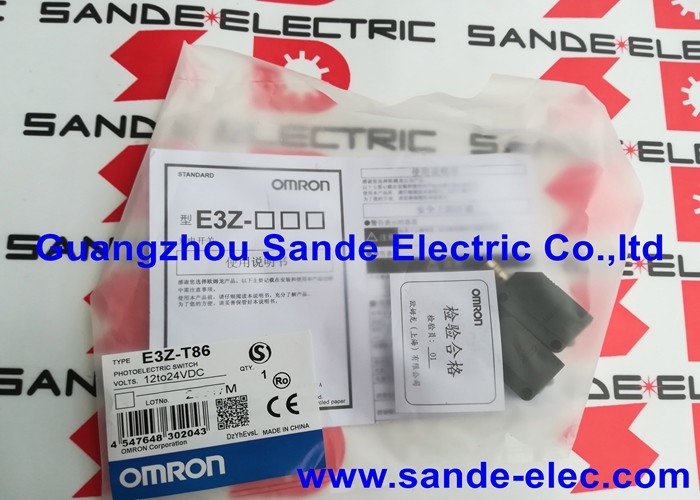
Omron E3Z-T86 | Through-Beam Photoelectric Sensor Set — 15m Sensing, Infrared 870nm, PNP Light-ON/Dark-ON, 12–24VDC, 100mA, IP67, M8 Connector, −40°C to +55°C
Overview
The Omron E3Z-T86 is a through-beam photoelectric sensor set from the E3Z compact series — emitter and receiver in matched square housings, each connecting via the M8 4-pin connector, covering a detection zone of up to 15 metres with infrared illumination at 870nm.
The E3Z series has sold more than one million units annually, a commercial volume that reflects the series' position as a standard selection across a wide range of industrial automation, packaging, material handling, and warehousing applications where miniature photoelectric sensors are specified.
The through-beam configuration places the emitter on one side of the detection zone and the receiver on the other.
The emitter continuously projects a modulated infrared beam; the receiver monitors the received signal level. When an opaque target breaks the beam path, the receiver's signal drops and the output switches.
This is the most immune photoelectric sensing method — it is unaffected by the target's surface reflectivity, colour, surface finish, or presentation angle — and it delivers the longest detection range from a given sensor size.
At 15 metres, the E3Z-T86 can span distances that most reflective sensors cannot approach.
The L suffix identifies the emitter in the E3Z-T86 pair (E3Z-T86-L), and the D suffix identifies the receiver (E3Z-T86-D). Both are sold together as the E3Z-T86 set.
The emitter contains no switching output; the receiver processes the received signal and generates the PNP output that connects to the PLC.
Key Specifications
| Parameter |
Value |
| Sensing Method |
Through-beam |
| Sensing Distance |
15 m |
| Standard Object |
Opaque, 12mm dia. min. |
| Light Source |
Infrared LED, 870 nm |
| Directional Angle |
3°–15° (emitter and receiver) |
| Output |
PNP, 100 mA max |
| Operation Mode |
Light-ON / Dark-ON selectable |
| Supply Voltage |
12–24V DC |
| Emitter Current |
15 mA max |
| Receiver Current |
20 mA max |
| Response Time |
1 ms max |
| Connection |
M8 4-pin connector |
| IP Rating |
IP67 + oil-proof |
| Operating Temperature |
−40°C to +55°C |
15-Metre Detection — Through-Beam Advantage at Range
The 15-metre sensing distance of the E3Z-T86 is the direct benefit of through-beam geometry. In diffuse sensing, the emitter and receiver are in the same housing, and the sensor relies on light reflecting from the target and returning to the receiver — the signal level falls with the fourth power of distance (inverse square law twice: once from emitter to target, once from target to receiver).
In through-beam sensing, the receiver sees the emitter directly — signal falls only with the square of distance, and the emitter's full output is directed toward the receiver without reflection losses.
This fundamental geometric advantage is why the E3Z-T86 achieves 15 metres while the E3Z diffuse-reflective variant covers 1 metre from the same housing.
For applications in large machine areas — conveyor system end-of-line detection, vehicle presence in loading bays, pallet detection in warehouse aisles, gate and access monitoring — the 15-metre through-beam capability eliminates the need for additional sensors or reflective accessories.
The 12mm minimum detectable object size specifies the smallest opaque target that reliably breaks the beam at maximum range.
Smaller objects — individual product orientation sensors, thin parts detection — require the sensor to be positioned closer to the target to ensure the small object fully interrupts the beam cross-section at the detection point.
870nm Infrared — Modulation and Immunity
The 870nm near-infrared wavelength is invisible to human eyes and is significantly attenuated by most optical bandpass filters — properties that benefit both safety (no visible beam in the work area) and performance (modulation at specific frequencies distinguishes the sensor's own beam from ambient infrared from fluorescent lighting, incandescent lamps, and sunlight).
Omron's E3Z series uses a unique algorithm for interference immunity that validates the received modulation pattern rather than only measuring signal level.
This approach rejects spurious signals from other E3Z sensors operating nearby, from high-frequency switching power supplies, and from pulsed infrared sources in the environment — a practical benefit in dense sensor installations and automated warehousing environments where multiple sensor pairs operate in close proximity.
−40°C to +55°C — Cold-Storage and Hot-Environment Capability
The extended cold temperature rating of −40°C is specific to the E3Z-T66/T86/R66/R86 connector models — Omron's E3Z documentation notes that this operating range applies to these connector variants while other E3Z models are rated to −25°C minimum.
This broader temperature range qualifies the E3Z-T86 for cold-storage warehouses, outdoor installations in cold climates, and refrigeration equipment where standard sensors cannot operate reliably through the startup sequence from deep cold temperatures.
At +55°C maximum, the E3Z-T86 covers warm industrial environments — unventilated machine enclosures, outdoor equipment in summer operation, and areas adjacent to thermal process equipment — without reaching the thermal limits that would compromise the receiver's amplifier circuitry.
FAQ
Q1: The E3Z-T86 is a set — does the emitter unit need to be connected to the PLC separately?
No. The emitter (E3Z-T86-L) requires only a power supply connection (24V DC supply to brown wire, 0V to blue wire). It generates no PLC output. The receiver (E3Z-T86-D) contains the amplifier, the output transistor, and the M8 connector with the PNP signal output (black wire). Only the receiver is connected to the PLC input.
The emitter and receiver each receive independent power supply connections — they do not chain power from one to the other. Both require the supply to be active for normal operation.
Q2: What does the Light-ON / Dark-ON selection change, and when is each appropriate?
Light-ON (LO): output activates when the beam is received (path clear). The PLC sees the output ON when nothing is blocking the beam, and OFF when a target blocks it. Dark-ON (DO): output activates when the beam is interrupted.
The PLC sees ON when a target is in the beam, and OFF when the path is clear. Use LO for standard object detection where the output should indicate target presence (output activates on detection).
Use DO for confirming that a passage is clear or for counting items passing through the beam (output activates when the beam is restored after each interruption).
Q3: The directional angle is 3°–15° — how precise must the emitter-receiver alignment be?
The directional angle defines the beam's cone of effective emission and reception. A 3°–15° range means the effective beam half-angle starts at 3° and the sensor can still detect within 15° of misalignment.
For 15m installations, a 3° misalignment at the emitter translates to approximately 785mm lateral offset at the receiver — far more than any mounting hardware can sustain accidentally.
In practice, alignment with a spirit level and initial coarse position sets both units to within 1°, which provides substantial margin.
Omron notes that the mechanical and optical axis offset in the E3Z is less than ±2.5°, simplifying alignment compared to earlier sensor designs.
Q4: Can the E3Z-T86 be used in environments with other infrared light sources such as heat lamps or infrared heaters?
The modulated infrared signal and Omron's interference immunity algorithm reject steady-state infrared sources — incandescent lamps, heat lamps, infrared heaters, and sunlight do not produce modulated signals at the sensor's operating frequency and are therefore rejected.
Pulsed infrared sources operating near the sensor's modulation frequency are the more concerning interference type. In practice, the E3Z-T86's immunity to external light in standard industrial environments is very high.
For installations near pulsed infrared dryers, curing lamps, or communication systems, verify that no interference exists during commissioning by monitoring the receiver's stability indicator.
Q5: What is the minimum object size that can be reliably detected at distances shorter than 15m?
The 12mm minimum object size specification applies at the maximum 15m range, where the beam's apparent diameter at the target location is the key factor.
At shorter distances, the beam cross-section at the target is smaller, and proportionally smaller objects can be detected reliably.
At 1m, objects of approximately 1mm diameter can interrupt the beam — relevant for applications such as thread detection, fine wire presence, or thin film edge sensing.
For each specific detection application, test the minimum reliably detectable size at the intended operating distance rather than relying on the nominal 12mm maximum-range specification.


 Your message must be between 20-3,000 characters!