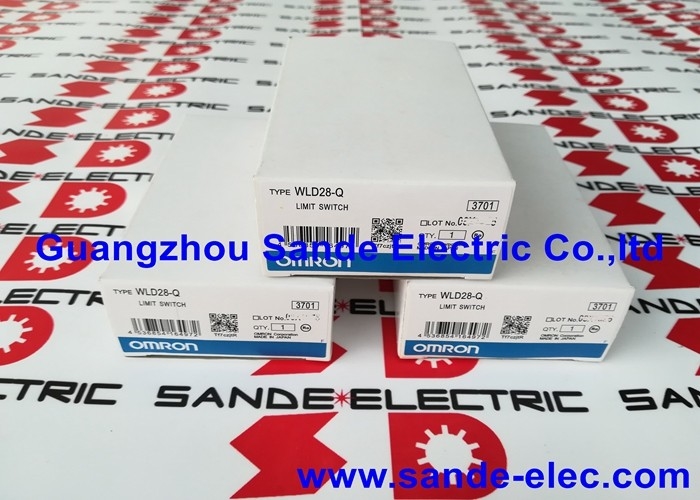
Omron WLD28-Q | General-Purpose Limit Switch — Coil Spring Actuator (6.5 dia. × 140mm), Snap Action, SPST-NO + SPST-NC, 10A/500VAC, Self-Reset, IP67
Overview
The Omron WLD28-Q is a coil spring actuator variant of the WL series general-purpose limit switch — the WL28 body fitted with a stainless steel coil spring at 6.5mm wire diameter and 140mm total length, providing an omnidirectional approach actuator that deflects under contact from any lateral direction and self-resets to the neutral position when the contact force is removed.
The snap action mechanism inside the switch body provides a clean, bounce-reduced contact transition regardless of the approach speed of the actuating element — from a slow-moving machine table to a fast-cycling conveyor pusher.
The WL series is Omron's primary line for general-purpose machine position sensing via physical contact.
Where inductive and photoelectric sensors have largely replaced limit switches in new designs for standard presence/absence detection, the WL series retains active application in contexts where physical contact is the correct detection method: flexible or soft parts detection where the switch must physically deflect with the target rather than detect metal at a gap, actuating elements where the approach direction is variable or omnidirectional, and installations where the coil spring's flexible travel enables detecting targets that would damage a rigid plunger or roller.
The coil spring actuator is the specific feature that defines this variant within the WLD28 product family.
The stainless steel coil provides corrosion resistance in coolant and oil environments, and the 140mm spring length gives a generous actuation zone — the spring deflects and actuates the internal switch over a length of travel far greater than a plunger or roller can accommodate.
This extended actuation travel is valuable for detecting passing targets where the approach is not precisely controlled, or where the machine's positioning repeatability is insufficient to guarantee reliable actuation of a short-travel plunger.
Key Specifications
| Parameter |
Value |
| Actuator |
Coil spring, SUS, 6.5mm dia. × 140mm |
| Operating Mechanism |
Snap action |
| Switching Mechanism |
Self-reset |
| Contact Form |
SPST-NO + SPST-NC |
| Contact Configuration |
2-circuit double break |
| Rated Current |
10 A (AC), 6 A (DC) |
| Rated Voltage |
500V AC max |
| Frequency |
50/60 Hz |
| IP Rating |
IP67 |
| Housing |
Die-cast aluminium |
| Mechanical Life |
15,000,000 operations |
| Electrical Life |
750,000 operations |
| Operating Force |
16.67 N |
| Standards |
EN60947-5-1, UL, CSA, CE |
Coil Spring Actuator — Omnidirectional Contact from Any Angle
The coil spring is the most versatile actuator in the WL series. Unlike the roller plunger (actuates only on vertical/axial approach) or the roller lever (actuates on a defined plane of rotation), the coil spring accepts actuation from any lateral direction — the spring bends under force from any angle and internally operates the snap action switch at a defined deflection angle regardless of which direction the force came from.
This omnidirectional characteristic eliminates the alignment requirement that makes other actuator types dependent on precise target approach geometry.
The stainless steel coil at 6.5mm wire diameter provides the material strength and corrosion resistance for industrial environments.
The 140mm overall spring length creates an actuation zone of approximately 100mm+ of usable travel — a target passing anywhere along this zone deflects the spring and actuates the switch, giving a generous detection window along the spring's length that plunger actuators cannot provide.
For applications like part ejection detection on presses, conveyor jam detection where a product can push from any direction, web or strip break detection on continuous process equipment, and presence sensing of flexible components that cannot push a rigid actuator, the coil spring's flexible, omnidirectional response is the enabling feature.
Snap Action Mechanism — Reliable Switching Independent of Approach Speed
The snap action mechanism stores energy in a spring until a defined trigger point, then releases it rapidly — transitioning the contacts at high speed regardless of how slowly or quickly the actuating force was applied.
This speed independence is critical for two practical reasons.
First, slow-moving actuating elements — a hydraulic table moving at 1mm/minute, a manual positioning fixture — apply force to the switch so slowly that a simple spring contact would traverse the switching zone gradually, producing an extended period of contact bounce or electrical arc at the contact surfaces. Snap action eliminates this by ensuring the contact travels from open to closed (or closed to open) in microseconds, independent of the actuating element's speed.
Second, snap action produces consistent contact force and contact pressure across the full range of operating speeds and temperatures.
The switching point repeatability — the mechanical hysteresis between the switch-on and switch-off positions — is tight and predictable, which is why Omron specifies the pretravel dimension (typically 1.7mm for the WLD28 roller plunger variants) with precision.
SPST-NO + SPST-NC — 2-Circuit Double Break
The contact configuration provides one normally open circuit and one normally closed circuit from a single switch body, each implemented as a double break — the contact interrupts the circuit at two points simultaneously.
Double break contacts provide twice the arc interruption distance compared to single break contacts at the same contact travel, which is why the WL series achieves the 10A/500VAC/600VAC contact rating in a compact switch body.
In machine control circuits, having both NO and NC contacts available from one switch body is the standard configuration for position interlocking: the NO contact confirms the actuated position to the PLC (closes when the spring is deflected), while the NC contact opens at the same time — providing a change-over action that can simultaneously energise one circuit and de-energise another with a single switch actuation.
FAQ
Q1: The spring is described as "self-reset" — what does this mean for operation?
Self-reset means the actuator returns to its neutral (free) position under spring force when the actuating element withdraws, and the contacts simultaneously return to their original state (NO opens, NC closes).
There is no latching or maintained action — the switch does not hold its actuated state after the actuating force is removed.
This is the standard configuration for position detection: the switch is actuated only while the target is pressing the spring, and the contact returns to its rest state as soon as the target withdraws.
Q2: What is the difference between the 2-circuit double break contact and a standard single break SPDT?
A standard SPDT (single pole double throw) switches a single common terminal between two contacts — one pole, two positions.
The WLD28-Q's 2-circuit double break contact configuration provides two separate, independent circuits: one SPST-NO (single pole single throw, normally open) circuit and one SPST-NC (single pole single throw, normally closed) circuit, each with double break action.
The two circuits switch simultaneously but are electrically isolated from each other. This allows the NO and NC circuits to switch different voltages or circuits independently, unlike an SPDT where both throws share the common terminal.
Q3: At 10A/500VAC, can the WLD28-Q switch motor circuits directly?
The 10A resistive current rating applies to non-inductive (resistive) loads at 250VAC. For motor loads, the inrush current at motor startup (typically 6× full-load current) must be within the switch's inrush rating, and the contact endurance at motor load current is lower than the rated resistive electrical life of 750,000 operations.
For small motor switching (fractional horsepower), direct switching is possible with appropriate derating.
For larger motors, an intermediate contactor protects the limit switch contacts and is standard practice.
Q4: The stainless steel spring is 140mm long — how is it secured to the switch body?
The coil spring attaches to the WLD28 body at the head section, where the spring base interfaces with the switch's actuating mechanism. The spring's deflection in any lateral direction transmits force to the internal snap action mechanism.
For installation, the switch body mounts to the machine with M4 screws through the switch housing mounting holes, with the spring oriented in the direction of expected target approach. The stainless steel construction resists the coolant, oil, and cleaning agents typical of machine tool environments.
Q5: What is the difference between general type service life and the rated electrical durability?
Mechanical life (15,000,000 operations) is the number of actuations the switch mechanism endures without load — spring deflection, snap action, and return — in standard conditions. Electrical life (750,000 operations) is the number of actuations at rated load (10A/250VAC resistive), after which contact resistance may increase beyond specification due to arc erosion at the contact surfaces.
In applications switching small PLC loads (5–20mA), the effective electrical life is far longer than the rated 750,000 operations — the contact erosion at microamp PLC input currents is negligible. For heavy load switching near rated current, the 750,000-operation electrical life is the limiting specification.


 Your message must be between 20-3,000 characters!