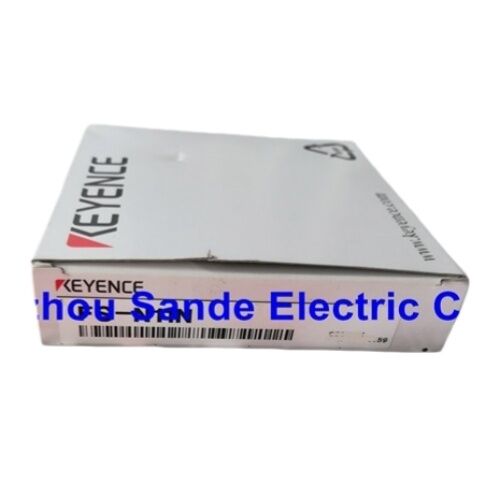
Keyence FS-N11N | Digital Fiber Optic Sensor Amplifier — NPN Output, 6 Response Modes, APC, 12–24VDC, Main Unit
Overview
The Keyence FS-N11N is the NPN output, cable-type main unit in Keyence's FS-N series of digital fiber optic sensor amplifiers. It processes light signals received through a separately mounted fiber optic sensor head, applies the FS-N series' digital signal processing to the received waveform, and outputs a discrete NPN switching signal to the machine controller.
The six selectable response time modes — from 50µs HIGH SPEED through to 16ms MEGA — let the same physical unit serve applications ranging from the fastest sorting and counting cycles to the stable, noise-filtered detection of slow-moving objects in electrically noisy environments.
The FS-N series separates the sensing head from the signal processing amplifier entirely.
The fiber optic head mounts directly at the detection point — in tight machine cavities, near hot surfaces, in high-vibration locations, or wherever a conventional photoelectric sensor body would not survive or fit.
The FS-N11N amplifier mounts away from the hostile environment in a clean, accessible DIN rail panel location.
The glass or plastic fiber optic cable connecting head to amplifier carries only light — no electrical signals travel to the detection point, which eliminates EMI pickup at the sensing location and allows use in environments where electrical sensors would produce false outputs.
The 4-element red LED light source provides broad, stable illumination across the fiber optic cable's acceptance cone, contributing to the consistent detection threshold that digital fiber amplifiers are specified for.
APC (Automatic Power Control), switchable on or off from factory-off default, maintains constant emitted light intensity regardless of temperature variation and LED aging, further stabilising the detection margin over the sensor's service life.
Key Specifications
| Parameter |
Value |
| Output Type |
NPN Open Collector |
| Supply Voltage |
12–24V DC |
| Control Output |
100mA max (standalone) / 20mA (multi) |
| Residual Voltage |
1V or less |
| Light Source |
Red, 4-element LED |
| APC |
ON/OFF switchable (factory: OFF) |
| Response Time Options |
50µs / 250µs / 500µs / 1ms / 4ms / 16ms |
| Mode Names |
HIGH SPEED / FINE / TURBO / SUPER / ULTRA / MEGA |
| Interference Prevention |
0 (HIGH SPEED) → 8 units (TURBO/SUPER/ULTRA/MEGA) |
| Unit Type |
Main Unit (expandable with FS-N expansion units) |
| Connection |
Cable type |
Six Response Modes — One Amplifier for Every Application Speed
The FS-N11N's six response time settings cover a 320:1 range from 50µs to 16ms, which is a wider span than most competing fiber amplifiers offer. Understanding what each mode provides — and what it costs — is the key to using the FS-N11N effectively.
HIGH SPEED at 50µs is the fastest mode, suited for detecting individual small parts on high-speed conveyors, counting pulses from encoders via fiber, or any application where the detection window is shorter than one millisecond.
In HIGH SPEED mode, interference prevention is disabled (0 units), which means multiple FS-N amplifiers operating in the same physical area may influence each other if their light sources overlap.
In HIGH SPEED, detection margin and noise immunity are subordinated to speed.
FINE at 250µs activates 4 interference-prevention units — a significant jump in mutual interference resistance for applications where multiple fiber sensors operate in close proximity while still requiring sub-millisecond response.
TURBO through MEGA modes progressively increase filtering and interference prevention (up to 8 units in TURBO/SUPER/ULTRA/MEGA) at the cost of response speed.
ULTRA at 4ms and MEGA at 16ms are appropriate for slow-moving targets in electrically noisy industrial environments where stable, false-output-free detection takes priority over switching speed.
When interference prevention is set to double mode, the number of manageable interference-prevention units doubles — useful in panel configurations with many FS-N amplifiers in close proximity.
Main Unit Architecture and Expansion
As a main unit, the FS-N11N is the starting point for multi-axis fiber sensor panels. Keyence FS-N expansion units connect directly to the main unit's side bus interface, sharing the main unit's power supply and communication output without requiring additional wiring for each added axis.
This daisy-chain architecture reduces panel wiring complexity in machines with five, ten, or more detection points served by fiber optic sensors.
The OLED display provides high-contrast readout of the received light intensity, the set threshold value, and the current output state — information that was previously available only from analog needle meters on older fiber amplifier generations.
During setup, the display allows one-touch calibration: the teach function samples the light level at the target position, calculates the optimal threshold, and applies it without manual adjustment.
During production, the OLED display shows the margin between the received signal and the threshold, which is the real-time indicator of how close the sensor is operating to its switching boundary — a small margin signals that the detection setup needs attention before a false output occurs.
FAQ
Q1: What fiber optic sensor heads are compatible with the FS-N11N?
The FS-N11N is compatible with Keyence's FS-series fiber optic heads across the standard diffuse, through-beam, and retro-reflective configurations.
The fiber unit connects to the amplifier's fiber input ports — one for emitter, one for receiver on through-beam setups, or a single port for diffuse types. Fiber units from the FS-V or older series may require adapter cables; confirm compatibility with Keyence for non-FS-N series fiber heads before ordering.
Q2: What does APC do, and when should it be turned on?
APC (Automatic Power Control) continuously monitors and adjusts the emitted light intensity to compensate for temperature changes and LED aging. With APC off (factory default), the emitted intensity is fixed and the detection margin may shift slightly over temperature extremes.
Turn APC on for applications in variable-temperature environments or where the sensor will operate for extended periods without recalibration, and where maintaining a consistent detection threshold over time is critical. In most standard applications, APC off with occasional recalibration is acceptable.
Q3: The maximum output current is listed as 100mA standalone and 20mA multi-connected — what does this mean?
When the FS-N11N is used alone, its NPN output can sink up to 100mA. When multiple FS-N units are connected in a series expansion chain sharing a common supply, the output current per unit is limited to 20mA to stay within the total current capacity of the shared bus.
Always verify that the connected load — PLC input card, relay coil, or indicator — draws current within the applicable limit for the installation configuration.
Q4: Can the FS-N11N operate on a 12V DC supply?
Yes. The FS-N11N accepts 12–24V DC (±10%), so a 12V supply is within spec. At 12V the NPN open collector residual voltage (1V or less) and the output current limits remain unchanged.
Confirm that the PLC input circuit is compatible with a 12V drive level if the supply is 12V — some PLC inputs require a higher ON voltage threshold that may not be reliably met at 12V.
Q5: How many FS-N expansion units can connect to a single FS-N11N main unit?
Keyence specifies the number of expansion units that can connect to a single main unit in the FS-N series system documentation. The practical limit depends on the total current draw of all connected units and the main unit's internal supply capacity.
For large fiber sensor panels, the FS-N11N main unit can support multiple expansion units per axis daisy-chain; confirm the maximum expansion count from Keyence's current FS-N series configuration guide for the specific firmware revision of the main unit.



 Your message must be between 20-3,000 characters!