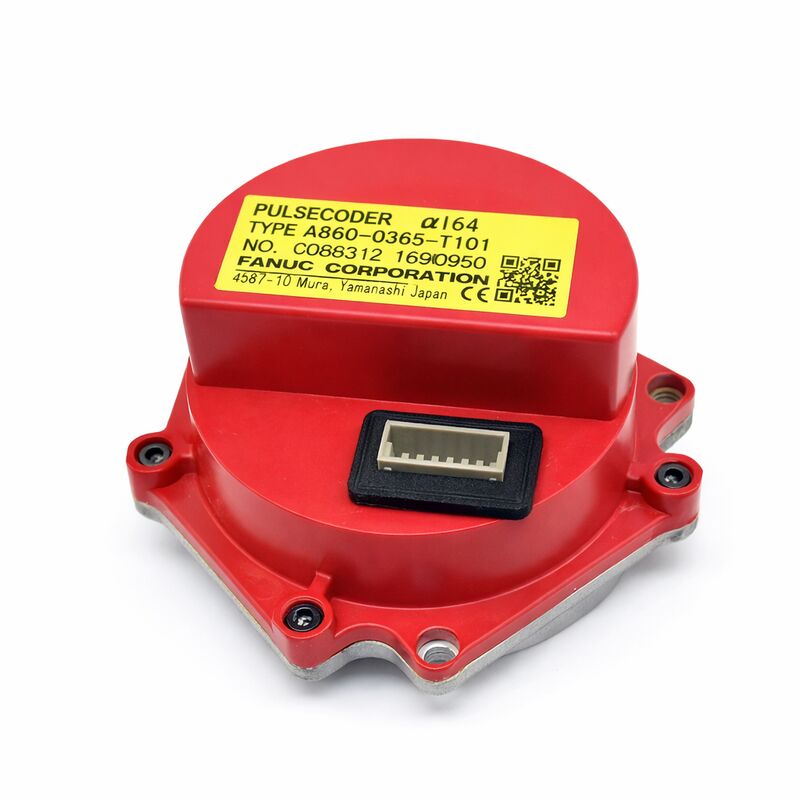
Fanuc A860-0365-T001 | Alpha αi64 Incremental Pulse Coder — 64,000P, 15-Pin D-Sub Connector, Small-Frame Alpha AC Servo Motors
Overview
The Fanuc A860-0365-T001 is the αi64 (64K ppr) incremental pulse coder for small-frame Fanuc alpha series AC servo motors, featuring a 15-pin D-Sub connector at the encoder body. It serves the same motor range as the αA64 absolute counterpart (A860-0360-T001) — the small alpha motors a1/3000, a2/2000, a2/3000, and αM2.5/3000 — but operates on fundamentally different feedback principles.
Where the absolute encoder retains position memory through machine power cycles, the incremental T001 counts pulses from an arbitrary starting position each time the machine powers up. Reference return is mandatory after every power cycle, including unplanned shutdowns.
The 15-pin D-Sub connector on the A860-0365-T001 connects to the motor's encoder cable assembly, which runs to the servo amplifier's encoder input.
The D-Sub connector type on this variant distinguishes it within the A860-0365 family from cable-integrated variants — the T001 is a connector-only encoder body, separate from the cable, allowing the cable to remain installed on the motor during encoder exchange.
For machine tool applications where the reference return sequence is a normal and accepted part of the startup procedure, the incremental αi64 delivers reliable 64K ppr feedback without the battery maintenance overhead of an absolute encoder installation.
There is no battery to monitor, no risk of absolute position data loss from a depleted cell, and no BAT alarm to respond to.
The encoder simply counts pulses from the moment the motor begins to rotate — uncomplicated, robust, and widely fitted across the alpha motor generation.
The A860-0365-T001's availability from surplus and exchange channels reflects the alpha motor population still in active service worldwide.
Small-frame alpha motors are fitted to lighter axes on machining centres, lathes, and special-purpose machines where a compact, moderate-torque servo drive is all that the application requires.
These motors remain productive long after they have aged out of Fanuc's current catalogue, and the T001 encoder is the part most commonly needed to keep them running.
Key Specifications
| Parameter |
Value |
| Encoder Model |
αi64 incremental |
| Resolution |
64,000 ppr |
| Feedback Type |
Incremental (A/B/Z quadrature) |
| Connector |
15-pin D-Sub |
| Compatible Motors |
a1/3000, a2/2000, a2/3000, aM2.5/3000 |
| Motor Series |
Alpha (pre-i generation) |
| CNC Compatibility |
15/16/18/21 (Model A) |
| Battery Required |
None (incremental type) |
| Reference Return |
Required at every power-up |
D-Sub Connector — Identification and Cable Compatibility
The 15-pin D-Sub is a widely recognised industrial connector standard — trapezoidal housing, 15 contacts in two rows, thumb-screw or wire latch retention.
On the A860-0365-T001, this connector is the mating interface between the encoder body and the motor's encoder cable.
The encoder body plugs into the cable's socket; the cable carries the A/B/Z encoder signals (differential RS-422 levels) from the encoder to the servo amplifier's encoder input card.
When sourcing a replacement T001, confirm that the motor's existing cable has the 15-pin D-Sub socket at the encoder end.
The A860-0365 family includes both T001 (D-Sub) and T101 (hardwired cable / Amphenol) variants, and these are not mechanically interchangeable at the motor end without cable modification.
Ordering the wrong connector variant results in an encoder that physically cannot connect to the installed cable — a recoverable situation if caught before the motor is reassembled, but a costly one if caught only after the machine has been de-installed.
Incremental Feedback Without Battery Dependency
The absence of battery backup is both the trade-off and the operational advantage of the αi64 T001. On the trade-off side: the machine cannot resume at its exact position after a power cycle without running a reference return.
On the advantage side: there is no battery to discharge unnoticed, no BAT alarm to respond to during production, and no risk of position data corruption from a depleted battery cell.
For machine tools that are powered down daily as part of normal operations, the reference return at startup adds 1 to 3 minutes per axis to the machine's ready time — a small overhead that most production environments accept without difficulty.
For machines that rarely power down, the operational difference between incremental and absolute feedback is even less significant in practice, because the reference return is infrequent in either case.
FAQ
Q1: What is the practical difference between the A860-0365-T001 and the A860-0360-T001 on the same motor?
Both encoders fit the same small-frame alpha motors and produce 64K ppr feedback to the same CNC generation. The T001 (A860-0360 family) is an absolute encoder — it retains position through power cycles using battery-backed multi-turn counting.
The T001 (A860-0365 family, the subject of this description) is an incremental encoder — it starts from zero at every power-up and requires reference return.
If a motor's original specification calls for an absolute encoder, fitting an incremental encoder instead changes the machine's startup behaviour: the CNC will require reference return after every power cycle.
This change must be reflected in the CNC's servo parameter for encoder type (typically parameter No. 2024 on compatible Fanuc systems) before the axis can run.
Q2: Can the A860-0365-T001 be installed on a motor that originally had a T101 variant encoder?
The T001 uses a 15-pin D-Sub connector; the T101 has a hardwired cable (or Amphenol connector depending on the specific T101 variant).
If the motor's encoder cable socket is a D-Sub female, the T001 fits directly.
If the motor's cable has a different connector (Amphenol or hardwired), the cable at the motor end must be adapted or replaced before the T001 can be fitted.
This is a cable adaptation task, not a fundamental compatibility barrier — the electrical specification of both encoder variants is identical for the same motor range.
Q3: How does the reference return cycle work with this encoder, and what does the Z-pulse do?
At power-up, the CNC drives the axis toward the hardware reference switch at a set approach speed. When the switch trips, the CNC slows the axis to a creep speed and waits for the first Z-pulse (one per motor revolution) to occur.
The Z-pulse's physical position on the disc is fixed by the encoder's internal construction, so the same Z-pulse fires at the same angular position on every revolution.
The CNC sets the axis machine position datum at this Z-pulse event and stores the relationship between the Z-pulse position and the machine zero.
This sequence repeats identically at every power-up, so the reference return always lands at the same machine position — repeatable to within one encoder count.
Q4: What should be checked when an axis with the A860-0365-T001 fails reference return reliably but shows increasing Z-pulse scatter over time?
Z-pulse scatter — where the reference return position varies by a small but observable amount each cycle — indicates that the Z-pulse is no longer firing consistently at the same shaft angle.
Causes include: a contaminated or degrading optical disc (the Z-track on the disc has accumulated particulate or has been scratched), bearing wear in the encoder (axial or radial play causes the disc to wobble, shifting the Z-pulse position slightly), or intermittent contamination on the encoder's internal photodetector.
None of these conditions are field-correctable. An encoder showing Z-pulse scatter must be replaced before the scatter grows large enough to cause reference return failures or position errors during production.
Q5: Is there a risk that fitting an incorrectly specified encoder will damage the servo amplifier?
The servo amplifier's encoder input circuit is designed for the Fanuc alpha encoder serial/quadrature signal levels. Connecting an encoder that produces signals outside these levels (e.g., a third-party encoder with incompatible output voltage levels) could damage the input circuit.
However, within the Fanuc alpha encoder family — T001, T101, V501, etc. — all variants produce compatible signal levels for the same amplifier generation.
The risk of hardware damage is primarily from voltage incompatibility (fitting an encoder with a different supply voltage or output voltage spec) rather than from choosing the wrong connector variant within the alpha family.
Always verify supply voltage compatibility (typically 5V DC for alpha encoders) when evaluating any replacement, including surplus units from unverified sources.


 Your message must be between 20-3,000 characters!