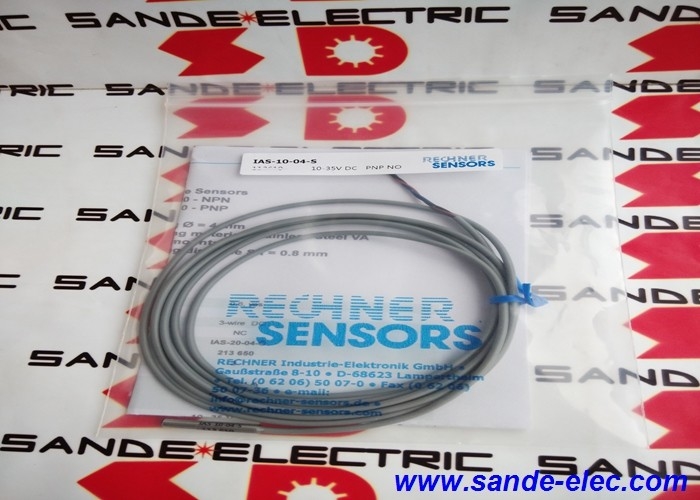
Rechner IAS-10-04-S | Inductive Proximity Switch — PNP, 0.8mm, 10–35V DC, 3-Wire, Reverse Polarity & Short-Circuit Protected, IP67
Overview
The Rechner IAS-10-04-S is a PNP 3-wire inductive proximity switch from Rechner's IAS-10 series — the PNP digital output family within Rechner's IAS range. With a 0.8mm nominal sensing distance, it operates at the short end of the inductive sensing spectrum: this is not a sensor for detecting machine guards from 10mm away, but for confirming the presence or precise position of very small components, thin metal targets, close-tolerance machined parts, or blade edges where the detection gap is intentionally narrow to achieve high position accuracy.
Rechner has been manufacturing IAS inductive sensors in Lampertheim, Germany for decades, and the IAS-10 series reflects that production history: straightforward, industrial-grade PNP sensors with the essential protections — reverse polarity, overload, and short-circuit — that prevent damage from the installation errors and transient conditions that occur in real machine environments.
The 10–35V DC supply range is the wide-voltage characteristic of Rechner's IAS-10 series, covering both 12V DC embedded supplies and the 24V DC industrial standard, as well as supplies that rise above 30V under certain load conditions.
At 0.8mm sensing range, the IAS-10-04-S is designed for applications where a larger sensing gap would introduce positional uncertainty.
The correlation between sensing distance and detection accuracy is direct: the smaller the sensing distance, the narrower the zone within which the sensor's switching point can vary due to temperature, voltage fluctuation, and target size variation.
For fine positioning feedback, the 0.8mm range's inherently tight switching zone provides the repeatability that longer-range sensors cannot match without calibration.
Key Specifications
| Parameter |
Value |
| Sensing Range |
0.8 mm |
| Output Type |
PNP, 3-wire |
| Supply Voltage |
10–35V DC |
| Output Current |
150 mA max |
| Protection |
Reverse polarity, overload, short-circuit |
| IP Rating |
IP67 |
| Operating Temperature |
−25°C to +70°C |
| Series |
IAS-10 (PNP output) |
| Manufacturer |
Rechner (Germany) |
IAS Series 10 — PNP Direct Drive for PLCs and Relays
Rechner's series classification is straightforward: the IAS-10 designation identifies a 3-wire PNP output sensor that sources current to its connected load when activated.
This means the sensor output wire provides the positive supply potential through the load to common when the target is detected — the standard PNP configuration for European-market industrial PLCs and control systems where PNP-input cards are the dominant standard.
The 3-wire PNP topology provides a clear advantage over 2-wire sensors for precision applications: with a separate power supply wire (brown), output wire (black), and common wire (blue), the output transistor operates independently of the load current.
There is no minimum load current requirement and no problematic leakage current that might falsely activate a sensitive PLC input — the output is either fully on (driving current through the load) or fully off (output transistor blocking, negligible leakage).
This clean switching behaviour is important in applications like NC-machine tool position interlocks where false trips could cause tooling damage.
The output is directly compatible with PLCs, relay coils, indicator lamps, and counter inputs that operate from the same 24V DC supply as the sensor.
With 150mA output current capacity, the IAS-10-04-S drives standard automation loads without additional amplification in the majority of applications.
0.8mm Sensing Distance — Close-Tolerance Position Verification
Eight-tenths of a millimetre is a small sensing distance that reflects a specific design requirement: the target must pass very close to the sensor face.
Applications where this arises include stamp-and-die position confirmation in punch press tooling (where the tool must enter the die to within fractions of a millimetre), thin blade or foil edge detection, needle or probe tip presence verification in medical assembly equipment, and fine-pitch ratchet or gear tooth detection in precision instruments.
The operating distance — the useful working zone within the nominal sensing distance — is typically 0 to 0.65mm for an 0.8mm-rated inductive sensor (approximately 80% of the rated Sn). Setting the actual detection gap within this operating distance, with a margin that accounts for mechanical vibration, temperature effects on both sensor and target, and target surface condition variation, is the calibration task that determines long-term detection reliability.
Non-ferrous material correction applies: aluminium, brass, copper, and stainless steel targets all produce shorter effective sensing distances than the 0.8mm iron standard.
At 0.8mm nominal distance, the already-small gap is further reduced for non-ferrous targets — for stainless steel approximately 0.56mm, for aluminium approximately 0.24mm. Confirm the actual switching distance with the specific target material before committing to the mechanical design.
IP67 — Reliable Sealing in Industrial Installations
IP67 ensures complete dust exclusion and protection against temporary submersion — the protection level appropriate for position sensors mounted inside machine working zones. The -S suffix in the IAS-10-04-S designation typically denotes a specific connection or cable type in Rechner's IAS coding system.
For the exact cable length, connector type, and body dimensions of this part number, verify from Rechner's current product documentation or the label on the sensor itself, as the -S suffix is used for various connection variants across Rechner's range.
Rechner sensors carry the standard protections: reverse polarity protection prevents damage if the supply wires are transposed at installation; overload protection prevents output transistor damage from momentarily excessive load; and short-circuit protection (electronic) prevents the sensor from being destroyed by an accidental output-to-common short during wiring.
These are not premium features on Rechner sensors — they are standard across the IAS-10 line.
FAQ
Q1: What does the -S suffix indicate in IAS-10-04-S?
In Rechner's IAS series nomenclature, the suffix codes after the core part number identify connection type, cable material, and other specific options. The -S suffix typically identifies a specific cable or connector variant — in some Rechner configurations,
S indicates a stainless steel housing option; in others, it identifies the cable length or connector type.
The definitive interpretation requires Rechner's product code decoder or the specific datasheet for IAS-10-04-S. Consult Rechner's technical documentation or the sensor's product label for the exact electrical connection format.
Q2: The IAS-10 series rating is 10–35V DC — does this mean the sensor is damaged above 35V?
Sustained supply voltages above 35V DC may damage the sensor's internal electronics. Transient voltage spikes above 35V — which occur in industrial DC supplies during load switching — are partially absorbed by the sensor's protective circuits, but sustained overvoltage is outside the rated operating range.
For supplies where voltage excursions above 35V are possible, use a transient suppressor or voltage clamp between the supply and the sensor's supply terminal.
Q3: Can IAS-10-04-S sensors be connected in series or parallel?
Rechner's IAS sensors can be connected in series (AND logic) or parallel (OR logic). In series, the total voltage drops of all sensors are added — with 10–35V supply, a maximum of 2–3 sensors can be daisy-chained before the cumulative voltage drop at the output reduces the effective voltage below the minimum threshold of the downstream load.
In parallel, the individual residual (off-state) voltages add up; connecting more than three sensors in parallel may cause the combined leakage to falsely activate sensitive loads. These limits are general guidance; verify from Rechner's IAS application notes for specific configurations.
Q4: How does the IAS-10-04-S behave when the target approaches at an angle rather than head-on?
The electromagnetic sensing field of an inductive sensor projects most strongly perpendicular to the sensing face (axial approach). Targets approaching at an angle produce a switching point that varies from the nominal sensing distance — earlier switching for approaches from certain angles and later for others, depending on the approach geometry.
For precision position sensing at 0.8mm range, the mechanical installation should constrain the target to an axial approach path.
Angled approaches introduce uncertainty into the switching position that grows in proportion to the approach angle deviation from perpendicular.
Q5: Is the IAS-10-04-S suitable for detecting zinc or nickel-plated parts?
Zinc die-cast and nickel-plated parts are electrically conductive metals that inductive sensors detect. The correction factor for zinc is close to the ferrous standard (approximately 0.8–1.0× depending on alloy), so zinc targets produce nearly the full rated 0.8mm sensing distance.
Nickel plating on a steel substrate is essentially transparent to the inductive field — the sensor detects the underlying steel. For nickel plating on a non-ferrous substrate, the effective distance depends on the substrate metal's correction factor.
For thin plating on aluminium, expect approximately 30% of the iron sensing distance — approximately 0.24mm for this sensor.


 Your message must be between 20-3,000 characters!