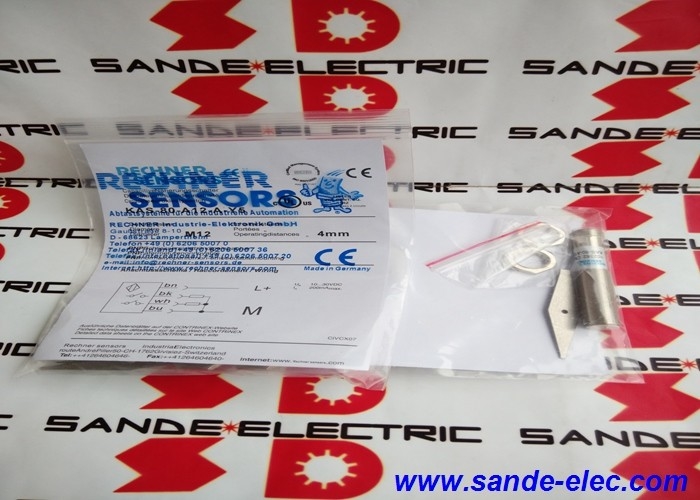
Rechner KAS-80-A12-A-Y5 | Capacitive Proximity Sensor — M12, PNP Antivalent, 6mm, Flush Mount, 10–35V DC, M12 Connector, IP67
Overview
The Rechner KAS-80-A12-A-Y5 is a flush-mountable capacitive proximity sensor from Rechner's KAS-80 series, offering 6mm sensing range from an M12 housing with the antivalent PNP output configuration — simultaneously providing both normally open and normally closed switching signals from the same sensor body.
The M12 Y5 connector designation identifies the 4-pin M12 flange connector that provides the electrical interface, housing two output wires (NO and NC), plus supply positive and common.
Capacitive sensing technology detects the presence of virtually any material — metals, plastics, glass, paper, liquids, granules, and powders — by measuring the change in the sensor's oscillating electromagnetic field capacitance when a target approaches the sensing face.
Unlike inductive sensors that respond only to conductive metals, the KAS-80-A12-A-Y5 detects non-metallic targets directly, making it appropriate for level detection in storage silos, presence confirmation of plastic components in assembly, liquid level monitoring through tank walls, and paper/label detection in packaging applications.
Rechner discontinued the KAS-80-A12-A-Y5 and replaced it with the KAS-80-A12-A-M12-PTFE/VAB-Y5-1-HP, which carries the same M12 flush, PNP antivalent, 4-pin M12 connector configuration with an updated PTFE-coated active surface for improved chemical resistance.
For retrofit installations requiring a direct replacement, the new code is the current equivalent; for maintenance stock of existing installations using the original KAS-80-A12-A-Y5, surplus units retain full functionality.
Key Specifications
| Parameter |
Value |
| Sensing Range |
6 mm (flush, ferrous standard) |
| Output |
PNP, antivalent (NO + NC) |
| Supply Voltage |
10–35V DC |
| Housing |
M12 × 1, cylindrical threaded |
| Mounting |
Flush (embeddable) |
| Electrical Connection |
M12 flange connector, 4-pin (Y5) |
| IP Rating |
IP67 |
| LED Indicator |
2-colour (green/yellow) |
| Protection |
Reverse polarity, overload, short-circuit |
| Status |
Discontinued / Replaced |
| Rechner Art. No. |
800724 |
Antivalent Output — Two Signals, One Sensor
The antivalent output configuration is one of the most useful but frequently underspecified features in capacitive sensor selection. A standard sensor provides a single output — either NO (closes when target is detected) or NC (opens when target is detected).
An antivalent sensor provides both simultaneously from a single housing: when the target is detected, the NO output activates AND the NC output deactivates at the same moment. When the target moves away, both reverse simultaneously.
This simultaneous dual-output has a specific purpose: the control system can monitor both signals and verify that they are always in opposite states.
If both outputs are simultaneously ON, or both simultaneously OFF, the sensor has failed — either the electronics are faulty or there is a short circuit on one of the output wires.
This diagnostic capability adds a layer of functional safety to the detection circuit that a single-output sensor cannot provide, without requiring any additional hardware.
In practice, antivalent outputs are specified in applications where the consequence of a missed detection or a false detection is a safety or quality concern — where the control system needs confidence that the sensor is working correctly, not just that it detected a target on the last cycle.
Injection moulding cavity checks, assembly confirmation with error-proofing requirements, and safety door interlock circuits with diagnostic monitoring are typical antivalent application contexts.
Capacitive Sensing — Detection Beyond Metals
The KAS-80-A12-A-Y5's 6mm sensing range applies to the standard calibration target (usually a ground steel plate). For non-metallic targets — which is where capacitive sensing is most commonly deployed — the effective sensing distance depends on the target material's dielectric constant.
Materials with higher dielectric constants produce stronger field perturbation and longer effective sensing distances; low-dielectric materials like dry plastics produce shorter distances.
Water (dielectric constant ~80) and aqueous solutions are among the easiest targets for capacitive sensors — level detection through tank walls is a classic capacitive application, where the sensor mounted outside a non-metallic tank detects the presence of liquid inside because the dielectric constant of water far exceeds that of the empty tank wall and air. Dry granular materials (grain, plastic pellets, powder) with moderate dielectric constants can typically be detected through thin walls of polypropylene or ABS up to a few millimetres thick. Pure oils have relatively low dielectric constants and may require the sensor to be close to the liquid surface without an intervening wall.
Flush Mount — Metal Bracket Installation
Flush mounting capability means the KAS-80-A12-A-Y5's sensing face can be installed level with the surrounding metalwork without the neighbouring metal reducing the 6mm sensing range.
The internal shielding of the sensor focuses the sensing field forward, preventing lateral field extension that would otherwise be absorbed by the metal mounting bracket. For applications where the sensor must be recessed into a tool, fixture plate, or machine surface for mechanical protection or clearance reasons, flush mounting is the enabling specification.
The M12 × 1 thread accepts standard M12 lock nuts, allowing axial position adjustment along the mounting bracket bore before locking the sensor in place.
Two lock nuts — one from each side of the mounting panel — provide the standard installation method for all cylindrical Rechner sensors.
Replacement and Successor
When the KAS-80-A12-A-Y5 reaches end of available stock and the installation requires an ongoing supply of sensors, the KAS-80-A12-A-M12-PTFE/VAB-Y5-1-HP (Rechner part 800724, now also listed as the new art. no.) is the direct replacement with an upgraded PTFE active surface coating.
PTFE provides resistance to cleaning agents, solvents, and process chemicals that the original housing material may not withstand in aggressive process environments. The electrical specifications — M12 flange connector, PNP antivalent, 4-pin, 10–35V DC — are compatible with existing wiring.
FAQ
Q1: What does the antivalent output mean for wiring the sensor to a PLC?
The 4-pin M12 connector on the KAS-80-A12-A-Y5 carries: Pin 1 = supply positive (brown), Pin 2 = NC output (white), Pin 4 = NO output (black), Pin 3 = common (blue) — confirm the exact pinout from Rechner's IAS-80 connector wiring diagram.
The PLC requires two digital input channels: one for the NO output and one for the NC output. In the control program, these two inputs should always be in opposite states; monitoring for both-high or both-low conditions provides the sensor health check that the antivalent design enables.
Q2: Can a capacitive sensor like the KAS-80-A12-A-Y5 detect through a stainless steel tank wall?
No. Stainless steel, like all metals, shields the capacitive field — the sensor detects the metal wall itself at maximum sensitivity rather than the liquid behind it.
Capacitive level sensing through walls applies only to non-metallic tank materials: polypropylene, PVC, glass, ceramic, and similar dielectrics.
For stainless steel tanks, the sensor requires a non-metallic inspection port, probe, or the sensor must be positioned at the liquid's open surface.
Q3: The sensing range is 6mm — is this adjustable?
The KAS-80 series (NORMLINE) sensors by Rechner are designed without an adjustment element on the body. The 6mm range is factory-set and not user-adjustable — this is the design philosophy of the NORMLINE product family, which prioritises simplicity and tamper-resistance.
If a shorter effective sensing range is required (to ignore a foreground layer while sensing a further target, for example), it must be achieved mechanically by repositioning the sensor further from the target, or by selecting a different Rechner KAS model that includes built-in sensitivity adjustment.
Q4: What is the switching frequency of the KAS-80-A12-A-Y5?
Rechner's KAS-80 NORMLINE series operates at 50 Hz switching frequency — appropriate for presence/absence detection at moderate speeds but not suitable for counting fast-moving individual items or detecting gear teeth at high RPM.
For applications requiring faster switching, Rechner's HighPerformance (HP) variants or their higher-frequency capacitive series would apply. The 50Hz limit is not a concern for the typical applications of capacitive sensors: level detection, slow-moving part presence confirmation, and fill-level monitoring all operate well below this frequency.
Q5: How is the KAS-80-A12-A-Y5 taught to detect a specific material at the required sensitivity?
The NORMLINE series operates without user-adjustable sensitivity — the factory setting is optimised for the standard 6mm target. For applications where the target material has a lower dielectric constant than the standard (dry plastics, wood, paper) and the effective sensing distance needs to be verified, the approach is to measure the actual switching distance with the specific target at the installation conditions.
If the actual distance is insufficient, either move the sensor closer or specify a Rechner KAS model with external sensitivity adjustment. The antivalent output's simultaneous NO/NC confirmation can be used during setup to verify reliable switching at the intended operating gap.


 Your message must be between 20-3,000 characters!